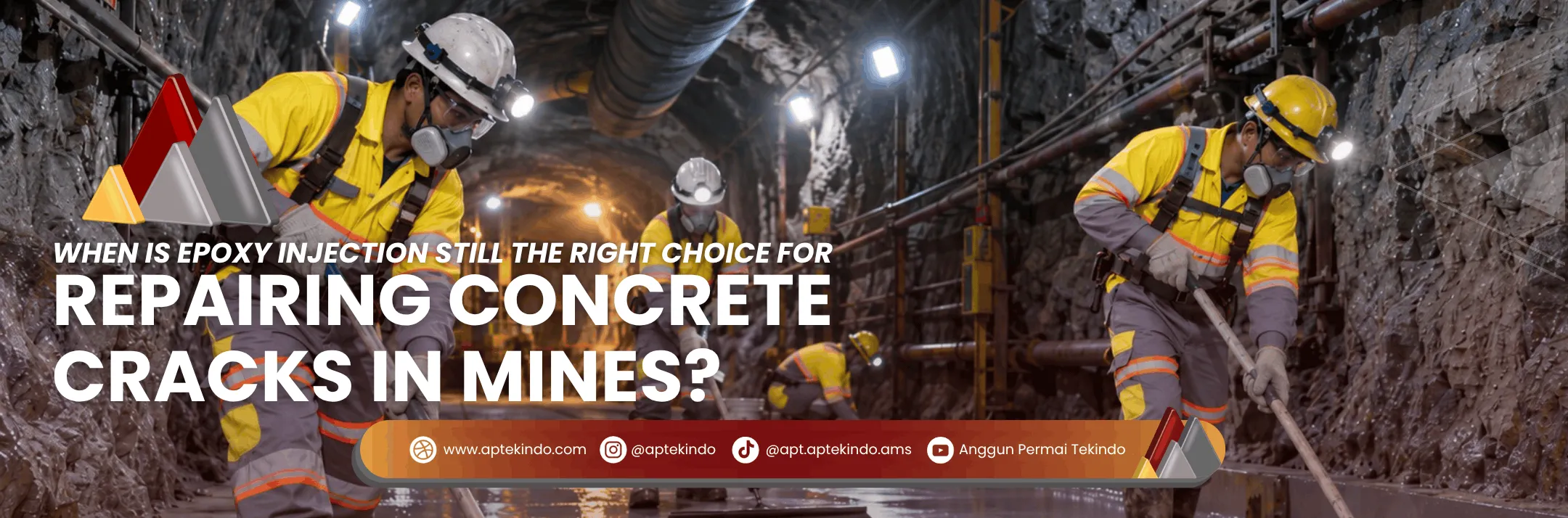
When Is Epoxy Injection Still the Right Choice for Repairing Concrete Cracks in Mines?
Epoxy injection for concrete cracks remains a sensible choice in underground mines, but only when three conditions are met: the crack is stable, the work area can be kept dry, and trained personnel and an adequate budget are available. Here is why, with test data.
Imagine the concrete lining of a mine tunnel beginning to develop fine cracks, less than a millimeter wide. Cracks like these are easy to dismiss as minor issues, but over time they can become pathways for water and aggressive substances, accelerating corrosion of the steel reinforcement inside the concrete. If left untreated, these small cracks can widen and propagate into other parts of the structure.
For decades, epoxy injection has been a standard solution for this type of problem. More recently, alternative methods using bacterial solutions have emerged and have been claimed to offer comparable effectiveness. The question is not which method is universally superior, but under what conditions epoxy injection remains a practical choice, and when other options should be considered.
How Epoxy Injection Works and What It Requires
Epoxy injection works by injecting liquid resin into concrete cracks through small drilled holes. The resin then hardens and bonds the two sides of the crack back together. The method is well established and known for providing strong adhesion and good durability in concrete repairs.
However, two conditions are often overlooked.
Condition 1: The crack must be stable (a “dormant” crack)
Epoxy injection is most suitable for dormant cracks: cracks whose width has stabilized and that are no longer actively moving. If the crack is still active and continues to widen because the structure has not fully stabilized, the hardened epoxy may crack again or fail as the crack continues to move.
Condition 2: The area must not be continuously wet
This is particularly important in mining environments: epoxy injection is generally not well suited to areas that remain continuously wet. Yet groundwater seepage is an unavoidable issue in many underground mining operations.
Test Data: Epoxy Injection vs Bacterial Crack Healing
An experiment on reinforced concrete beams intentionally cracked through flexural loading provides a concrete indication of how epoxy injection performs compared with bacterial crack-healing methods. The unrepaired beam was able to carry approximately 65 kN before the steel reinforcement began to yield. A beam repaired using epoxy injection reached a load of 69.45 kN before cracking and, after repair, was still able to carry 63.2 kN, equivalent to approximately 93% of its pre-cracking capacity (Khan et al., 2023).
That is a strong result, only slightly below one of the bacterial repair methods tested in the same study. The beams repaired using bacterial solutions retained between 84% and 97% of their pre-cracking load capacity, depending on the application method. This means that, in terms of structural load-carrying capacity alone, epoxy injection remained comparable to, and in some cases slightly better than, the newer alternative.
Table 1. Summary of the experimental program and results of beams before and after crack healing (Khan et al., 2023)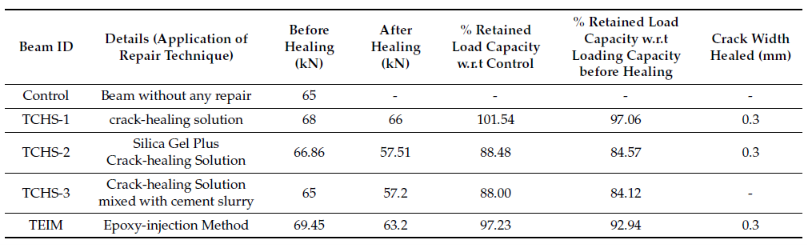
One note: these figures come from a single test on reinforced concrete beams, so they are best read as an indication of relative performance rather than a benchmark for every field condition.
Why Epoxy Injection May Be Less Suitable in Some Mining Areas
Load-carrying capacity is only one part of the story. Other considerations include:
- Skilled workers are required. Epoxy injection requires trained and experienced workers to ensure that the resin fills the entire crack rather than simply sealing the visible surface. If the application is not carried out carefully, the repair may perform far below its potential.
- Cost tends to be higher. The application cost tends to be higher than some simpler alternative methods.
- Remote locations. For mining sites far from major cities or with limited access to specialized technicians, the combination of higher skill requirements and cost can become an important consideration.
- Moisture near seepage paths. If the cracked area is close to groundwater seepage, epoxy injection may not perform as intended because continuous moisture can interfere with resin curing and bond performance.
When Does Epoxy Injection Remain the Best Choice?
Epoxy injection remains a practical option when three main conditions are met:
- The crack is stable. It is not an active crack that continues to move because the structure has not fully stabilized.
- The repair area can be kept dry during injection and curing. This could include structural areas located away from active seepage or areas equipped with effective drainage systems.
- Trained personnel and sufficient resources are available, so that the repair is properly executed from the beginning.
If one of these conditions is not met, particularly continuous moisture, it may be worth considering alternative repair methods specifically designed to perform under wet conditions. This does not mean that epoxy injection is no longer useful. Rather, its application needs to be matched to the actual site conditions instead of being applied uniformly to every damaged section of a mine structure.
Choosing the Concrete Crack Repair Method Based on Site Conditions
Selecting the right concrete crack repair method for a mining structure requires more than choosing the method that is most commonly used or historically well established. Moisture conditions, crack stability, and the availability of skilled personnel should all be considered before deciding which method is most appropriate.
This type of site-specific assessment is consistent with APTEKINDO’s approach to evaluating concrete structures in mining environments and recommending reinforcement or repair methods based on actual field conditions rather than simply following the most commonly used method elsewhere.
Found cracks in concrete structures at your mine? Discuss crack condition, moisture, and access to skilled personnel on your site with the APTEKINDO team.
Frequently Asked Questions (FAQ)
What is epoxy injection for concrete cracks?
Epoxy injection is a repair method in which liquid resin is injected into concrete cracks through small drilled holes. The resin hardens and bonds the two sides of the crack back together.
Can epoxy injection be used in wet areas or near water seepage?
It is generally not recommended. Continuous moisture can interfere with resin curing and bond performance. For wet areas, consider other methods specifically designed for wet conditions.
Which is stronger: epoxy or bacterial crack healing?
In this study’s tests on reinforced concrete beams, the epoxy-repaired beam retained about 93% of its load capacity, while beams repaired with bacterial solutions retained 84% to 97%, depending on the application method. In terms of structural strength alone, the two are competitive.
What is the difference between active and dormant cracks?
A dormant crack has a stable width and is no longer moving, which makes it suitable for epoxy injection. An active crack continues to widen because the structure has not stabilized, so injected epoxy may crack again elsewhere.
References
Khan, S. U., Ayub, T., & Khan, S. (2023). Performance of epoxy-injection and microorganism-based crack-healing techniques on cracked flexural members. Buildings, 13(11), 2697. https://doi.org/10.3390/buildings13112697
- Share