

Strip Mining: Maintaining Long-Term Mine Pillar Stability
Debris Around Mining Pillars Can Actually Prevent Further Deterioration
At many coal mining sites using the strip mining method, the sides of support pillars gradually deteriorate over time, even years after mining operations have ceased. The fragments detached from the pillar walls do not simply disappear. They fall and accumulate at the base of the pillars, forming debris piles that gradually increase in height.
These debris piles have often been regarded merely as a by-product of pillar deterioration, indicating that the pillar is gradually becoming smaller and weaker. However, the accumulated debris itself plays a role that is rarely taken into account: it can cover and support the remaining pillar surfaces, preventing further deterioration.
Conventional Models Assume That Pillars Will Continue to Deteriorate Indefinitely
Common pillar design methods for strip mining generally calculate the factor of safety based on the condition of the pillar at a particular point in time. Once the pillar is considered safe based on the design calculation, it is generally assumed to remain safe in the future. Some other approaches have attempted to incorporate the effects of weathering and stress-induced deterioration into the calculation, assuming that the deterioration rate remains constant over time.
The problem is that this constant-rate assumption leads to an unusual logical consequence: if pillar deterioration is assumed to continue indefinitely, every pillar will eventually fail, regardless of how robust its initial design may be. This conclusion clearly does not reflect actual field conditions, as many old strip mining pillars have remained stable for decades without significant problems.
Debris Piles as a Natural Protection for Mining Pillars
Pillar deterioration can eventually stop once the surrounding debris pile becomes sufficiently high. When the accumulated debris reaches the height of the pillar and forms a natural slope corresponding to its angle of repose, the pillar surfaces become covered and supported by the debris. At this point, weathering and stress can no longer directly affect the pillar surface, causing further deterioration to cease (Yu et al., 2018).
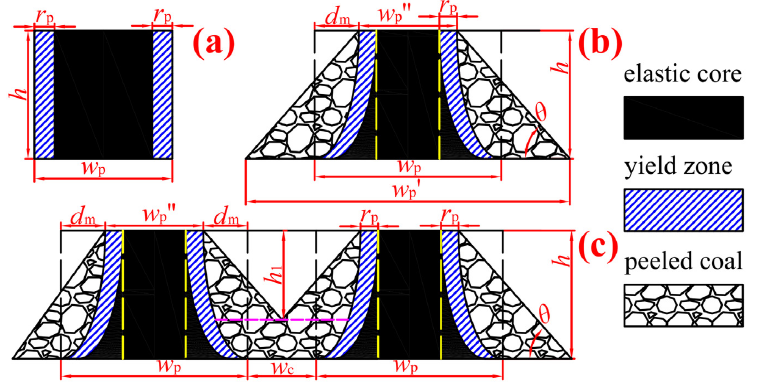
Figure 1. Intact strip pillar model and pillar deterioration models: (a) intact strip pillar; (b) “isolated” pillar deterioration model; and (c) “non-isolated” pillar deterioration model.
The extent to which a pillar deteriorates before becoming protected by the accumulated debris depends on the width of the mined area. If the mining width is sufficiently large, the debris piles developing from opposite sides of the pillar will not meet, and the pillar is considered “isolated.” If the mining width is narrower, the two debris piles will overlap more quickly, allowing the pillar to become protected sooner. Since the mining width in strip mining is typically greater than 20 meters, most pillars in this mining method are classified as isolated pillars.
This model was tested at two actual coal mines in China that used the strip mining method and were fully mined out between 1985 and 1987. After mining operations ceased, monitoring indicated that the ground surface remained relatively stable, with subsidence of only approximately 34 to 38 centimeters. No pillar failures or building damage were reported at that time. Based solely on these observations, it would be reasonable to conclude that the pillars were safe for the long term.
Read Also: Block Strip Mining: An Efficient Mining Sequence
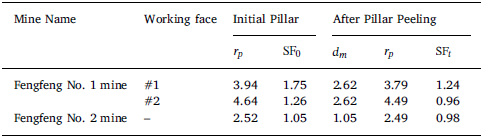
However, after the effect of pillar deterioration was incorporated into the calculations, the situation changed significantly. At one working site, the factor of safety initially calculated at 1.75 decreased to 1.24 after the deterioration process reached its limiting condition. At another working site, the factors of safety decreased from 1.26 and 1.05 to 0.96 and 0.98, respectively, indicating that the pillars had fallen below the safety threshold.
Around 2013, nearly three decades after mining operations had ended, pillar failures and subsequent ground subsidence were indeed reported at both locations, accompanied by damage to buildings above the mined areas (Yu et al., 2018).
Table 2. Pillar factors of safety before and after deterioration
Pillar Geometry Determines the Impact of Deterioration
Not all pillars are affected by deterioration to the same extent. The ratio between pillar width and height plays a significant role in determining the magnitude of the long-term impact. Slender pillars, with widths significantly smaller than their heights, can experience a substantial reduction in their factor of safety due to deterioration. In contrast, wider and shorter pillars are much less affected by the same process.
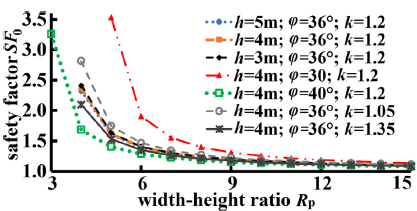
Figure 2. Relationship between the initial factor of safety SF₀ and the pillar width-to-height ratio Rₚ.
Mining depth also plays an important role in strip mining. Shallow mines tend to use smaller pillars, making them more vulnerable to deterioration than pillars in deeper mines. This means that the shallower the mining operation, the greater the safety margin that should be incorporated from the beginning, rather than relying solely on calculations based on the condition immediately after mining is completed.
Designing Pillars to Remain Stable for Decades
These findings change the way mining width and pillar design decisions should be considered in strip mining. Excessive mining width can increase coal recovery, but it can also increase the risk of wave-like ground subsidence that may damage buildings at the surface when the mining width exceeds one-third of the mining depth.
Conversely, pillars designed to be excessively slender to minimize material usage may be vulnerable to long-term strength degradation due to deterioration that was not considered during the initial design.
Calculations that account for the limiting extent of pillar deterioration and the protective effect of accumulated debris provide a much more realistic assessment than simply relying on the factor of safety calculated immediately after mining operations are completed. This is particularly important for post-mining land that may later be used for residential areas or buildings, because pillar failure does not always occur immediately. It can develop years later without clear early warning signs.
Assessing the True Service Life of a Mining Pillar
Assessing the safety of post-mining land should not stop at evaluating pillar conditions immediately after mining operations have ended. Pillar deterioration, the natural limitation created by the accumulated debris itself, as well as pillar geometry and mining depth, should be considered from the strip mining design stage to anticipate potential long-term failures well before they actually occur.
This understanding forms part of APTEKINDO’s approach to evaluating pillar stability and developing ground support solutions for post-mining areas, including consideration of potential secondary ground subsidence that may emerge years after mining operations have ceased.
References
Yu, Y., Deng, K., Luo, Y., Chen, S., & Zhuang, H. (2018). An improved method for long-term stability evaluation of strip mining and pillar design. International Journal of Rock Mechanics and Mining Sciences, 107, 25–30. https://doi.org/10.1016/j.ijrmms.2018.04.045
- Share