

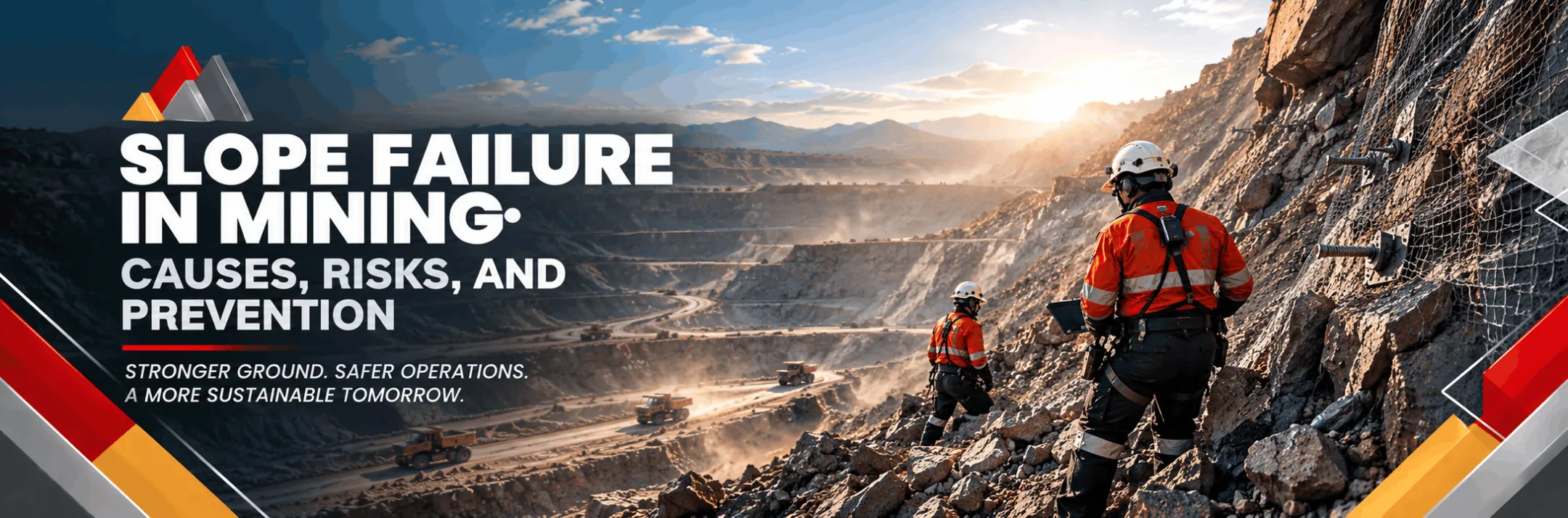
Slope Failure in Mining: Causes, Risks, and Prevention
What Is Slope Failure in Mining?
In the mining industry, slopes are an important part of mine design and operational activities, particularly in open-pit mining. Slopes are formed through excavation, which changes the geometry of the ground and rock surface. These changes can affect stress conditions and the equilibrium of surrounding soil and rock masses.
Slope failure occurs when a soil or rock mass loses stability and undergoes unwanted movement. This movement can range from rockfalls and single- or multiple-bench failures to larger-scale movements involving sections of a mine wall.
The severity and mechanism of failure depend on geological conditions, material properties, slope geometry, groundwater, and mining activities.
Slope failure is not only a geotechnical concern. It can affect worker safety, access roads, equipment, infrastructure, and the continuity of mining operations.
For this reason, slope stability management should be integrated into mining planning, execution, and ongoing monitoring.
What Causes Slope Failure?
There is no single cause of slope failure that applies to every mining site. In many cases, instability results from a combination of geological conditions, environmental changes, design factors, and operational activities.
1. Geological Conditions and Rock Structures
Rock mass characteristics have a significant influence on slope stability. Discontinuities such as joints, faults, bedding planes, and other weak surfaces can create potential pathways for rock movement.
The orientation and condition of these structures relative to the slope face can influence the failure mechanism. Understanding local geology and rock mass structure is therefore an important part of geotechnical assessment.
2. Slope Geometry and Excavation Activities
Slope height, inclination, bench configuration, and excavation sequence all influence stability.
Mining activities can change slope geometry and the surrounding stress conditions. If the design or execution does not adequately account for actual geotechnical conditions, the risk of instability may increase.
Slope geometry should therefore be established through geotechnical analysis and reviewed when site conditions change.
3. Groundwater and Surface Water
Water is an important factor in slope management. Under certain conditions, increased pore water pressure can reduce the effective stress and shear strength of soil. Surface water flow can also cause erosion that gradually deteriorates slope surfaces.
Water management measures may include surface drainage, infiltration control, dewatering, and groundwater control, depending on the technical assessment.
The requirements and effectiveness of each method depend on the site's geological, hydrological, and hydrogeological conditions.
4. Weathering and Erosion
Exposure to weather, moisture variations, and water flow can cause weathering or erosion in certain materials.
These processes may deteriorate slope surfaces, increase loose material, or contribute to localized instability.
In appropriate conditions, Erosion Control and surface protection can help manage surface deterioration. However, they do not automatically resolve instability affecting the entire slope mass.
5. Operational Activities and Additional Loading
Blasting, vibration, material placement, heavy equipment traffic, and changes in excavation activities may influence slope conditions.
Their effects depend on the initial slope condition, the distance and intensity of the activities, soil or rock characteristics, and the operational design.
Risk management should therefore consider the interaction between geotechnical design and mining activities.
What Are the Risks of Slope Failure in Mining?
Slope failure can have different consequences depending on its location, the volume of moving material, the failure mechanism, and the activities taking place in the affected area.
Potential risks include:
Worker safety: exposure to falling rocks or moving soil and rock masses.
Equipment damage: heavy machinery and facilities may be struck or buried by moving material.
Access disruption: haul roads and work routes may become blocked or damaged.
Production delays: activities in affected areas may need to stop for inspection and remediation.
Infrastructure damage: facilities and structures near the slope may be affected.
Additional costs: investigation, repair, cleanup, and stabilization works may require significant resources.
The potential impact cannot be determined from the slope's appearance alone. Risk evaluation should consider the likelihood of failure, its consequences, and the exposure of people and assets.
How Can Slope Failure Be Prevented or Controlled?
No single method can guarantee that slope failure will never occur. However, risks can be managed through a combination of appropriate design, operational controls, monitoring, and technical interventions.
1. Geotechnical Investigation and Assessment
The first step is to understand the ground conditions through investigations appropriate to the complexity of the project.
Relevant data may include material properties, geological structures, groundwater conditions, slope geometry, and mining activities.
This information supports stability analysis, identification of potential failure mechanisms, and the selection of suitable control measures.
2. Slope Design and Ground Control
Slope design should account for geotechnical conditions, mining methods, bench geometry, and the potential consequences of failure.
Ground control management also involves operating procedures, inspections, risk communication, and defined actions when actual conditions differ from design assumptions.
3. Drainage and Groundwater Control
Water management can be an important part of slope stability control.
Depending on site requirements, measures may include surface drainage, runoff management, dewatering, or groundwater control systems.
The selected approach should be based on an understanding of the water sources and their influence on the potential instability mechanism.
4. Slope Protection and Slope Stabilization
When technical intervention is required, several methods may be considered depending on actual site conditions.
Soil Nailing: can reinforce soil masses where ground conditions and design requirements are suitable.
Shotcrete: can provide surface protection or form part of an engineered support system.
Mesh: can help retain surface material or form part of a reinforcement system.
Rock Bolts and Anchors: can reinforce rock masses or selected slope systems.
Erosion Control: helps manage surface erosion.
Drainage: helps control surface water or groundwater as required.
These methods are not automatically interchangeable. Selection should be based on the failure mechanism, ground conditions, and geotechnical design.
5. Monitoring and Regular Inspections
Monitoring helps evaluate how slope conditions change over time.
Depending on project requirements, methods may include visual inspections, surveying, displacement monitoring instruments, or other monitoring technologies.
Indicators such as new cracks, changes in slope geometry, rockfalls, changes in water seepage, or measurable movement should be addressed through established reporting and assessment procedures.
Monitoring does not replace design or risk controls. It forms part of a broader system for detecting changes and supporting informed decisions.
The Relationship Between Slope Failure, Soil Nailing, and Slope Protection
Understanding the causes of slope failure helps determine whether a site requires surface protection, reinforcement, water management, or a combination of approaches.
For example, if surface erosion is the primary issue, Erosion Control and drainage may form important parts of the solution. However, if an assessment identifies the potential for movement of the soil mass, these measures alone may be insufficient, and a suitable Slope Stabilization system may need to be evaluated.
Soil Nailing may be an option where site conditions and design requirements are suitable. Meanwhile, Shotcrete and mesh can serve as components of a facing system or surface material retention system.
The need for each component must be established through engineering design rather than assumed to apply to every slope.
A systematic solution-selection process can follow this sequence:
Investigate → Assess → Design → Implement → Monitor → Review
This approach connects geotechnical understanding with field execution and performance evaluation.
The Role of a Specialist Mining Services Company
Technical slope-related works may require an integrated combination of materials, equipment, skilled personnel, safety procedures, and quality control.
A specialist mining services company may support specific parts of the work, such as Slope Protection, Soil Nailing, Shotcrete, Grouting & Injection, Ground Stabilization, or water control, depending on its service capabilities and the project's scope.
However, technical methods and design decisions should remain grounded in site investigation, geotechnical assessment, and applicable project requirements.
For APTEKINDO, this topic also creates a relevant connection between educational content about slope stability and more specialized discussions of Soil Nailing and Slope Protection.
Conclusion
Slope failure in mining can be influenced by geological conditions, slope geometry, groundwater, erosion, and operational activities. Because the causes vary between sites, the same method cannot be applied universally.
Geotechnical assessment, appropriate design, ground control, drainage, monitoring, and technical methods such as Soil Nailing, Shotcrete, and Erosion Control can form part of a comprehensive risk management strategy.
The objective is to understand the instability mechanism, select appropriate control measures, and continuously evaluate slope performance.
References
WorkSafe Western Australia. Geotechnical Considerations in Open Pit Mines: Guideline.
Read the guidelineWorkSafe Western Australia. Ground Control for Western Australian Mining Operations: Code of Practice.
Read the code of practiceWorkSafe Western Australia. Ground Control Management in Western Australian Mining Operations: Guideline.
Read the guidelineFederal Highway Administration (FHWA). Geotechnical Engineering Circular No. 7 – Soil Nail Walls.
Access FHWA resources
- Share