

Shotcrete vs. Rock Bolting: Understanding Their Roles in Underground Ground Support
1. Introduction
Underground mining involves excavating rock masses that may contain fractures, joints, faults, and other geological discontinuities. Once excavation takes place, the natural balance of the surrounding rock can change, potentially increasing the risk of rockfalls, ground deformation, and instability.
To manage these risks, mining operations use ground support systems designed to maintain excavation stability and protect workers and equipment. Two commonly applied methods are shotcrete and rock bolting.
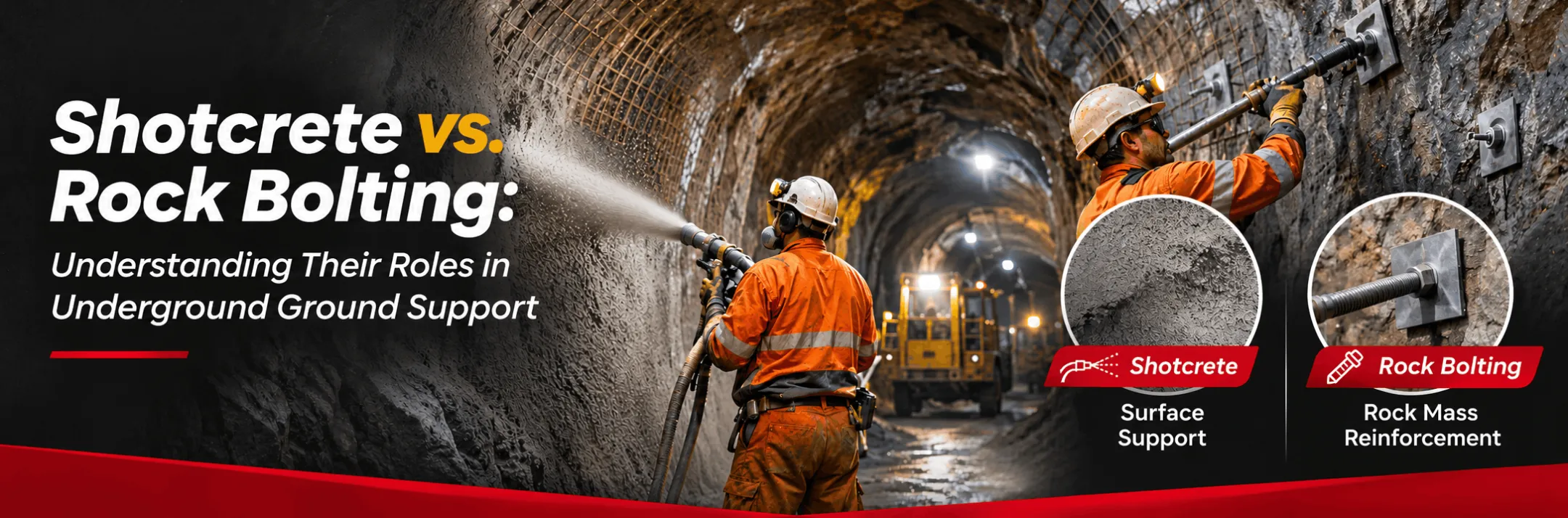
Although both contribute to underground ground support, they perform different functions. Shotcrete provides surface support by covering exposed rock, while rock bolts reinforce the rock mass by anchoring potentially unstable sections. Understanding their individual roles is essential when selecting an appropriate support strategy.
2. Understanding Shotcrete in Underground Mining
Shotcrete is a concrete mixture consisting primarily of cement, aggregates, and water, applied pneumatically at high velocity onto a prepared surface. It can be installed using either the wet-mix or dry-mix process.
In underground mining, shotcrete is commonly applied to tunnel walls, roofs, and other exposed rock surfaces to provide surface support and help control loose or fractured rock.
Its main functions include:
Surface containment: Helps hold fractured rock fragments in place and reduces the potential for small pieces of rock to fall from exposed surfaces.
Crack and discontinuity coverage: Covers exposed joints and fractures, helping maintain the integrity of the excavation surface.
Load distribution: Transfers loads across the supported surface, particularly when reinforced with fibres or used together with mesh and other support elements.
Surface protection: Helps protect exposed rock from weathering and deterioration associated with water exposure.
Shotcrete can be applied as plain or fibre-reinforced material. Fibre-reinforced shotcrete contains steel or synthetic fibres that can improve toughness and post-cracking performance, depending on the material design and application requirements.
The performance of shotcrete depends on several factors, including its early strength development, bond strength, thickness, toughness, and application quality. These properties should be evaluated against the requirements of the mine's ground control plan.
3. Understanding Rock Bolting in Underground Mining
Rock bolting is a ground reinforcement technique that involves installing steel bolts into drilled holes in the surrounding rock mass. The bolts are designed to improve rock mass stability by connecting fractured sections, reinforcing potentially unstable blocks, or anchoring them to more competent rock.
Depending on the ground conditions and design requirements, rock bolts may use mechanical anchors, cement grout, or resin-based anchoring systems.
Their main functions include:
Rock mass reinforcement: Helps bind fractured or discontinuous rock sections together.
Block stabilization: Restrains potentially unstable rock blocks from moving or separating.
Load transfer: Transfers forces between weaker rock zones and more competent surrounding rock.
Deformation control: Helps limit movement within the reinforced rock mass, depending on the bolt type, installation, and ground conditions.
Common rock reinforcement options include fully grouted rebar bolts, resin-anchored bolts, friction stabilizers, and cable bolts. Each type has different installation requirements and performance characteristics.
The selection of rock bolts depends on factors such as rock quality, fracture patterns, stress conditions, excavation geometry, and the expected loading environment. Correct installation and quality control are also essential to ensure that the reinforcement performs as intended.
4. Key Differences Between Shotcrete and Rock Bolting
Shotcrete and rock bolting are often discussed together because they contribute to the same ground support system. However, their mechanisms and primary functions are different.
| Aspect | Shotcrete | Rock Bolting |
|---|---|---|
| Primary function | Surface support | Rock mass reinforcement |
| Application | Sprayed onto exposed rock surfaces | Installed into drilled holes in the rock |
| Main purpose | Contains loose and fractured surface material | Reinforces and anchors potentially unstable rock |
| Support mechanism | Provides a protective and load-resisting surface layer | Transfers loads within the rock mass |
| Typical application | Tunnel walls, roofs, and exposed excavation surfaces | Roofs, walls, and fractured rock zones |
| Common variations | Plain and fibre-reinforced shotcrete | Mechanical, resin-anchored, and fully grouted bolts |
In practical terms, shotcrete works primarily at the excavation boundary, while rock bolts reinforce the rock mass behind that boundary.
This distinction is important because neither method automatically replaces the other. The appropriate combination depends on the geological conditions and the required ground support performance.
5. How Shotcrete and Rock Bolting Work Together
In many underground mining applications, shotcrete and rock bolting are used as complementary components of an integrated ground support system.
Rock bolts reinforce the surrounding rock mass by anchoring or connecting fractured sections. Shotcrete then provides surface containment, helping prevent smaller rock fragments from loosening or falling between reinforcement points.
For example, in a fractured underground development heading, rock bolts may be installed to reinforce the roof and walls. Shotcrete can subsequently be applied to cover the exposed surfaces and provide additional containment.
Depending on the ground conditions and support design, wire mesh, fibre-reinforced shotcrete, straps, or cable bolts may also be incorporated.
This combination can be particularly important in weak, highly fractured, or high-stress ground conditions, where a single support component may not provide all the functions required. Research on underground mine support systems emphasizes the importance of integrating reinforcement and surface support components to maintain overall stability.
6. Factors in Selecting Ground Support Methods
Choosing between shotcrete, rock bolting, or a combination of both requires an assessment of site-specific conditions. Important considerations include:
1. Rock Mass Conditions
Rock strength, geological discontinuities, fracture distribution, and rock mass classification influence the type and level of support required.
2. Ground Stress and Deformation
Deep underground excavations may experience high in-situ stresses and mining-induced deformation. Support systems must be selected according to the expected loading and ground behaviour.
3. Groundwater Conditions
Water infiltration can affect rock mass stability and the performance of certain support materials. Appropriate drainage, water control, and material selection should therefore be considered.
4. Excavation Geometry and Operational Requirements
Tunnel dimensions, excavation methods, production cycles, and equipment access can influence installation sequences and support selection.
5. Installation Quality and Material Performance
The effectiveness of shotcrete and rock bolts depends on proper material specifications, competent installation, and quality control. Shotcrete thickness, adhesion, and strength development, as well as bolt installation and anchorage performance, should be verified against the applicable design requirements.
7. The Importance of Integrated Ground Support
Effective underground ground support is rarely determined by one method alone. Different geological conditions create different support requirements, making an integrated approach important for managing ground instability.
Shotcrete and rock bolting address different aspects of rock mass behaviour. Rock bolts reinforce the surrounding rock, while shotcrete provides surface containment and additional support at the excavation boundary.
When designed and installed appropriately, these methods can work together with other support elements, such as wire mesh, cable bolts, and straps, to create a more comprehensive ground support system.
The design must nevertheless be based on proper geotechnical assessment, site-specific ground conditions, and the mine's ground control requirements. No single support method should be applied universally without considering the characteristics of the excavation.
8. Conclusion
Shotcrete and rock bolting play distinct but complementary roles in underground mining. Shotcrete provides surface support by containing loose and fractured rock, while rock bolts reinforce the rock mass by anchoring and connecting potentially unstable sections.
Understanding these differences helps mining operations select appropriate ground support strategies based on geological conditions, excavation requirements, and operational risks.
By combining suitable support methods and maintaining proper installation quality, underground mining operations can improve excavation stability and support safer working conditions.
References
1. National Institute for Occupational Safety and Health (NIOSH). (2015). Shotcrete Design and Installation Compliance Testing: Early Strength, Load Capacity, Toughness, Adhesion Strength, and Applied Quality. DHHS (NIOSH) Publication No. 2015-107. Read publication.
2. National Institute for Occupational Safety and Health (NIOSH). NIOSH Mining Program Evidence Package for 2008–2018, section: Shotcrete Support Systems for Deep Metal Mines. Read report.
3. Ontario Ministry of Labour, Immigration, Training and Skills Development. Ground Control in Underground Mines. Read guidance.
4. NSW Department of Primary Industries. (2003). Management of Rockfall Risks in Underground Metalliferous Mines. Read guidance.
5. Thompson, A. G., Villaescusa, E., & Windsor, C. R. (n.d.). Mining and Ground Support, Rock Tech Centre. Read technical paper.
6. Ground Support Guidelines for Squeezing Ground Conditions. (2023). Journal of the Southern African Institute of Mining and Metallurgy. Read article.
- Share