

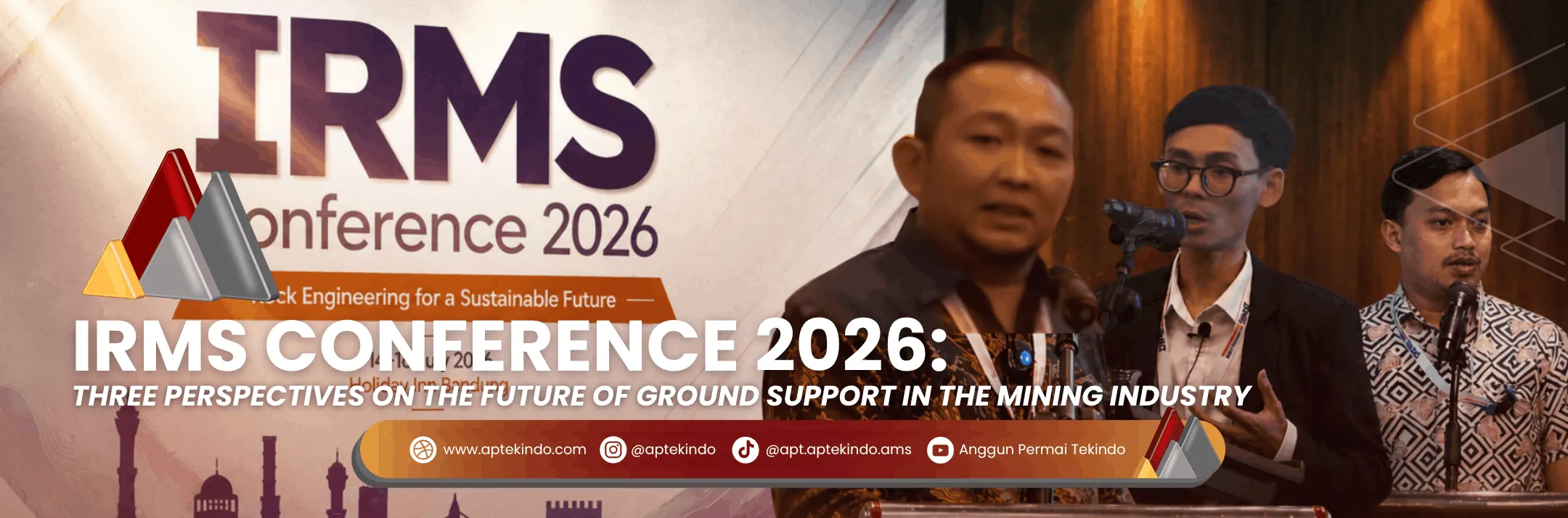
IRMS Conference 2026: Three Perspectives on the Future of Ground Support in the Mining Industry
Every mining operation faces unique geotechnical challenges. At one site, the primary concern may be the risk of rockfall on open slopes. At another, groundwater inflow becomes the critical factor determining the success of underground excavation. As mining activities extend to greater depths, the demand for ground support systems capable of adapting to changing rock mass conditions continues to increase.
These challenges became the focus of discussions at IRMS Conference 2026 (Indonesia Rock Mechanics Society), the annual forum that brings together engineers, academics, consultants, and mining professionals to exchange knowledge on the practical application of rock mechanics in real-world projects. At this year's conference, APTEKINDO participated by presenting three technical papers delivered by Cyrillus Arthur Saputra (Chief Engineer), Hazmi Andreanur (Sr. Engineer), and Okky Chandra Perdana (Operational Director), covering the implementation of ground support systems, the evaluation of pre-grouting effectiveness, and the evolution of cementitious technologies based on project experience in Indonesia.
Understanding Rock Mass Conditions Before Installing Ground Support
Cyrillus Arthur Saputra's presentation demonstrated that ground support decisions should be established through comprehensive field investigations and engineering verification before any support system is installed (Saputra, 2026).
One of the featured case studies involved the construction of a 2,000 kJ rockfall barrier extending approximately 350 meters, making it the longest installation of its kind in Indonesia (Saputra, 2026).
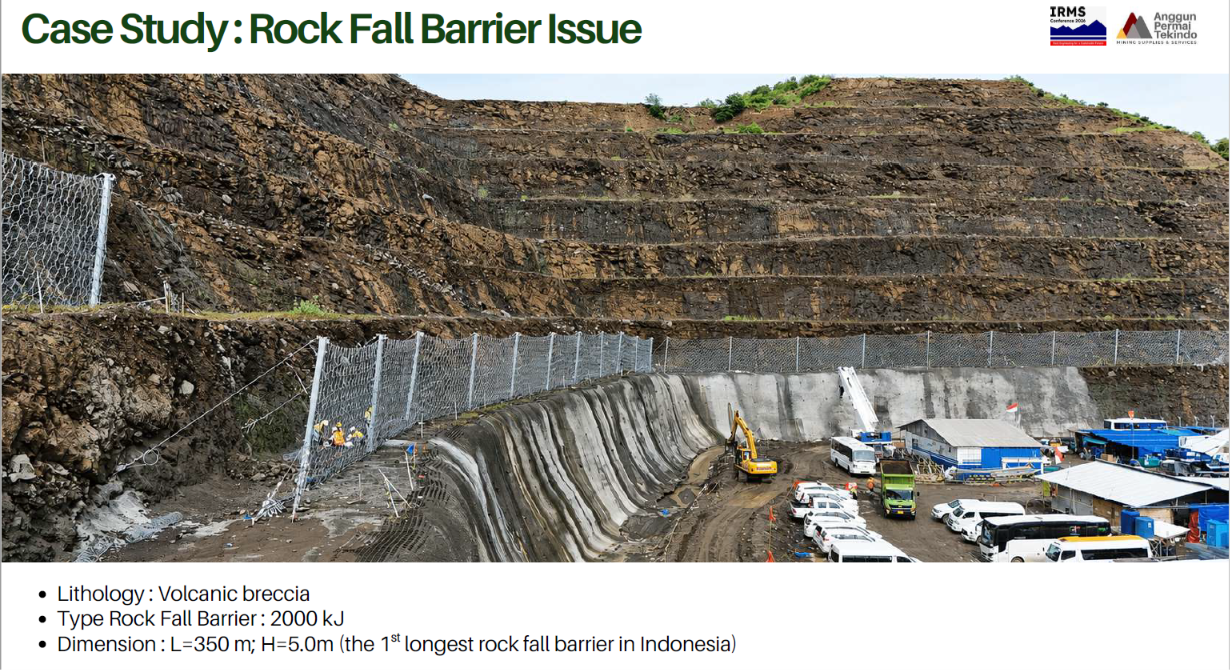

The barrier capacity was determined through slope geometry evaluation, lithological characterization, rockfall trajectory simulations using RocFall2, and anchor verification through destructive pull-out testing. The pull-out test produced an ultimate bond stress of 945 kPa within volcanic breccia, which served as one of the key design parameters (Saputra, 2026).
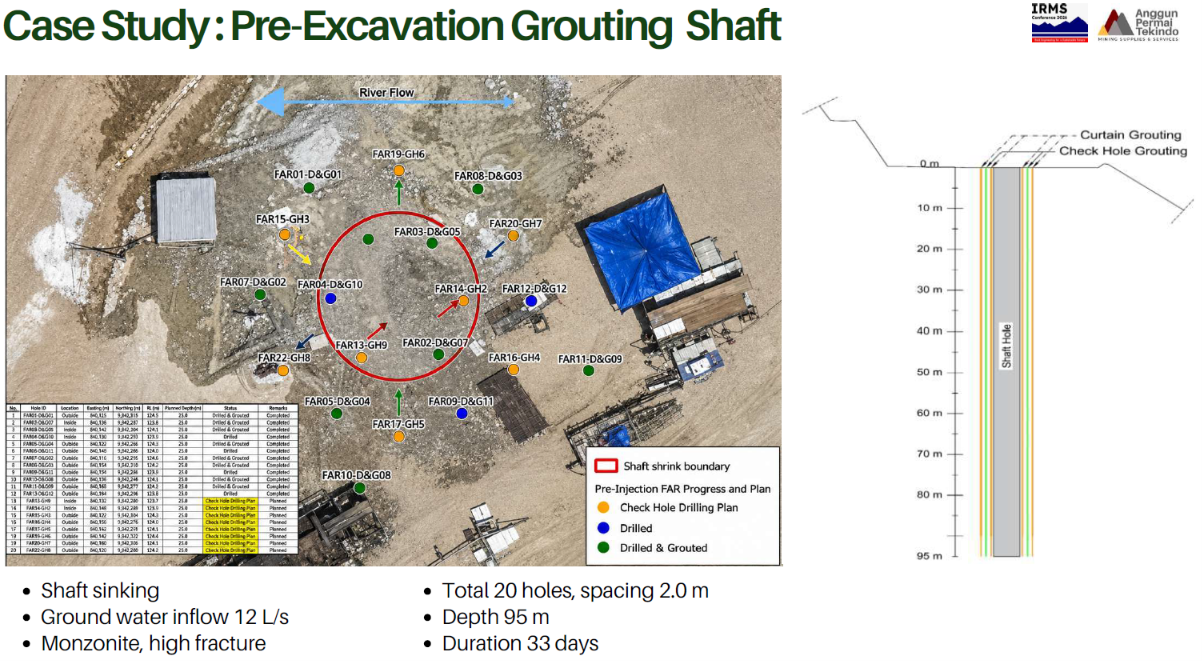
Arthur also presented a pre-excavation grouting program conducted during the construction of a vertical shaft. The program utilized 20 grout holes, each reaching a depth of 95 meters, with a total injection volume of 24,091 kg of microfine cement to reduce groundwater inflow prior to excavation (Saputra, 2026).

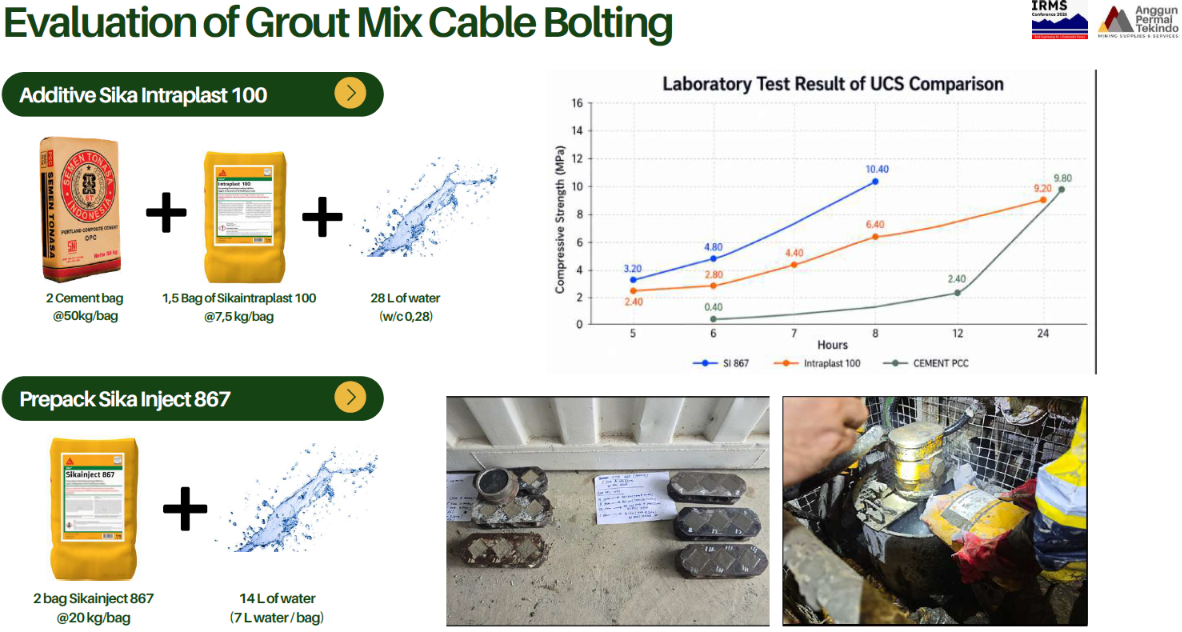
Another case study evaluated a cable bolt system using grout enhanced with chemical additives. Testing showed that the system achieved a proof load of 5.69 tons within six hours, exceeding the target proof load of 5 tons required for early-age readiness (Saputra, 2026).
Curing time is often regarded as a fixed component of the underground development cycle. However, these testing results demonstrate that curing duration can still be optimized, provided that every modification is supported by rigorous engineering verification.

Lugeon Values Determine the Next Engineering Decision
Vertical shaft construction frequently encounters significant groundwater inflow. Under such conditions, the effectiveness of a pre-grouting program should not be judged by the amount of cement injected but rather by the reduction in rock mass permeability achieved after treatment.
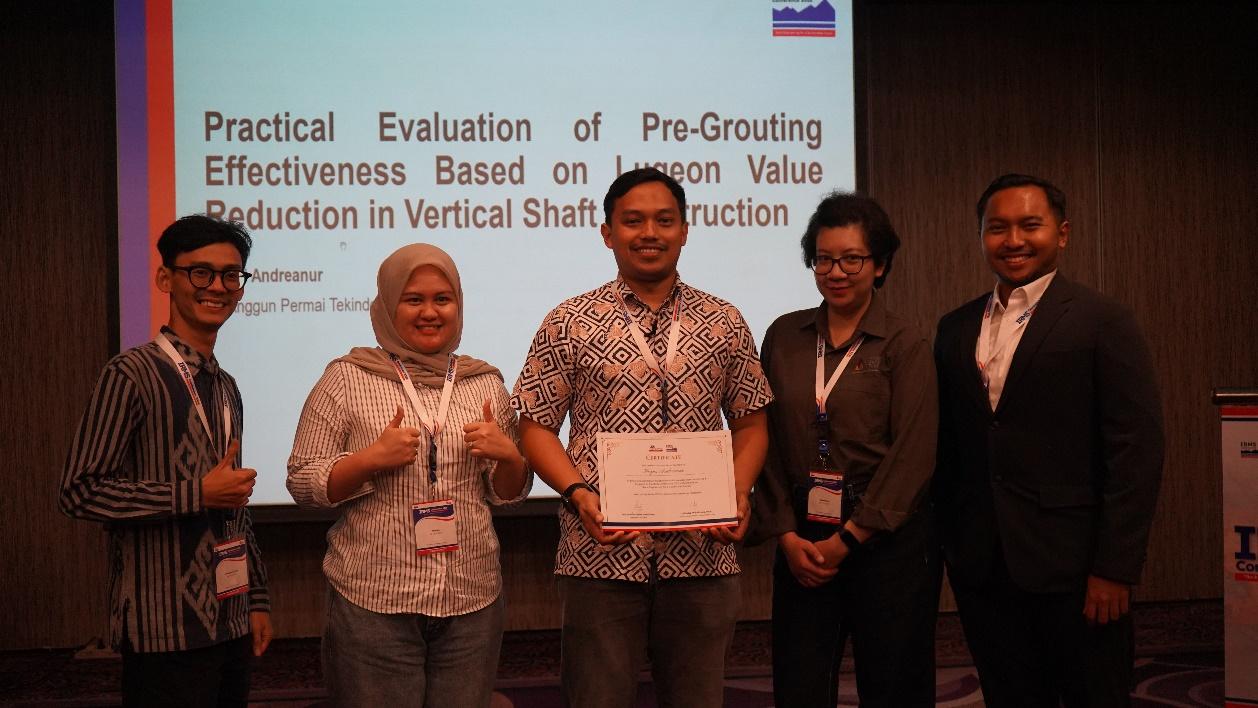
Hazmi Andreanur presented a case study from an underground mining project in Sulawesi located near the Palu-Koro Fault Zone. The grouting program employed microfine cement, selected for its ability to penetrate fine rock fractures under relatively high groundwater flow conditions (Andreanur et al., 2026).
The effectiveness of the treatment was evaluated using the Lugeon Test. Before grouting, the average permeability was measured at 6.83 Lugeon (Lu). Following completion of the injection program, repeat testing indicated that the value had decreased to 1.64 Lu, representing a reduction of 5.19 Lu (Andreanur et al., 2026).
This significant reduction confirmed that groundwater flow paths within the rock mass had been successfully minimized, allowing the excavation area to satisfy the engineering acceptance criteria before construction progressed.
Cementitious Technologies Continue to Evolve with Mining Challenges
A broader strategic perspective was presented by Okky Chandra Perdana, Operational Director of APTEKINDO, who discussed how cementitious technologies continue to evolve alongside the increasing complexity of modern mining operations (Perdana, 2026).
According to Perdana (2026), many underground mines now operate at depths exceeding 1,000 meters, where higher rock stresses, increased deformation, and elevated rockfall risks require more advanced support systems. These conditions have accelerated the transition from conventional support methods toward cement-based materials that can be engineered to meet specific field requirements.
This evolution has been driven largely by the application of concrete admixtures, enabling the properties of cementitious materials to be tailored for different construction needs. Accelerators are used to increase early strength development, retarders control setting time, while plasticizers and superplasticizers improve workability without increasing the water-to-cement ratio (Perdana, 2026).
In underground mining, cementitious technologies are widely applied to stabilize excavations and control rock mass deformation. In surface mining, similar materials are used for slope stabilization and rockfall protection systems (Perdana, 2026).
Perdana also highlighted several emerging technologies that are expected to shape the future of mining ground support, including Fiber-Reinforced Shotcrete, Robotic Shotcrete, Smart Concrete Sensors, and Self-Healing Concrete. These innovations aim to improve structural ductility, application consistency, real-time performance monitoring, and the long-term durability of ground support systems (Perdana 2026).
What Connects These Three Perspectives?
Although the three presentations addressed different engineering challenges, they shared a common philosophy. Pull-out testing, Lugeon testing, material characterization, and the selection of appropriate admixtures all serve the same purpose: reducing engineering uncertainty before construction begins (Saputra, 2026; Andreanur et al., 2026; Perdana, 2026).

The experience presented during IRMS 2026 clearly demonstrated that advances in geotechnical technology cannot be separated from rigorous field verification. New technologies only create value when supported by reliable testing, while testing itself becomes meaningful only when translated into sound engineering decisions based on the actual characteristics of the rock mass.
This philosophy also forms the foundation of APTEKINDO's approach in supporting geotechnical works across Indonesia's mining industry, from grouting programs and ground support systems to the development of advanced cementitious solutions tailored to diverse site conditions.
References
Andreanur, H., Faiz, Z.A., Afrizal, A., Ardhan, L.F., Hadimar, N.Y., Kumalasari, I.R., Saputra, C.A., & Wibisono, D. (2026). Practical Evaluation of Pre-Grouting Effectiveness in Vertical Shaft Excavation: A Case Study from an Underground Mining Project in Indonesia. APTEKINDO Technical Paper.
Perdana, O.C. (2026). The Evolution and Strategic Role of Cementitious Technologies in Modern Mining. APTEKINDO Technical Paper.
Saputra, C.A. (2026). Workshop IRMS 2026: Artificial Ground Support on Slope, Underground Works, Batching Plant Operation, Geosynthetic Solutions, Geotechnical Solutions, Additional Expertise (Mining and Civil Works Infrastructure), Structural Repair and Strengthening, Waterproofing, and Polyurea. APTEKINDO Technical Paper.
- Share