

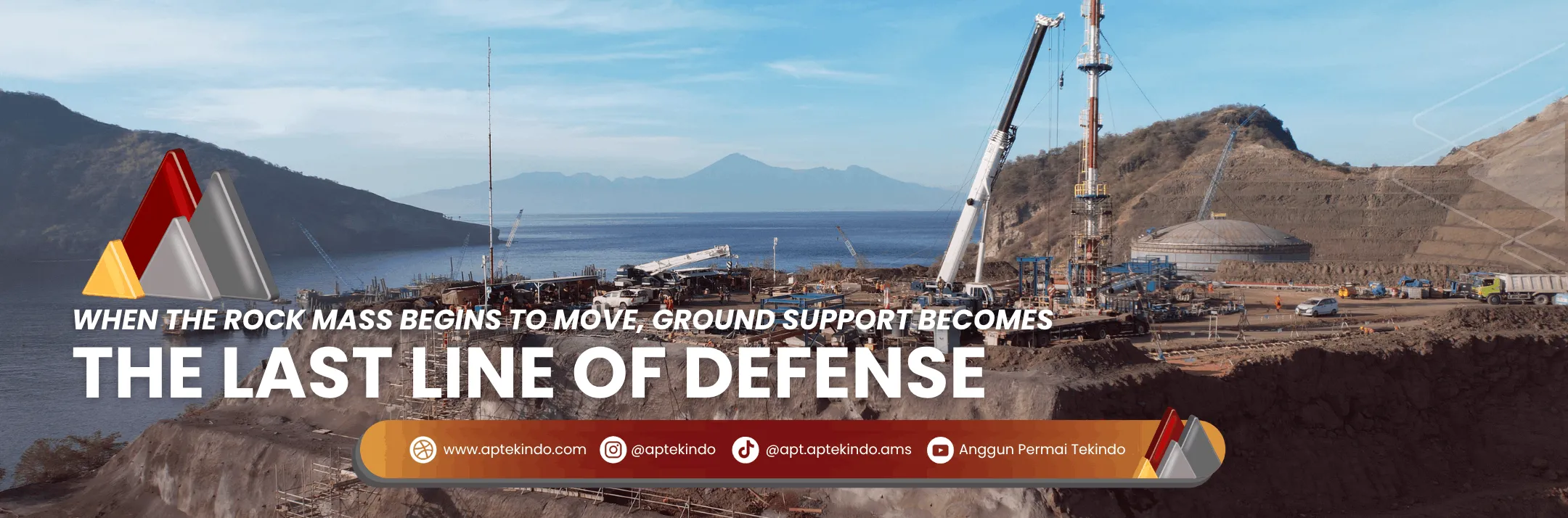
When the Rock Mass Begins to Move, Ground Support Becomes the Last Line of Defense
No engineer wants to discover cracks along the walls of an underground excavation during a routine inspection. Not because every crack inevitably leads to collapse, but because its appearance often signals that the equilibrium of the rock mass has begun to change. In many cases, excavation failure does not occur suddenly. It starts with stress redistribution caused by excavation, followed by the propagation of natural discontinuities and gradually increasing deformation before any visible signs appear on the surface.
This perspective distinguishes modern ground control practices from conventional approaches. The focus is no longer limited to reinforcing rock after signs of instability emerge, but rather to understanding how the rock mass will respond from the moment an excavation is created. Ghasemi et al. (2025) explain that changes in stress distribution are among the primary factors governing the stability of underground mine excavations. Consequently, ground support systems should be designed based on the behavior of the rock mass rather than solely on the compressive strength of intact rock obtained from laboratory testing.
Excavation Stability Is Never Determined by a Single Factor
In practice, two underground excavations with similar dimensions do not necessarily require the same ground support system. The differences often lie in rock mass quality, the orientation of geological discontinuities, groundwater conditions, and stress changes that develop throughout the mining process. For this reason, engineers cannot rely on a single parameter when designing ground support.
This understanding is consistent with the findings of Ghasemi et al. (2025), who explain that excavation stability results from the interaction of multiple geological and geomechanical factors. As mining operations extend to greater depths, the influence of in-situ stress on rock mass behavior becomes increasingly significant. This explains why modern underground mining relies more heavily on geotechnical modeling and continuous field evaluation than solely on experience gained from previous projects.

For engineers, these findings have clear implications. Decisions regarding ground support should not begin with selecting the type of rock bolt or determining the thickness of shotcrete. The first question that must be answered is how the rock mass is expected to behave throughout the service life of the underground excavation. The answer to this question forms the basis for selecting the most appropriate support system.
Ground Support Functions as an Integrated System
A common misconception is that successful ground support depends primarily on using the strongest available reinforcement material. In reality, the effectiveness of a support system depends far more on how each component works together as an integrated whole.
For example, rock bolts reinforce the rock mass by binding individual rock blocks together, allowing them to behave as a more stable and unified structure. Wire mesh helps retain smaller rock fragments, while shotcrete protects excavation surfaces from material detachment caused by discontinuities and weathering processes. When additional support capacity is required, cable bolts can be installed to anchor into deeper, more competent rock layers. According to Li et al. (2024), combining multiple support systems provides superior performance compared with relying on a single reinforcement method because each component contributes a complementary mechanical function.
This systems-based approach explains why ground support design can never be universally standardized. A support system that performs well at one site may not deliver the same results elsewhere because rock mass characteristics, excavation geometry, and mining conditions vary from one project to another.
Monitoring Determines Whether Ground Support Continues to Perform as Designed
Ground support work does not end once shotcrete has been sprayed or rock bolts have been installed. Once an excavation becomes operational, engineers must verify that the support system continues to perform according to the original design assumptions. The rock mass continues to evolve due to stress redistribution, blasting activities, and mining advancement. Without continuous monitoring, a support system that was initially adequate may gradually lose its effectiveness over time.
For this reason, modern ground control increasingly relies on continuous field monitoring. Ghasemi et al. (2025) explain that geotechnical instrumentation—including extensometers, microseismic monitoring, LiDAR, and remote sensing technologies—enables engineers to detect rock mass deformation much earlier than visual inspections alone. These data allow engineers to determine whether observed deformation remains within design limits or whether corrective action is required.
This evolution demonstrates that ground support has progressed from a passive reinforcement system into an adaptive engineering system. Field data are no longer collected merely for documentation purposes; instead, they serve as the basis for continuously updating geotechnical evaluations throughout the life of the mine. This approach enables engineering decisions to be made based on actual site conditions rather than relying solely on assumptions established during the initial design phase.
Advances in technology have also created opportunities to incorporate artificial intelligence (AI) into deformation analysis, enabling engineers to identify complex deformation patterns that are difficult to recognize manually. According to Ghasemi et al. (2025), integrating monitoring data with predictive models will become one of the major directions for future ground control systems in underground mining. Although these technologies are still evolving, they clearly demonstrate that the quality of engineering decisions will increasingly depend on the ability to interpret and utilize data, not solely on field experience.
Ground Support Is a Fundamental Component of Mine Safety
Mine safety does not depend on a single reinforcement material or one specific support method. It depends on how the entire support system is designed according to the characteristics of the rock mass and continuously evaluated throughout mining operations. Ground support becomes truly effective when geotechnical investigations, engineering analysis, support system design, and ongoing monitoring function as an integrated process.
The same principle applies across many other areas of geotechnical engineering. Roshan et al. (2022) explain that the success of reinforcement methods—whether applied to soil or rock—depends on selecting solutions that match actual field conditions and address the specific failure mechanisms involved. In other words, no single reinforcement technique can be universally applied to every project without considering the local geological and geotechnical characteristics.
This philosophy also underpins the geotechnical services provided by APTEKINDO. Every technical recommendation is developed based on comprehensive site investigations, engineering analysis, and risk evaluation, ensuring that the selected ground support system is tailored to the specific needs of each project. Through this approach, ground support is no longer viewed merely as a reinforcement activity but as an essential strategy for protecting workers, maintaining operational continuity, and supporting the long-term productivity of mining operations.
References
Ghasemi, E., et al. (2025). Ground Control Systems for Deep Underground Mining: Advancing Safety and Sustainability.
Li, X., et al. (2024). Recent Advances in Shotcrete Technology for Underground Ground Support.
Roshan, M. J., et al. (2022). Improved Methods to Prevent Railway Embankment Failure and Subgrade Degradation: A Review. Transportation Geotechnics, 37, 100834.
- Share