



Block Strip Mining: An Efficient Mining Sequence
No mining area remains unchanged throughout the life of a surface mine. As mineral reserves are progressively extracted, the mining face advances, haul roads become longer, waste disposal areas are relocated, and heavy equipment is reassigned to different working areas. Although these changes occur gradually, they influence nearly every activity within the pit.
For this reason, mining is carried out in sequential stages rather than all at once. Each mining block is developed according to a planned sequence, allowing overburden removal, coal exposure, and equipment relocation to proceed in a coordinated manner.
Hartman (1987), Hustrulid and Kuchta (2006), and Darling (2011) describe mining sequence planning as a fundamental component of surface mine design because it determines how the pit develops throughout the mine's operational life.
Block Strip Mining applies this principle by dividing the mining area into multiple working blocks. Each block has clearly defined boundaries, making pit development easier to control from one production period to the next. The mining sequence can therefore be planned according to the specific conditions of each block rather than treating the mine as a single large excavation.
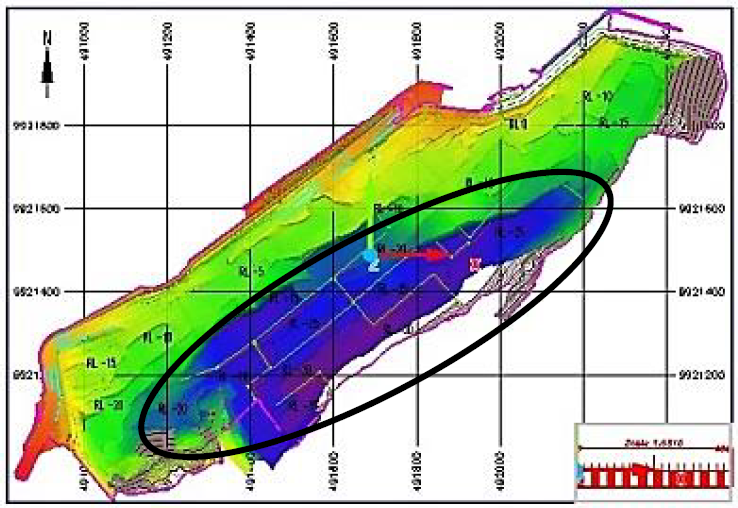
Parhusip et al. (2021) implemented this approach after evaluating the previously used mining system. The mining area was divided into nine production blocks, designated BA through BI. This subdivision simplified the preparation of mining sequences while providing clear operational boundaries for each production period.
Before developing the mining sequence, the pit design was established using an overall slope angle of 41°, a single-bench slope angle of 60°, a bench height of 10 m, and a bench width of 10 m. These design parameters were subsequently modeled in Minescape 5.7 to generate the final pit geometry and establish the mining sequence for each production block (Parhusip et al., 2021).
From Pit Design to Monthly Production Targets
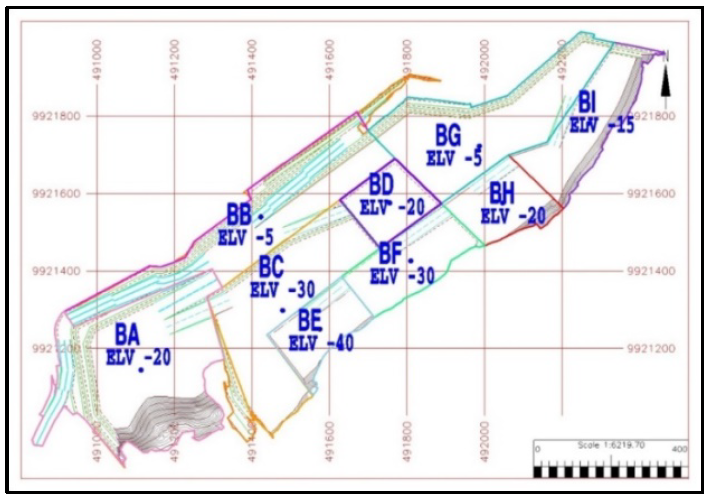
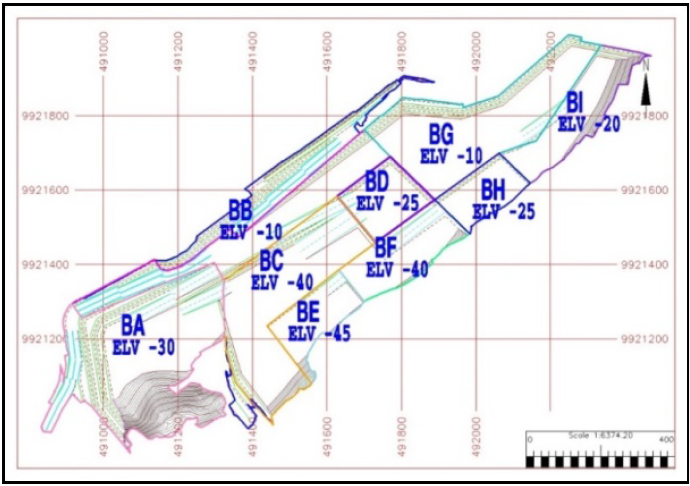
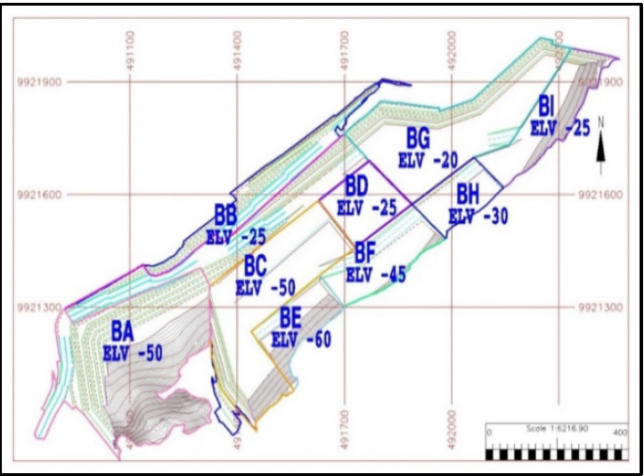
The division into nine mining blocks served as the starting point for preparing monthly mining plans. While the boundaries of each block remained unchanged, the mining elevations were progressively lowered to meet production targets for April, May, and June. This approach eliminated the need to redesign the pit each month, as only the mining elevations changed while the block boundaries continued to serve as the primary planning framework.
Changes in mining elevation directly affected the volume of material scheduled for extraction. In the April mine plan, approximately 498 thousand tonnes of coal were targeted, accompanied by about 3.58 million BCM of overburden and a stripping ratio of 7.2. During May, the planned coal reserve decreased to approximately 460 thousand tonnes with 3.56 million BCM of overburden. By June, coal production increased slightly to around 481 thousand tonnes, while overburden volume declined to 3.42 million BCM. The stripping ratio also varied according to the geological characteristics of the blocks mined during each production period.
These variations demonstrate that each mining block possesses distinct characteristics. Some blocks require relatively limited overburden removal, whereas others exhibit significantly higher stripping ratios. Such information forms the basis for production scheduling because the amount of waste material removed is not always proportional to the amount of coal recovered during a given period.
The monthly production plans were then used to allocate mining equipment across individual blocks. The number of excavators, haul trucks, and work sequences was adjusted according to the material volume scheduled for removal during each month. Consequently, the pit design became more than a conceptual engineering drawing; it evolved into the operational foundation for daily production planning.
Aligning Equipment Requirements with the Mining Plan
Mine planning does not end after estimating overburden volumes and coal reserves. These production estimates become the basis for determining the number and capacity of equipment required in each mining block. As material volumes increase, greater loading and hauling capacities are needed to ensure production targets remain achievable.
Parhusip et al. (2021) determined equipment requirements based on the material volume planned for each production period. The objective was to ensure that equipment productivity remained balanced with the monthly overburden and coal production targets established during mine planning. This stage effectively links engineering design with field implementation by allocating equipment resources according to the workload of each mining block.
Simulation results indicated that overburden removal would be performed using Komatsu PC2000 and Komatsu PC1250 excavators combined with HD785 and HD465 dump trucks.
This equipment combination was selected based on individual machine productivity and the haul distance to the designated waste disposal area. In the June production plan, the overburden haul distance reached approximately 2.62 km, requiring careful fleet sizing to minimize excavator waiting time while maintaining efficient haul truck cycle times.
The study also employed the Match Factor (MF) as an indicator of balance between loading and hauling equipment. An MF value of 1 indicates that excavator and truck capacities are well balanced, minimizing equipment idle time. Achieving this balance is essential because simply increasing the number of haul trucks does not necessarily improve production, whereas an insufficient truck fleet can leave excavators waiting for available hauling units.
The equipment calculations demonstrate that changes in mine design inevitably affect operational requirements. As overburden volumes increase or haul distances change, the number of equipment units and their deployment patterns must be adjusted to maintain productivity close to planned production targets.
This relationship illustrates that mine planning extends beyond pit geometry and reserve estimation; it also ensures that every stage of mining can be executed with adequate equipment capacity (Parhusip et al., 2021).
Every mining operation begins with careful planning. Dividing the mining area into blocks, establishing mining sequences, and determining equipment requirements provide the foundation for achieving production targets in a systematic and measurable manner. The study by Parhusip et al. (2021) demonstrates that the Block Strip Mining approach helps organize mining stages more effectively while improving operational control throughout each production period.
For APTEKINDO, understanding mining sequences is the foundation for designing geotechnical solutions that are tailored to each project's requirements. Through its ground support, grouting, and soil improvement services, APTEKINDO supports the mining industry with solutions that are adapted to site conditions and each stage of the mining operation. Learn more about APTEKINDO's services by visiting the APTEKINDO website at aptekindo.com
References
Darling, P. (Ed.). (2011). SME Mining Engineering Handbook (3rd ed.). Society for Mining, Metallurgy, and Exploration.
Hartman, H. L. (1987). Introductory Mining Engineering. John Wiley & Sons.
Hustrulid, W., & Kuchta, M. (2006). Open Pit Mine Planning and Design (2nd ed.). Taylor & Francis.
Parhusip, R., et al. (2021). Simulation of Technical Mine Design and Mining Scheduling Using the Block Strip Mining Method.
- Share