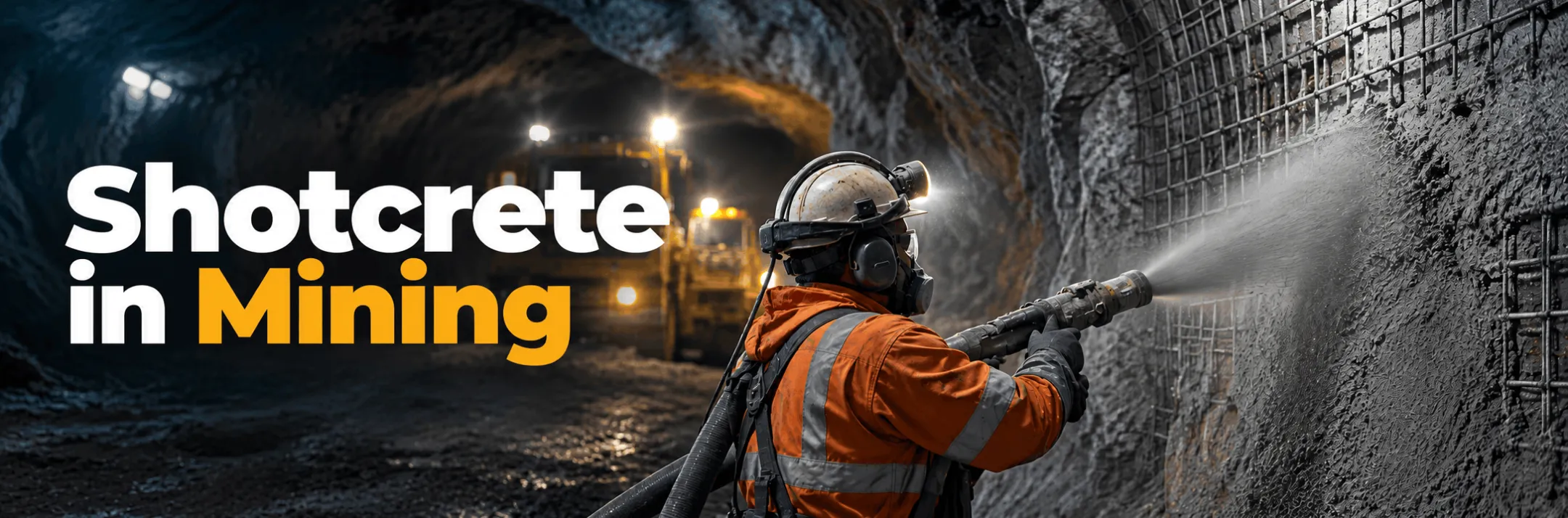
Shotcrete in Mining: More Than Just a Surface Lining
In mining operations, particularly underground mining, maintaining the stability of mine openings is essential for supporting worker safety and operational continuity. Following excavation or blasting, rock surfaces may experience loose fragments, cracking, or changing ground conditions that require appropriate treatment based on geotechnical assessments. One method used as part of a ground support system is shotcrete.
Shotcrete is more than just concrete sprayed onto a rock surface. When properly designed and applied to meet technical requirements, it can form part of a ground support system that helps control rock detachment and maintain the stability of underground excavations.
What Is Shotcrete in Mining?
Shotcrete is concrete or mortar applied to a target surface by spraying it under pneumatic pressure. This spraying process allows the material to adhere to irregular rock surfaces without requiring conventional formwork.
In underground mining, shotcrete is used as part of the ground support system in tunnels, development headings, and other mine openings. It can help retain rock fragments and reduce the likelihood of loose material detaching from the surface, while complementing other support systems such as rock bolts, wire mesh, and other reinforcement elements.
According to the National Institute for Occupational Safety and Health (NIOSH), shotcrete is one of the methods that can support ground control and help reduce the risk of accidents caused by falling rocks in underground mines.
Why Is Shotcrete Important in Mining Operations?
1. Helping Control Rock Detachment
Rock surfaces in mine openings may contain fractures, discontinuities, or varying geological conditions. Shotcrete can help bind surface rock fragments and reduce the risk of ravelling, which refers to the gradual detachment of rock material.
However, shotcrete is not a standalone solution for every ground condition. The need for rock bolts, mesh, or other support methods must still be determined through geotechnical assessment and ground support design.
2. Conforming to Irregular Rock Surfaces
One of the key advantages of shotcrete is its ability to follow the contours of irregular rock surfaces. This characteristic makes it suitable for various underground openings where conventional formwork-based lining methods may be difficult to implement.
3. Supporting Excavation Cycle Efficiency
In underground mining, the time required to install ground support can affect the efficiency of operational cycles. Shotcrete with suitable early-strength characteristics can help make the ground support process more efficient.
Nevertheless, decisions about when work can safely resume must follow design requirements, test results, and site-specific safety procedures. Rapid hardening alone should never be the sole basis for determining when an area can be re-entered.
4. Combining Shotcrete with Fiber Reinforcement
Fiber-reinforced shotcrete incorporates fibers into the mixture to improve the material's behavior after cracking. Certain types of fibers can help control crack opening and provide residual load-bearing capacity after cracks develop.
The type of fiber, mixture characteristics, and required performance must be determined based on the design and application conditions. Fiber reinforcement is not automatically a replacement for all conventional ground support systems.
Factors Affecting Shotcrete Quality
Shotcrete performance depends on more than the quality of the concrete mixture. The final result is also influenced by surface preparation, application methods, site conditions, and quality control.
Mix Design and Admixtures
The proportions of cement, aggregates, water, fibers where applicable, and concrete admixtures must be tailored to project specifications. In certain applications, accelerator admixtures are used to support early-strength development. Their selection must consider material compatibility, mixture characteristics, and required performance.
Spraying Technique
Application quality is influenced by the operator's skill, nozzle distance and angle, spraying pressure, and consistency of the application process. Improper techniques can increase rebound, produce uneven thickness, or reduce the quality of the bond between the material and the surface.
Surface Preparation and Site Conditions
Surfaces receiving shotcrete must be prepared in accordance with project specifications. Loose material, dust, and unsuitable surface conditions can affect adhesion. Groundwater conditions, water flow, work access, ventilation, and space constraints underground must also be considered when planning the application method.
Quality Control and Testing
Quality control is necessary to ensure that shotcrete meets project requirements. Testing may include compressive strength, early strength, flexural capacity or toughness for fiber-reinforced shotcrete, and bond quality as required by the design.
NIOSH emphasizes the importance of testing and evaluating shotcrete quality to support the implementation of safe ground support systems. Quality control should therefore be integrated into the design, application, and inspection processes.
Shotcrete Is Not a Replacement for All Ground Support Methods
Despite its various benefits, shotcrete cannot always function as a standalone ground support system. Its effectiveness depends on rock mass conditions, excavation characteristics, applied loads, designed thickness, and the reinforcement methods used alongside it.
Under certain conditions, shotcrete must be combined with rock bolts, wire mesh, or other support systems. The appropriate method should be selected based on geotechnical assessments and a design that reflects actual site conditions.
It is also important to distinguish between shotcrete used as part of underground mine ground support and its application on open-pit slopes. On slopes, shotcrete may be used for specific purposes, such as surface erosion control, but the underlying slope must already be stable. Shotcrete alone does not resolve overall slope instability.
APTEKINDO's Role in Shotcrete Solutions for Mining
Effective shotcrete application requires alignment between materials, application methods, equipment, quality control, and operating conditions. Shotcrete work should therefore be considered part of an integrated technical solution rather than simply a concrete spraying activity.
Through its engineering-driven mining solutions approach, PT Anggun Permai Tekindo (APTEKINDO) supports the mining industry with technical solutions and services related to shotcrete, concrete admixtures, and other operational mining requirements. The selection of appropriate solutions must remain aligned with project specifications and relevant technical assessments.
Conclusion
Shotcrete plays an important role in mining ground support systems, particularly in helping control rock detachment and support the stability of underground excavation surfaces. However, its performance depends on mix design, application techniques, surface conditions, testing, and integration with other ground support systems.
With appropriate geotechnical planning and consistent quality control, shotcrete can serve as an important component in supporting mining safety and operational efficiency.
Contact APTEKINDO to discuss your shotcrete, concrete admixture, and technical solution requirements for mining operations.
Technical References
- National Institute for Occupational Safety and Health (NIOSH). Shotcrete Design and Installation Compliance Testing: Early Strength, Load Capacity, Toughness, Adhesion Strength, and Applied Quality. Read the NIOSH publication.
- American Shotcrete Association. Ground Support & Underground. Read the guidance.
- Directorate General of Highways, Indonesia. SKh-3.7.18 Sprayed Concrete (Shotcrete), 2022. View the technical specification.
- EFNARC. Publications and Sprayed Concrete Guidelines. View EFNARC publications.
- Share