

Why Concrete Durability Becomes a Critical Factor in Mining Areas
Durability Challenges of Concrete in Mining Environments
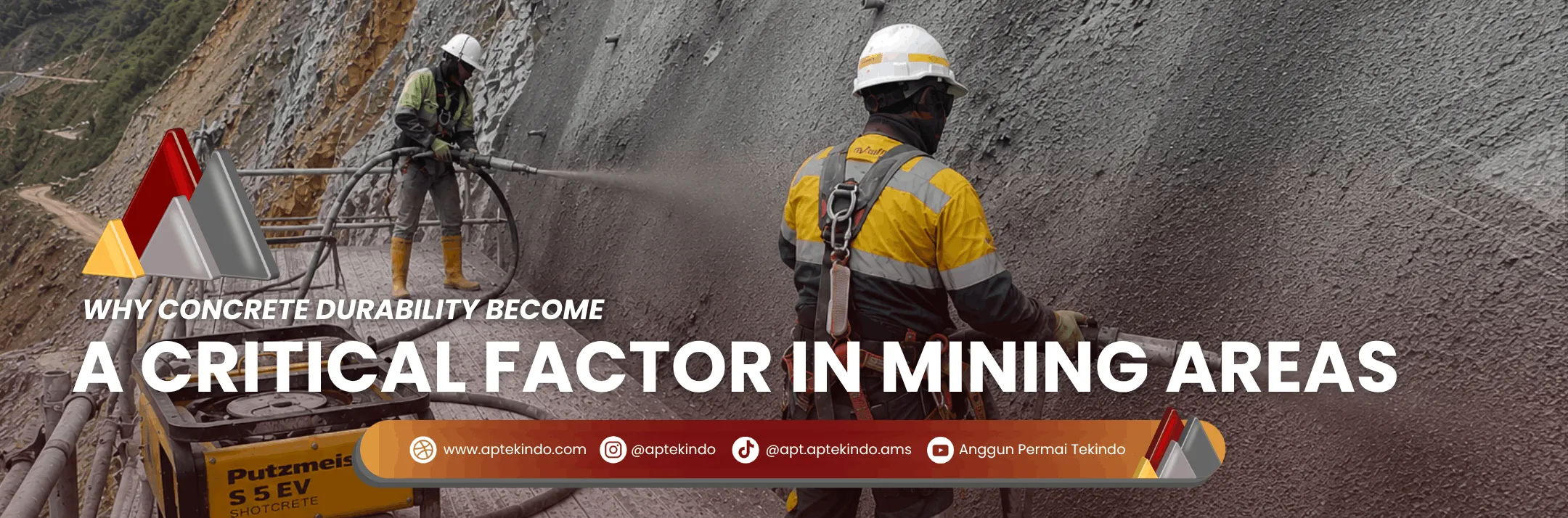
Concrete has become one of the essential elements in mining infrastructure. This material is widely used in drainage channels, retaining structures, heavy equipment workshop foundations, production facilities, and various utility areas supporting mining operations. Although concrete appears structurally strong, its performance in mining environments is highly influenced by aggressive field conditions.
Exposure to water, high humidity, temperature fluctuations, and abrasive materials can accelerate structural deterioration when concrete is not designed with adequate durability. In many cases, damage develops gradually through microscopic changes within the material. Small cracks, increased permeability, and reduced concrete density often become the early stages before more severe structural failures occur.
For this reason, approaches to concrete design in the mining industry have started to evolve. The focus is no longer limited to achieving compressive strength, but also includes the material’s ability to maintain long-term performance. This has become increasingly important in mining construction works and geotechnical projects operating continuously under demanding environmental conditions.
Research on concrete durability explains that concrete resistance is influenced by the material’s ability to withstand environmental stress, abrasion, chemical attacks, and various deterioration mechanisms (Agudelo et al. 2023). This explanation demonstrates that concrete quality is determined not only by its initial strength, but also by the structure’s capability to sustain performance throughout its operational lifespan.
The Impact of Mining Environments on Concrete Quality
In mining areas, these challenges emerge throughout nearly every operational stage. Structures located near mine water flow, for example, face higher risks of water and aggressive substance penetration. If concrete porosity is too high, water can more easily infiltrate the material and accelerate internal deterioration.
High-intensity heavy equipment activity also creates additional stress on operational support structures. Repetitive vibrations can enlarge microcracks within concrete that were previously invisible. When such conditions persist over long periods, the service life of structures may decline faster than originally planned.
Other studies explain that concrete durability is strongly affected by alkali-silica reaction (ASR), which can cause damage in large-scale structures such as concrete walls, rigid pavements, dams, and bridges (Agudelo et al. 2023). This deterioration phenomenon indicates that concrete damage is influenced not only by structural loads, but also by chemical reactions developing within the material itself.
The Role of Supplementary Cementitious Materials in Mining Concrete
As a result, the use of supplementary cementitious materials has become increasingly common to improve the microstructural quality of concrete. Additional materials such as fly ash and metakaolin are considered capable of producing concrete with lower porosity and improved density.
Agudelo et al. (2023) explain that metakaolin can improve concrete microstructure by filling voids within the cement paste, thereby increasing density and reducing porosity. A denser concrete structure helps minimize the penetration of water and aggressive substances into the material. This condition is essential for maintaining the service life of mining infrastructure operating in highly humid environments.
Improved microstructural quality also enhances concrete resistance against changing field conditions. Continuous wetting and drying cycles can accelerate crack formation in highly porous concrete. In contrast, materials with better density tend to demonstrate more stable resistance to operational environmental changes.
Sustainability considerations have also begun influencing the development of modern concrete technology. The utilization of industrial by-products has become one of the widely adopted approaches within the construction sector. Research shows that the use of such materials not only helps stabilize industrial waste, but also contributes to reducing the carbon footprint of construction processes (Agudelo et al. 2023).
This approach is highly relevant to the mining industry’s growing focus on material efficiency and operational sustainability. Infrastructure with better durability generally requires lower maintenance frequency, allowing long-term resource consumption to be reduced.
The Importance of Workability and Admixtures in Mining Construction
In addition to material composition, concrete quality in the field is also influenced by casting processes. Mining work areas often have limited access and more complex construction conditions compared to conventional civil projects. These situations make concrete workability a crucial factor to ensure optimal material placement.
Modern concrete admixture technologies are widely used to improve flowability without excessively increasing the water-cement ratio. The technical data of Sika® ViscoCrete®-3115 N explains that this admixture is designed to produce highly flowable concrete, self-compacting concrete, and water reduction of up to 30%.
Reducing water content helps produce concrete structures with lower porosity. In mining environments, this condition is important for limiting the penetration of water and aggressive substances that may accelerate material deterioration.
Good flowability also allows concrete to fill voids more evenly, reducing the risk of honeycombing and internal voids. Such casting quality significantly influences the long-term performance of operational mining facilities.
Technical product data further explains that the admixture helps improve concrete density and carbonation resistance. These characteristics are highly relevant for mining infrastructure requiring stable performance with lower maintenance demands.
Concrete Durability as Part of Mining Operational Efficiency
Interestingly, many concrete-related issues in mining areas only become visible after facilities begin operating intensively. Standing water, abrasive materials, and heavy equipment activity can accelerate deterioration when material quality is not designed according to operational conditions from the beginning.
For this reason, durability has now become an important component of mining operational efficiency strategies. High-quality concrete infrastructure not only supports workplace safety, but also reduces the potential for disruptions to production activities.
The demand for concrete with long-term performance is expected to continue increasing alongside the growing complexity of mining construction and geotechnical projects in the field. Understanding microstructural quality, material permeability, and resistance to aggressive environments has become an essential part of maintaining sustainable mining operational infrastructure, including projects carried out by PT. APTEKINDO as a mining contractor.
References
Agudelo G, Palacio CA, Monteiro SN, Colorado HA. 2023. “Concrete durability and alkali-silica reaction mitigation using supplementary cementitious materials”. Construction and Building Materials. 378:131152.
Bhanja S, Kumar A, Singh R. 2023. “Effect of sulfate attack on strength and microstructure of fly ash blended concrete”. Materials Today: Proceedings. 77:1480–1487.
PT Sika Indonesia. 2022. Sika® ViscoCrete®-3115 N Technical Data Sheet. Bogor (ID): PT Sika Indonesia.
- Share