

A Perfect Mine Plan Can Still Violate Regulations
In the evaluation of environmental permits for mining operations, it is not uncommon for the production schedule option with the highest economic value to be rejected, while another option with significantly lower economic value is approved. This is not necessarily due to a calculation error. The reason is that two mine blocks that are each safe when mined independently may violate environmental requirements when mined simultaneously.
Cases like this provide clear evidence of something that mine planners rarely recognize: many environmental regulations are not simply numerical limits that can be adjusted up or down. Instead, they consist of conditional requirements essentially, “if this occurs, then that action is required” that are interconnected with one another.
Environmental Rules Have Traditionally Been Treated as Numerical Limits
Almost all mine planning systems treat environmental requirements as numerical limits similar to equipment capacity: do not exceed a certain number of megaliters of water, a certain number of gigajoules of energy, or a certain number of decibels of noise.
If a production plan exceeds these limits, the system applies a penalty to its economic value. The greater the violation, the greater the penalty. The plan with the lowest penalty is then considered the most feasible option.
This approach makes sense for regulations that are genuinely linear, such as total annual water consumption. The problem is that many environmental regulations in practice do not work this way. Mining a block containing sulfide minerals may trigger a requirement for acid mine drainage treatment, regardless of the production volume.
Two blocks that are each below the safe wastewater threshold when mined independently may exceed the capacity of the treatment facility if they are mined during the same period. Rules of this nature cannot be reduced to a single numerical limit because they are conditional and involve interdependencies between blocks.
READ ALSO: Strengthening Mining Company Governance Through the 2026 RKAB
When an Almost-Perfect Plan Turns Out to Be Non-Compliant
A test conducted on a small mine model containing twenty-five blocks demonstrated how significant this issue can be. Three production plans were compared. The first plan had the highest economic value, approximately USD 47 million, but violated five of the eight applicable environmental rules.
The second plan performed much better, violating only one rule, with an economic value of approximately USD 38.5 million. The third plan fully complied with all eight rules, but had the lowest economic value, at approximately USD 31.1 million (Kudzawu-D'Pherdd et al., 2026).
Table 1. Comparison of Z3 with penalty functions for the 25-block case
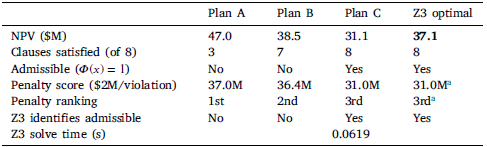
The single violation in the second plan is particularly interesting. Two mine blocks, referred to here as Block 17 and Block 22, do not violate any requirement when mined individually. However, when both are mined simultaneously, the capacity of the acid mine drainage treatment facility is exceeded. No adjustment to energy consumption, water use, land disturbance, or noise can resolve this violation. The only solution is to remove one of the two blocks from the production plan, a decision that reduces the economic value by at least USD 4.3 million.
The three penalty methods tested in this case fixed penalty, adaptive penalty, and Lagrangian penalty all consistently ranked the non-compliant plan higher than the fully compliant plan. In contrast, a logic-based approach called Z3 immediately identified the third plan as the only valid solution, in less than one-fifteenth of a second.
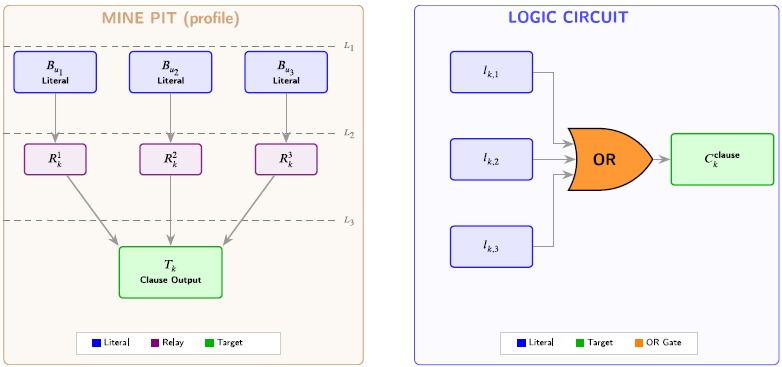
Figure 1. Relay block mechanism for ECMPP. Left: In the physical mine model, the upper literal blocks and relay blocks must be mined (True) to enable mining of the deeper target block. Right: This structure maps the disjunctive (OR) nature of SAT clauses into conjunctive (AND) precedence relationships in mine planning using standard AS/US logic symbols.
Further testing using more realistic mine data, with the number of blocks ranging from fifty to more than seven hundred, showed that this logic-based approach could still solve the problems within a reasonable time, ranging from a few seconds to less than four minutes for the largest case.
This demonstrates that the method is suitable for environmental feasibility screening, although it has not yet been tested at the scale of a full industrial mine, where the number of blocks can reach millions.
READ ALSO: Developing a Mine Exploration Program: From Data to Reserves
Why This Matters to Mine Planners and Managers
The most direct implication concerns how feasibility assessment systems are used by many mining companies. If an environmental rule takes the form of a conditional requirement rather than simply a numerical limit, increasing or decreasing the penalty value in a penalty-based system will not necessarily improve the result.
The problem is not the calibration of the numbers, but rather how the system interprets compliance as something that can be measured gradually, when in reality it is often a matter of whether a requirement is satisfied or not.
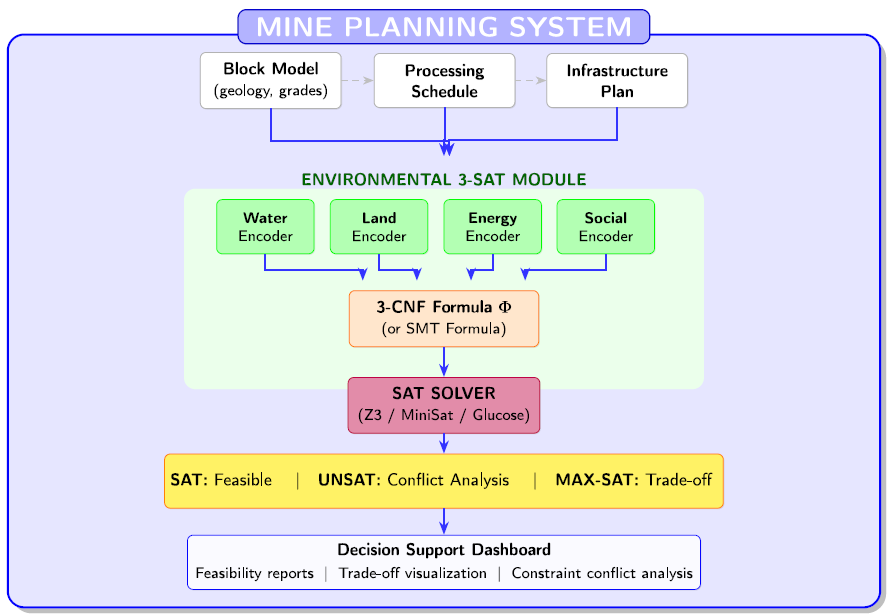
Figure 2. Conceptual framework. (For interpretation of the color references in this figure caption, readers may refer to the online version of the article.)
For mine planners, the most practical step is to first classify the types of environmental rules applicable to their projects. Rules that genuinely take the form of linear limits, such as total annual emissions, can still be handled effectively by existing planning systems.
However, rules that are conditional and interconnected between blocks, such as restrictions on certain combinations of mining activities, are likely to require different analytical tools to ensure that the results are reliable when submitted to regulators.
The current scale of application should also be understood realistically. This logic-based approach is best suited for environmental feasibility screening and pre-feasibility studies, where the number of blocks being evaluated typically ranges from hundreds to thousands. For full-scale production scheduling involving millions of blocks, further development is still required before the approach can be routinely implemented.
Accurate Data Determines the Right Rules
Determining which environmental requirements are numerical limits and which are conditional requirements is not simply a desk-based exercise. It requires an understanding of actual field conditions, the geotechnical characteristics of each block, and how individual blocks influence one another. This is where APTEKINDO supports mining projects by developing accurate field data and geotechnical assessments, ensuring that the environmental feasibility requirements formulated for a project truly reflect actual site conditions rather than assumptions made on paper.
References
Kudzawu-D'Pherdd, R., Nuviadenu, J., Neil, D., Kudzawu-D'Pherdd, E., Linus, J. H., & Ouabo, E. R. (2026). NP-completeness of mine planning under logical environmental constraints. Applied Computing and Geosciences, 31, 100365. https://doi.org/10.1016/j.acags.2026.100365
- Share