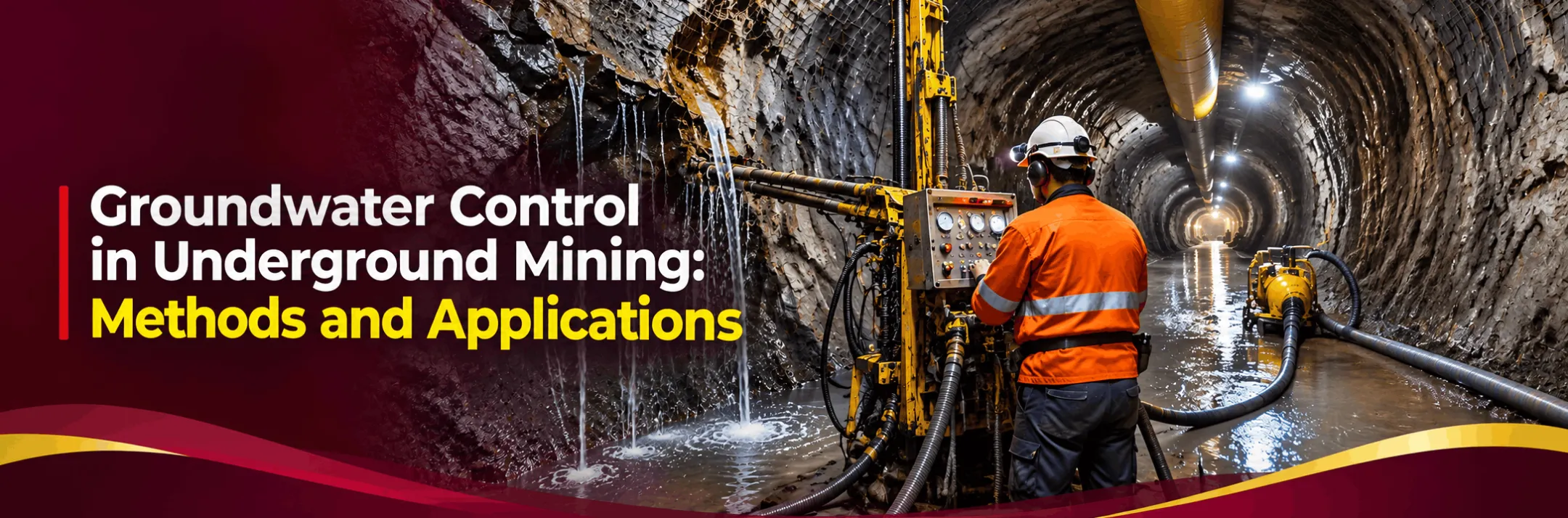
Groundwater Control in Underground Mining: Methods and Applications
Introduction
Groundwater is one of the major challenges in underground mining operations. As mining activities extend deeper below the surface, the interaction between groundwater systems and underground excavations becomes increasingly complex.
Water can enter underground mine workings through geological fractures, joints, faults, permeable rock formations, and water-bearing aquifers. When not properly managed, groundwater inflow can affect excavation conditions, damage underground infrastructure, disrupt mining activities, and increase operational risks.
Excessive water ingress may also contribute to ground instability, particularly where water interacts with fractured or weathered rock formations. In certain geological conditions, sudden water inflows can develop into serious water inrush hazards.
To address these challenges, mining operators implement groundwater control strategies that combine geological investigation, grouting, drainage, and dewatering systems.
Understanding how these methods work and when they should be applied is essential for maintaining safe and efficient underground mining operations.
What Is Groundwater Control in Underground Mining?
Groundwater control refers to a series of engineering and water management techniques designed to regulate, reduce, or prevent groundwater from entering underground excavations.
The main objective is to maintain manageable water conditions around mining areas while protecting underground structures, equipment, and personnel.
Groundwater control may involve sealing water pathways, reducing groundwater pressure, redirecting water flow, or removing accumulated water from underground workings.
Depending on geological and hydrogeological conditions, groundwater control methods can be implemented before excavation, during mine development, or throughout production activities.
Common situations requiring groundwater control include:
- Water seepage through fractured rock masses.
- Groundwater infiltration through geological faults.
- High groundwater pressure surrounding underground excavations.
- Water inflows through mine shafts and tunnels.
- Water-bearing geological formations intersected during excavation.
- Connections between underground workings and adjacent water sources.
Effective groundwater management requires an understanding of the geological structures and groundwater flow conditions surrounding the mining area.
Why Is Groundwater Control Important in Underground Mining?
Groundwater can significantly influence underground mining conditions. Without appropriate management, uncontrolled water inflows may affect safety, infrastructure, and operational performance.
Several important reasons make groundwater control essential.
1. Maintaining Underground Excavation Stability
Groundwater movement can influence the mechanical behavior of certain soil and rock formations.
In fractured or weathered rock masses, water infiltration may contribute to the deterioration of geological materials and affect the stability of underground excavations.
Controlling groundwater pathways through appropriate grouting and drainage techniques can help reduce these risks.
2. Reducing Water Inrush Risks
Water inrush occurs when large volumes of water suddenly enter underground mine workings.
This may happen when excavation intersects water-bearing formations, geological faults, or interconnected underground water systems.
Depending on the volume and pressure involved, water inrush can threaten workers, damage equipment, and interrupt mining operations.
Groundwater investigation, preventive grouting, and appropriate drainage systems are important components of water hazard management.
3. Protecting Underground Infrastructure
Continuous water infiltration can affect underground infrastructure, including mine shafts, tunnel linings, drainage systems, and electrical installations.
In certain conditions, flowing water may also transport fine particles and contribute to erosion around underground structures.
Appropriate groundwater control measures help protect infrastructure and reduce the need for repeated rehabilitation work.
4. Improving Operational Efficiency
Uncontrolled groundwater inflows can interrupt excavation activities, increase pumping requirements, and create additional maintenance demands.
Managing groundwater conditions helps maintain more predictable working environments and supports the continuity of underground mining operations.
Common Groundwater Control Methods Used in Mining
The selection of groundwater control methods depends on several factors, including groundwater pressure, rock permeability, fracture distribution, water inflow rates, and excavation requirements.
The following methods are commonly considered in underground mining projects.
1. Grouting for Groundwater Control
Grouting is one of the important methods used to control groundwater infiltration in underground mining.
The process involves injecting specialized grout materials into fractures, joints, voids, or permeable geological formations to reduce water flow through accessible pathways.
Once the grout sets or reacts, it forms a barrier or sealing structure that helps restrict groundwater movement.
Common grouting materials include:
- Cement-based grout.
- Microfine cement grout.
- Chemical grout.
- Specialized polyurethane or resin-based grout systems.
The selection of grout material depends on fracture characteristics, water pressure, groundwater flow conditions, and the required sealing performance.
Grouting can be applied before excavation as a preventive measure or after excavation when water seepage has been identified.
It is particularly useful in fractured rock formations, fault zones, and localized water-bearing structures.
2. Pre-Excavation Grouting
Pre-excavation grouting is performed before excavation reaches a potentially water-bearing geological zone.
The objective is to improve ground conditions and reduce groundwater permeability ahead of the excavation face.
Grout is injected through strategically positioned boreholes to seal fractures and reduce the pathways through which groundwater may enter the excavation.
This method is particularly relevant when geological investigations indicate the presence of water-bearing structures or zones with significant seepage potential.
By addressing groundwater pathways in advance, pre-excavation grouting can help reduce unexpected water inflows during mine development.
3. Post-Excavation Grouting
Post-excavation grouting is performed after excavation when groundwater infiltration or other geological weaknesses have been identified.
Injection boreholes are installed around the affected area to deliver grout into water-bearing fractures, joints, or voids.
The objective is to seal accessible water pathways and reduce groundwater inflow into the underground excavation.
This approach is commonly considered for localized seepage, water leakage through tunnel linings, and fractured rock formations exposed during excavation.
The injection procedure must be designed according to actual water flow conditions, geological characteristics, and the structural requirements of the affected area.
4. Dewatering Systems
Dewatering refers to the removal of accumulated groundwater from underground mining areas through pumping and drainage systems.
Unlike grouting, which aims to restrict groundwater movement through geological pathways, dewatering manages water that has already entered or accumulated within the mine.
Common dewatering systems include:
- Sump pumping systems.
- Underground drainage channels.
- Submersible pumps.
- Mine drainage boreholes.
- Surface dewatering wells.
Dewatering is essential for maintaining accessible and manageable working conditions in underground excavations.
The required pumping capacity depends on groundwater inflow rates, storage conditions, mine layout, and the expected volume of water that needs to be removed.
5. Drainage Boreholes
Drainage boreholes are drilled to intercept water-bearing geological structures and provide controlled pathways for groundwater discharge.
Depending on their orientation and geological conditions, these boreholes can help reduce groundwater pressure around underground excavations.
Some drainage boreholes are designed to allow water to flow by gravity, while others require connection to pumping systems.
This method can be useful when sealing all groundwater pathways through grouting is impractical or when controlled drainage provides a more suitable engineering solution.
Drainage boreholes are often considered alongside grouting and dewatering as part of an integrated groundwater management strategy.
Grouting vs. Dewatering: Understanding the Difference
Although both methods are used in groundwater control, grouting and dewatering serve different engineering purposes.
| Aspect | Grouting | Dewatering |
|---|---|---|
| Main objective | Reduce groundwater pathways | Remove accumulated groundwater |
| Method | Injecting grout into fractures and voids | Pumping or draining water |
| Application | Water-bearing geological structures | Mine excavations and water collection areas |
| Primary effect | Restricts water movement | Lowers water accumulation or pressure |
| Typical equipment | Injection pumps and drilling systems | Pumps, pipelines, and drainage systems |
In practice, these methods are not necessarily alternatives to each other.
A mining project may require grouting to reduce groundwater inflows while using dewatering systems to manage the remaining water entering underground workings.
The appropriate combination depends on site-specific hydrogeological conditions and engineering assessments.
Factors to Consider When Selecting a Groundwater Control Method
Selecting an appropriate groundwater control method requires a detailed understanding of the geological and hydrogeological environment.
Several important factors should be evaluated.
1. Geological Conditions
Rock type, fracture distribution, fault structures, and geological discontinuities influence groundwater movement and the suitability of different control methods.
2. Groundwater Pressure
Groundwater pressure affects the potential rate of water inflow and the requirements for grouting, drainage, and pumping systems.
3. Rock Permeability
Permeability determines how easily water can move through rock formations. Highly fractured or permeable zones may require specialized grouting or drainage approaches.
4. Water Inflow Rate
The volume and rate of groundwater entering an excavation help determine the required sealing capacity, pumping capacity, and drainage arrangement.
5. Excavation Design and Mining Sequence
The depth, geometry, location, and development sequence of underground excavations influence when groundwater control measures should be implemented.
6. Environmental Considerations
Groundwater control activities should also consider potential impacts on surrounding aquifers, surface water systems, and groundwater-dependent environments.
A proper assessment helps ensure that the selected groundwater control method is technically appropriate and compatible with the mining operation.
The Role of Grouting Technology in Modern Underground Mining
As underground mining operations develop into deeper and more complex geological environments, grouting technology continues to play an important role in groundwater management.
Advancements in injection equipment, grout formulations, and drilling techniques provide more options for addressing water-bearing fractures and geological structures.
For example, microfine cement grout can be considered where finer penetration into accessible fractures is required, while selected chemical or resin-based grout systems may be suitable for particular water-flow conditions.
However, successful grouting depends on more than the injection material itself.
A reliable application requires geological investigation, appropriate material selection, controlled injection procedures, and post-treatment verification.
Monitoring groundwater inflow before and after treatment is also important for evaluating whether the intended reduction in seepage has been achieved.
Grouting should therefore be considered as part of an integrated groundwater control strategy rather than a standalone solution for every underground water problem.
Conclusion
Groundwater control is an essential part of safe and efficient underground mining operations.
Uncontrolled groundwater infiltration can affect excavation stability, increase water inrush risks, damage underground infrastructure, and disrupt mining activities.
Several methods can be used to manage these challenges, including grouting, pre-excavation grouting, post-excavation grouting, dewatering systems, and drainage boreholes.
Each method serves a different purpose, and the appropriate approach depends on geological conditions, groundwater pressure, rock permeability, and operational requirements.
For mining operators, understanding these groundwater control techniques is an important step toward managing geotechnical risks and maintaining reliable underground operations.
PT Anggun Permai Tekindo (APTEKINDO) provides specialized grouting and mining engineering solutions to support ground stabilization and groundwater control requirements in the mining industry.
References
1. Gray, I. (2024). Dealing with Groundwater in Underground Mining. Deep Mining 2024, Australian Centre for Geomechanics.
Read publication.
2. Daw, G. P., & Pollard, C. A. (1986). Grouting for Ground Water Control in Underground Mining. International Journal of Mine Water, 5(4), 1–40.
Read publication.
3. Straskraba, V. (1998). Water Control in Underground Mines – Grouting or Drainage? International Mine Water Association.
Read publication.
4. Goodman, W., Van Dyk, D., Grobler, N., & Osborne, A. (2018). Water Ingress Mitigation Programs for Underground Mines – Hydrogeological and Rock Mechanical Demands on Grout Properties. International Mine Water Association.
Read publication.
5. Yuan, S., et al. (2024). Multicriteria Risk Assessment of Water Inrush in Underground Mines with Large-Scale Curtain Grouting. Geomatics, Natural Hazards and Risk.
Read publication.
6. Development and Application of New Composite Grouting Material for Sealing Groundwater Inflow and Reinforcing Wall Rock in Deep Mine. Scientific Reports (2018).
Read publication.
- Share