

Rock Fall Barrier: Protection for Safer Mining Operations
Geotechnical Risks in Underground Mining Operations
Underground mining operations have risk characteristics that are significantly different from open-pit mining. Limited working spaces, constantly changing rock conditions, and the high dependence on excavation stability make safety an inseparable part of operational productivity. Even slight changes in rock mass conditions can directly affect work access, equipment movement, and worker safety within mining areas.
One of the most common threats in underground mining is rockfall. This risk often arises from rock stress redistribution after blasting activities, the formation of new fractures, or the weakening of rock zones surrounding production tunnels. In some conditions, rocks may appear stable on the surface but have actually experienced a reduction in load-bearing capacity due to internal structural changes.
Rockfall issues are not only associated with major collapses. Small to medium-sized rock fragments are often the source of accidents in underground mining areas because they occur suddenly and are difficult to predict. Situations like these have made rock protection systems an important component in the design of modern underground mining operations.
The use of rockfall barriers, wire mesh, rock bolts, and deformation monitoring has now become a standard approach in many underground mining projects. The objective is not merely to stop falling rocks but to maintain operational working areas without compromising safety factors.
Rock Stress Changes and Rockfall Potential
In practice, the primary challenge in underground operations lies in continuously changing rock stress conditions as mining excavations develop. As production areas expand, pressure distribution around tunnels also changes. Zones that were previously stable may experience stress release or the formation of new fractures within a relatively short period.
Conditions like these make reactive approaches increasingly risky. Waiting until a collapse occurs is clearly not an ideal option for modern mining operations. Many mining companies have started implementing preventive approaches by utilizing support systems and impact energy protection systems to reduce the potential for rock failure.
Research by Pimpinella et al. (2025) explains that modern rockfall barrier systems function as dynamic energy dissipation structures. When rocks strike the barrier, the impact energy is not absorbed by a single component alone. The impact force is distributed through net panels, wire ropes, support structures, and energy dissipating devices before being gradually absorbed.
This approach is particularly interesting because modern protection systems are intentionally designed to undergo controlled deformation. Barriers are not made completely rigid. A certain degree of flexibility is necessary so that impact energy can be absorbed without immediately triggering structural failure. In other words, deformation is not always a sign of failure but part of the protection mechanism itself.
The study also shows that force distribution within barriers is strongly influenced by impact position, impact direction, and support structure conditions. Impacts occurring on specific sides can produce uneven load distributions, causing certain ropes to experience greater forces than others. If the system capacity is insufficient, localized failure may occur even though most of the structure still appears intact.
These characteristics are highly relevant in underground mining operations because mining excavation geometries rarely have completely uniform shapes. Every crosscut, decline, and production drift may have different geotechnical conditions. Minor changes in fracture orientation or rock quality often produce different ground support responses as well.
The Impact of Rockfall on Operational Productivity
In the field, the impact of rockfall is not only felt from a safety perspective. Working areas with high instability levels usually require additional inspections, rock scaling, or temporary operational shutdowns before production can continue. In operations with strict production targets, these conditions can disrupt the entire work cycle.
Many mining productivity disruptions actually originate from seemingly minor geotechnical issues. Underground access roads blocked by minor collapses, deformation of support structures, or rock weakening around excavations can slow equipment mobilization and material distribution. If these conditions occur repeatedly, their impact on operational efficiency becomes significant.
As a result, rockfall barrier systems are now increasingly viewed as part of operational strategy rather than merely additional safety equipment. The more stable the working area is maintained, the lower the potential downtime caused by geotechnical disturbances.
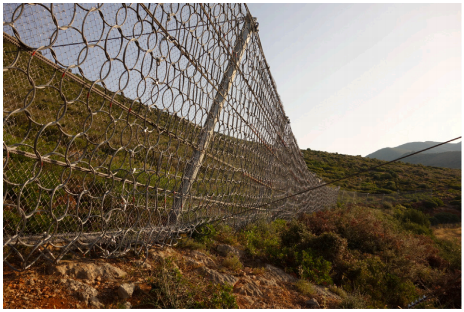
Figure 1. Rockfall barrier.
Monitoring and Analytical Modelling in Underground Mining Operations
Pimpinella et al. (2025) also emphasize the importance of analytical modelling approaches in understanding barrier behavior under dynamic impact conditions. These models are used to evaluate energy distribution, wire rope deformation, and support structure responses under various rock impact scenarios.
Modelling-based approaches are becoming increasingly important because underground rock behavior is often difficult to predict through visual observation alone. Small fractures that are invisible on the surface can develop into sources of rock release when production areas experience stress changes due to mining activities.
The development of geotechnical monitoring technology has also changed how underground mining operations manage rock-related risks. Monitoring displacement, support system deformation, and changes in ground movement conditions are now increasingly used to detect potential disturbances at an early stage. Minor changes in support structures can become early warning signals that rock conditions are beginning to lose stability.
Approaches like these make underground mining management increasingly dependent on the integration of rock mechanics, geotechnics, and operational planning. Safety is no longer separated from productivity because both directly influence one another in field operations.
The Importance of Regular Support System Evaluation
Another interesting aspect is that barrier performance lifespan often becomes a challenge in itself. Systems that still appear visually sound may no longer possess the same energy dissipation capacity after receiving repeated impacts over long periods. Minor deformation, wire rope corrosion, or changes in support tension can gradually reduce system performance without being immediately noticed.
This is why routine evaluation of support systems has become an important part of underground mining operations. Periodic inspections help ensure that protection systems are still capable of functioning according to their design capacity when future impacts occur.
Geotechnical risks in underground mining operations can never be completely eliminated. However, through a combination of monitoring, appropriate support structures, and rockfall barrier systems designed according to field conditions, the potential for disruptions can be controlled much more effectively. Approaches like these are increasingly necessary in modern mining operations that demand a balance between workplace safety and production continuity.
References
Pimpinella F, et al. (2025). “Generalized analytical model for flexible rockfall barriers under dynamic impact conditions”. Computers and Geotechnics, 188, 107602.
- Share