

Why Bearing Capacity Should Never Be Overlooked in Mining
A crusher may be designed with a steel structure that incorporates a high safety factor. An ROM pad can be constructed with pavement layers that meet specifications, while haul roads use selected materials capable of supporting large-capacity haul trucks. However, all of these infrastructures have one thing in common: eventually, all loads are transferred to the ground.
When the soil cannot support these loads, the resulting problems are often not structural failures, but rather gradual settlement, deformation, or increasing maintenance requirements that disrupt mining operations.
Therefore, in mining projects, soil bearing capacity is not merely a matter of structural safety. Its significance goes far beyond that, as it determines whether infrastructure can maintain its performance for years under continuously changing operational loads. Haul roads that require frequent repairs reduce equipment productivity.
Settlement in ROM pad areas can interfere with loading activities. Even process equipment foundations may lose precision if soil deformation occurs unevenly. In other words, soil characteristics influence operational efficiency just as much as the quality of the structures built above them.
Bearing Capacity Is Not Just About Maximum Load
Many people understand bearing capacity as the ability of soil to support loads without experiencing failure. This definition is correct, but in mining operations, engineers rarely wait until the soil reaches its failure condition.
More commonly, they focus on changes in soil behavior before that limit is reached. Excessive settlement, permanent deformation, or loss of soil stiffness can create operational problems even when, theoretically, the soil still has an adequate factor of safety against failure.
This is why bearing capacity evaluations are always associated with serviceability, not merely ultimate capacity. A soil may still be capable of carrying the load in theory, but if its deformation has already affected the performance of haul roads or the stability of foundations, the condition still requires attention. This approach makes geotechnical analyses in mining more focused on operational sustainability rather than simply meeting minimum design requirements.
According to Das and Sivakugan (2019), bearing capacity evaluations should consider both ultimate capacity and the deformation limits that are still acceptable for the structure and the intended function of the infrastructure. This approach helps engineers select solutions that are not only theoretically safe but also capable of maintaining facility performance throughout its operational life.
Every Mining Infrastructure Imposes Different Loading Conditions
Engineers cannot use a single bearing capacity value for an entire mine site because each facility generates different loading patterns. Crusher foundations experience significant static loads accompanied by vibrations during operation.
Haul roads are subjected to repeated dynamic loading from mine truck traffic. Waste dumps exert continuously increasing pressure as material volumes grow, while ROM pads must maintain surface stability to ensure that heavy equipment operations remain safe and efficient.
These differences in loading characteristics lead to different bearing capacity requirements. This is why engineers do not only calculate the magnitude of the loads but also evaluate how the soil will respond to those loads throughout the service life of the infrastructure.
Such an approach enables more targeted designs while reducing the risk of major repairs after the facilities begin operating.
How Do Engineers Determine Soil Bearing Capacity?
Determining soil bearing capacity is not simply a matter of plugging numbers into an equation. Before conducting the analysis, engineers must understand subsurface conditions through geotechnical investigations.
Information such as soil type, the thickness of each layer, groundwater levels, and the mechanical properties of the materials forms the basis for predicting how the soil will respond to loads from the planned infrastructure. Without this information, the bearing capacity values used in design become assumptions that may lead to inappropriate decisions.
To obtain this information, investigations are typically conducted through a combination of drilling, Standard Penetration Tests (SPT), Cone Penetration Tests (CPT), laboratory testing, and field observations.
According to Das and Sivakugan (2019), the results of these investigations are used not only to calculate ultimate bearing capacity but also to evaluate settlement potential and soil deformation characteristics that may affect structural performance throughout its service life.
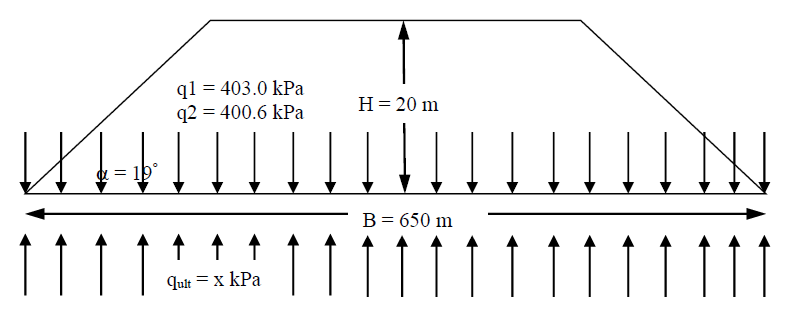
Bearing Capacity Calculation Based on Borehole Data
When Bearing Capacity Does Not Meet Design Requirements
Investigation results do not always indicate ideal soil conditions. In some locations, soil bearing capacity may be lower than design requirements, particularly in areas with soft soils, weathered materials, or fills that have not been adequately consolidated.
Such conditions do not necessarily mean that the project must be halted or that all the soil must be replaced. Instead, engineers evaluate various alternatives to ensure that the infrastructure can still be constructed with an acceptable level of risk.
The selected alternative depends on the cause of the problem. If structural loads can still be adjusted, modifying the foundation design may provide an efficient solution. If soil characteristics are the limiting factor, soil improvement methods can be considered to enhance soil performance before construction begins.
In certain situations, relocating the facility to an area with more favorable geotechnical conditions may be more economical than forcing construction at the original location. In other words, bearing capacity is not merely a calculated value; it serves as the basis for evaluating various engineering decisions.
Soil Bearing Capacity Helps Reduce Operational Risks
Decisions regarding soil bearing capacity are often made during the early stages of a project, but their impacts are felt throughout the entire life of the mining operation. Infrastructure built on soils whose characteristics are well understood generally requires more manageable maintenance, has a lower risk of deformation, and can support production activities more consistently.
Conversely, if geotechnical evaluations are limited, the consequences may emerge years later in the form of repair costs, operational disruptions, or even temporary shutdowns of certain areas.
Therefore, bearing capacity analysis is not only intended to satisfy design requirements but also serves as an integral part of project risk management. Information obtained from geotechnical investigations allows engineers to identify potential issues early, evaluate alternative solutions, and select the approach that best suits both field conditions and the operational objectives of the mine.
References
Das, B. M., & Sivakugan, N. (2019). Principles of Foundation Engineering (9th ed.). Cengage Learning.
- Share