


When Slope Stability Cannot Be Solved with One Type of Reinforcement
The slope has been reinforced. Minipiles have been installed. The factor of safety values from the stability analysis have also met the design criteria. However, one question still needs to be answered: which part of the slope actually became more stable?
This question appears simple, but the results of an analysis on a case study in Montisoni, Italy, reveal a rather interesting issue. After the installation of minipiles, the analysis yielded a minimum factor of safety of 1.27. This figure satisfies the design requirements used in the study. The problem is that the critical slip surface was actually located on a part of the slope that did not interact with the minipiles. This means that a factor of safety value that meets the criteria does not necessarily imply that the entire slope benefits equally from the stabilization system.
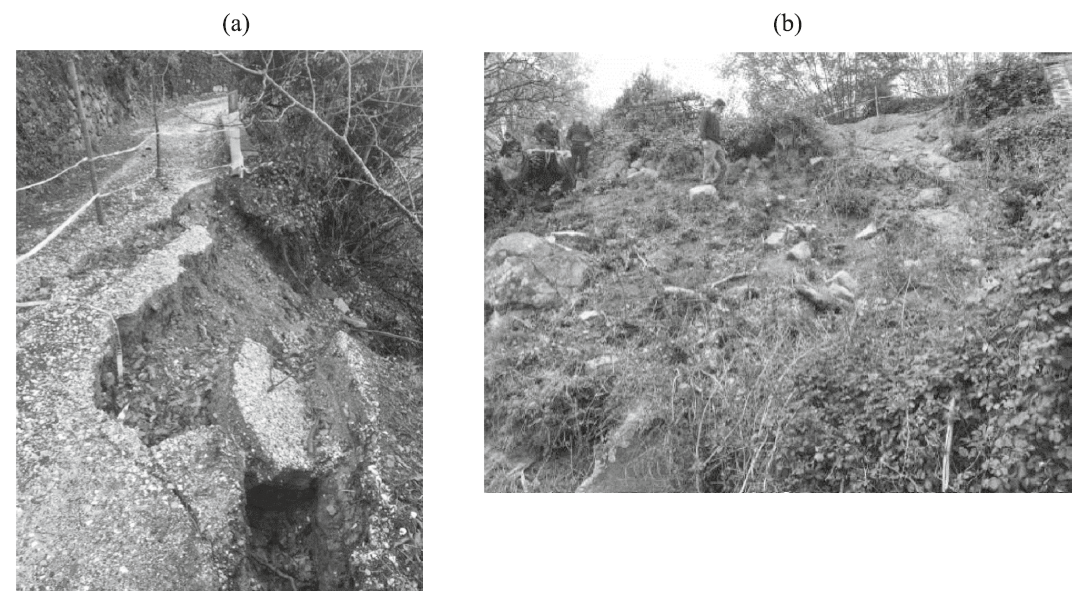
Figure 1. The Montisoni landslide in 2020: (a) view from the road; (b) view from the bottom of the slope.
This finding is relevant for slope stabilization work in mining areas. Slope geometry changes as mining progresses, the materials composing the slope are not always homogeneous, and water conditions can alter slope response. Therefore, the selection of a reinforcement system needs to consider the failure mechanism to be controlled, not merely aim for a single factor of safety value.
Reinforcement must be placed according to the landslide mechanism
In slope stability analysis, the factor of safety essentially compares the shear strength of the soil with the mobilized shear stress along the slip surface. The Limit Equilibrium Method (LEM) evaluates a number of slip surfaces to find the most critical mechanism.
The consequences of this are quite important in design. A reinforcement element can work on a slip surface that intersects or interacts with it, but its influence becomes limited if the failure mechanism develops through another zone.
In the Montisoni study, the minipiles contributed to stability through their interaction with the soil mass. However, the critical slip surface in the conventional configuration did not pass through the zone influenced by the minipiles. The addition of minipiles did not automatically improve the entire failure mechanism.
For mining slope designers, the implication is clear: the location of reinforcement must follow the geometry and depth of the landslide mechanism. Reinforcement at the toe of the slope does not always solve the problem if the failure develops at a shallower depth or outside the influence zone of that element.
Vegetation has a mechanical contribution, but its depth is limited
Vegetation is often used as part of environmental management. From a geotechnical perspective, the root system also contributes to the shear strength of the soil.
Roots increase shear strength by intercepting tensile cracks and shear planes, while also providing additional cohesive and frictional contributions to the soil layer penetrated by the root system.
However, this contribution has physical limits. The root system primarily develops in shallow soil layers. Therefore, nature-based solutions (NBS) are more suitable for shallow or near-surface instability. Deep-seated movements with high stress levels still require conventional reinforcement elements.
There is another factor often overlooked in simple analyses: the strength of NBS changes over time.
In the Montisoni study, the geotechnical model accounted for both root system development and the degradation of wooden elements in the live crib wall and live grid. The analysis was conducted at several time stages up to 25 years after construction.
The results showed that the root contribution to stability increased as the root system grew. At the same time, the wooden elements underwent degradation. The changes in these two components resulted in changes in the mechanical properties of the system over time.
Therefore, NBS should not be modeled as a material with a single strength value assumed constant throughout the design life. Time becomes part of the geotechnical behavior of the system.
When two stabilization mechanisms work together
The limitations of each system open up room for combining several stabilization mechanisms.
In the study, the combined configuration used minipiles, a live crib wall, and a live grid. The minipiles provided mechanical contribution in the deeper zone, while the vegetation-based system worked in the shallow layer and developed as roots grew. The analysis results showed that the combined configuration provided an increase in stability compared to the configuration using only NBS.
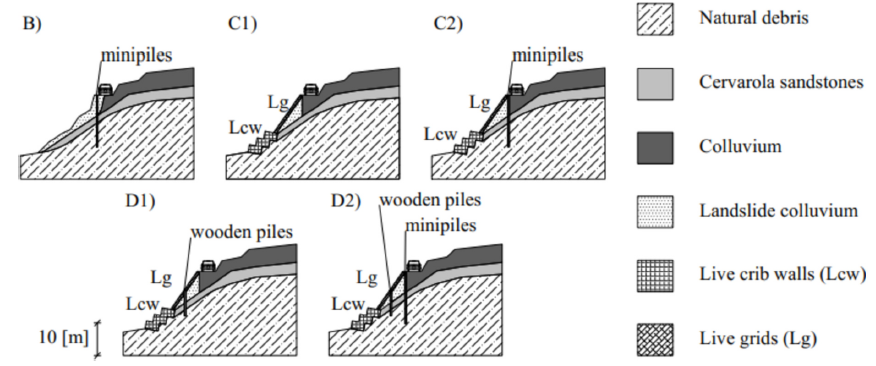
Figure 2. Comparison of stabilization scenarios
Changes over time were also observed in the combined configuration. For scenario C2, the factor of safety value on the critical sample increased from the initial stage to the 25-year age. For scenario MN, the minimum FS of the sample increased from 3.22 in the second year to 3.48 in the 25th year. The average value increased from 5.49 to 6.33.
However, these figures do not mean that NBS can be directly applied to all slopes. During the construction stage, using NBS alone did not yet provide a sufficiently high level of reliability in this study. Performance improved after the root system developed.
There is another lesson from this analysis. The researchers did not only look at one slip surface with the lowest FS. Of the 10,000 slip surfaces generated for each scenario, the 5% lowest FS values were analyzed as a separate group to examine the distribution of stability.
For geotechnical work, design evaluation should not stop at the question, "what is the lowest FS value?" The next questions are, "where is that slip surface located, what influences it, and how does the mechanism change over time?"
Slope stabilization is highly dependent on local conditions. Geometry, stratigraphy, water conditions, slip surface depth, material characteristics, and post-construction changes can all alter the response of a reinforcement system. The Montisoni study itself confirms that the analysis results are case-specific and cannot simply be transferred to other locations.
A more rational approach is to view stabilization as a system. Conventional elements can handle mechanisms that require mechanical capacity from the outset, while NBS can contribute to the shallow layer and develop as vegetation grows.
For geotechnical work in mining, this way of thinking opens up opportunities to combine various technologies according to the mechanism of the problem. Ground support, shotcrete, grouting, injection systems, soil improvement, and vegetation-based solutions can all be placed based on their function and working zone.
At APTEKINDO, this principle is part of the approach to providing geotechnical solutions: first understanding the field conditions, then determining the appropriate form of reinforcement according to the mechanism and stability requirements at hand.
References
Uzielli, M., Geppetti, A., Borselli, L., Renzi, S., & Preti, F. (2025). Comparative geotechnical analysis of slope stabilization through conventional, soil and water bioengineering, and combined solutions. Ecological Engineering, 212, 107487.
- Share