Superplasticizer in Geopolymer Shotcrete for Mining: Why the Right Dosage Decides Reliability
Geopolymer shotcrete is only reliable if the mixture is fluid enough to be placed and still strong once hardened. In a study of fly ash-based geopolymer concrete, a superplasticizer dosage of 1.5% by weight of fly ash raised the slump from 4–6.5 cm to 8–10 cm, with a compressive strength of 31.63 MPa (target: 30 MPa) (Herwani et al., 2018).
Shotcrete is one of the primary methods used to reinforce mine tunnel walls and roofs immediately after excavation. To adhere evenly and harden properly, the concrete mixture needs to be fluid enough to be sprayed while still maintaining sufficient strength after hardening. One material that is increasingly being considered for this application is geopolymer concrete, a type of concrete that does not use Portland cement at all.
The challenge is that geopolymer concrete has a tendency similar to conventional concrete: if the mixture is too stiff, the final product can become porous and uneven. The study directly evaluated how this issue could be addressed using an admixture called superplasticizer (Herwani et al., 2018).
What Is Geopolymer Concrete and Why Does It Tend to Be Stiff?
Geopolymer concrete is produced from fly ash, a coal combustion by-product rich in silica and alumina, which is activated using an alkaline solution such as sodium hydroxide rather than Portland cement (Herwani et al., 2018). However, its physical properties present a similar challenge to conventional concrete: when the mixture is too stiff and viscous, it becomes difficult to work with, place, and compact, increasing the risk of voids.
How stiff is the mixture without admixtures?
The study directly measured the consistency of geopolymer concrete mixtures without any admixture. The slump value, which indicates the fluidity of fresh concrete, ranged from only 4 to 6.5 centimeters. A mixture this stiff was described as behaving like a highly viscous gel, while compaction was relatively slow and required additional vibration equipment (Herwani et al., 2018).
Superplasticizer Improves Workability Without Sacrificing Strength
Effect of dosage on slump
Adding a naphthalene-based superplasticizer significantly reduced the mixture’s viscosity. At a dosage of 1.5 percent by weight of fly ash, the slump increased to 8–10 centimeters. At 2 percent, the slump increased further to 11–16 centimeters, with the highest value of 16 centimeters recorded in the mixture with a 10 M sodium hydroxide solution (Herwani et al., 2018).
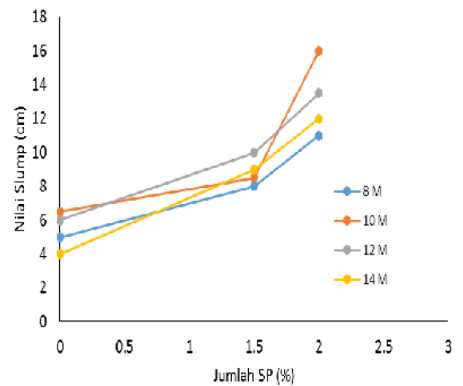
Figure 1. Relationship between slump value and superplasticizer dosage in geopolymer concrete
Effect of dosage on compressive strength
Interestingly, the increased fluidity did not compromise the concrete’s strength. At the optimum dosage of 1.5 percent and a sodium hydroxide concentration of 8 M, the concrete achieved a compressive strength of 31.63 MPa, approximately 5.42 percent higher than the target design strength of 30 MPa. The study also reported that as the slump increased, the concrete became easier to place into molds and voids in the specimens decreased, without bleeding during hardening (Herwani et al., 2018).
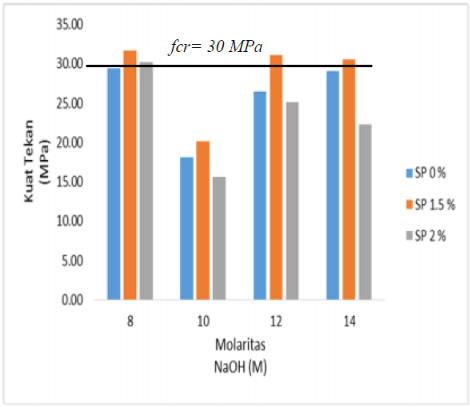
Figure 2. Comparison of 28-day geopolymer concrete compressive strength with the target design strength
The Right Dosage, Not Simply a Higher Dosage
Increasing the superplasticizer dosage beyond 1.5 percent did not provide a proportional benefit. At a dosage of 2 percent with an 8 M sodium hydroxide concentration, the concrete achieved a compressive strength of 30.21 MPa, slightly lower than at the 1.5 percent dosage. The study concluded that while superplasticizer is effective in reducing the water requirement of the mixture, it becomes less effective in further increasing strength once the optimum dosage has been exceeded (Herwani et al., 2018).
Effect of sodium hydroxide concentration
The concentration of the sodium hydroxide solution used to activate the fly ash also affected the results. Among the four concentrations tested (8, 10, 12, and 14 M), the 8 M concentration produced the most consistent results close to the target strength at 28 days. The largest deviation occurred at 10 M, which the study attributed to the formation of sodium crystallization or precipitates in the solution, interfering with the activation of the fly ash (Herwani et al., 2018).
What Does This Mean for Shotcrete Applications in Mining?
For mining operators considering geopolymer concrete as a shotcrete material, the two findings above provide relevant practical guidance:
- Without adjusting workability, the mixture tends to be too stiff. This may result in a porous layer when used as a ground support layer.
- Superplasticizer at the appropriate dosage, not simply a higher dosage, was shown to improve workability while maintaining or even slightly increasing compressive strength.
These findings indicate that the reliability of a geopolymer concrete mixture is not determined by a single material or parameter, but by the appropriate combination of admixture dosage and activator solution concentration. This combination needs to be tested and adjusted for each specific mixture rather than assumed to be the same for all applications.
Study Limitations to Keep in Mind
- The study measured workability (slump) and 28-day compressive strength of fly ash-based geopolymer concrete, using one type of superplasticizer (naphthalene-based).
- The study did not test shotcrete spraying in the field, so mixture performance when sprayed in a tunnel needs to be tested directly.
- The results apply to the combination of materials tested. Dosage and activator concentration need to be adjusted for each mixture.
Conclusion: Reliable, Not Just Strong on Paper
Determining whether a geopolymer concrete mixture is suitable for mine shotcrete requires more than looking at its compressive strength on paper. How easily the mixture can be handled and applied, as well as how accurately the admixture dosage is controlled, are equally important to ensure that the final layer is dense and free of voids.
These considerations form part of the approach used by APTEKINDO when evaluating shotcrete material mixtures, including adjusting admixture dosages such as superplasticizer, so that the resulting ground support layer is genuinely reliable, not merely strong on paper.
Considering a new shotcrete mixture for your mine? Discuss your material needs and site conditions with the APTEKINDO team.
Frequently Asked Questions (FAQ)
What is geopolymer concrete?
Geopolymer concrete is concrete that does not use Portland cement. In this study, it was made from fly ash activated with an alkaline solution such as sodium hydroxide.
What does superplasticizer do in geopolymer concrete?
Superplasticizer makes the mixture more fluid and easier to work with, and reduces the water requirement. In this study, the slump rose from 4–6.5 cm to 8–10 cm at a 1.5% dosage.
What is the optimum superplasticizer dosage?
In this study, the optimum dosage was 1.5% by weight of fly ash, giving a compressive strength of 31.63 MPa with 8 M sodium hydroxide. A 2% dosage gave 30.21 MPa, slightly lower.
Which sodium hydroxide concentration gave the most consistent results?
The 8 M concentration gave the most consistent results close to the target strength at 28 days. The largest deviation occurred at 10 M, which was linked to sodium crystallization or precipitates in the solution.
References
Herwani, Imran, I., Budiono, B., Pane, I., Zulkifli, E., & Elvira. (2018). Efektivitas superplasticizer terhadap workabilitas dan kuat tekan beton geopolimer [In Indonesian]. PORTAL Jurnal Teknik Sipil, 10(2), 12–18.
- Share