Pre-Excavation Grouting vs. Post-Excavation Grouting: What Are the Differences?
Introduction
Groundwater inflow, fractured rock masses, and unstable geological conditions can create significant challenges in underground mining and tunnelling operations. These conditions may affect excavation safety, ground stability, and operational efficiency.
One of the techniques used to address these challenges is injection grouting, a process in which grout is injected into soil, rock fractures, joints, or other voids to improve ground conditions and control water movement.
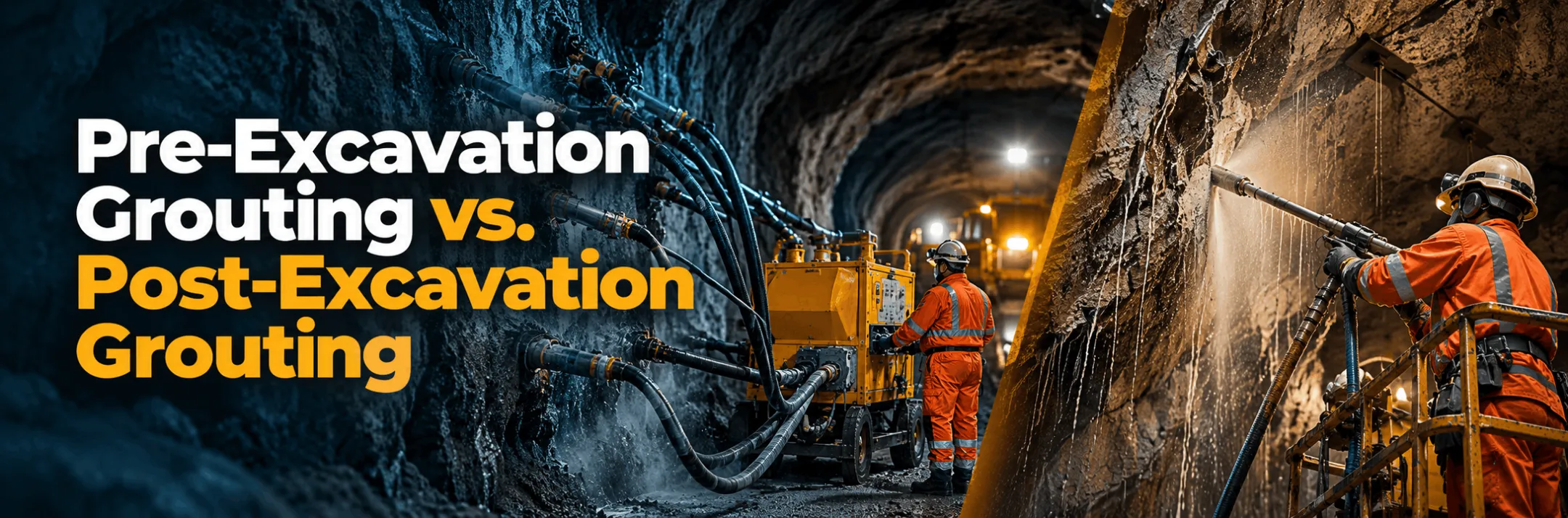
Depending on the project requirements and excavation sequence, grouting can be performed before or after excavation. These approaches are commonly referred to as pre-excavation grouting and post-excavation grouting.
Although both methods aim to improve ground conditions, they differ in their timing, application, and technical considerations. Understanding these differences helps mining and tunnelling teams determine the most appropriate grouting strategy for a specific project.
What Is Pre-Excavation Grouting?
Pre-excavation grouting is a ground treatment method performed before excavation reaches the target area. Grout is injected into the surrounding soil or rock mass to reduce permeability, seal fractures, and improve ground conditions ahead of excavation.
In underground mining and tunnelling, this method is particularly relevant when excavation is expected to encounter fractured rock, water-bearing discontinuities, or areas with potentially high groundwater pressure.
How Does Pre-Excavation Grouting Work?
The process generally involves the following steps:
- Geological assessment: The ground conditions, rock fractures, groundwater conditions, and anticipated excavation requirements are evaluated.
- Drilling: Grout holes are drilled from an accessible working area toward the target rock mass ahead of the excavation face.
- Grout injection: A suitable grout material is injected under controlled pressure to penetrate accessible fractures and discontinuities.
- Verification: Grouting performance is assessed using appropriate site-specific criteria, which may include water pressure testing, water inflow observations, or other verification methods.
- Excavation: Excavation proceeds after the required treatment objectives have been met and the area is considered ready for the next stage.
Key Benefits of Pre-Excavation Grouting
- Groundwater control: Helps reduce groundwater inflow by sealing suitable water-conducting fractures.
- Improved ground conditions: Can improve the condition of fractured rock masses, depending on the grout properties and geological characteristics.
- Risk reduction: Helps address anticipated water-related and ground-condition challenges before excavation reaches the treated zone.
- Excavation planning: Provides an opportunity to treat identified problem areas as part of the excavation sequence.
The effectiveness of pre-excavation grouting depends on factors such as fracture characteristics, grout penetration, groundwater pressure, injection parameters, and the quality of verification.
What Is Post-Excavation Grouting?
Post-excavation grouting is performed after excavation has exposed the target area or after a particular section of an underground structure has been excavated. The technique is used to treat identified fractures, voids, water-bearing pathways, or other ground conditions that require additional treatment.
In mining and tunnelling, post-excavation grouting may be applied when groundwater inflow, leakage pathways, or localised ground defects are identified during or after excavation.
How Does Post-Excavation Grouting Work?
The process typically involves the following steps:
- Condition assessment: The exposed excavation, surrounding rock mass, water inflow, and suspected leakage pathways are examined.
- Drilling and access preparation: Grout holes are positioned to reach the identified fractures, voids, or treatment zones.
- Grout injection: The selected grout is injected using suitable pressure and an appropriate injection sequence.
- Performance verification: The treated area is evaluated against the project’s acceptance criteria, such as reduced water inflow or improved sealing performance.
- Follow-up treatment: Additional injection may be required if the verification results indicate that the treatment objectives have not been achieved.
Key Benefits of Post-Excavation Grouting
- Targeted treatment: Allows grouting to focus on conditions identified during excavation.
- Responsive problem-solving: Can address specific leakage pathways or localised ground defects.
- Treatment flexibility: Injection locations and procedures can be adjusted based on observed site conditions.
- Supplementary ground treatment: Can complement earlier grouting or other ground-control measures when required.
However, the effectiveness of post-excavation grouting depends on accessibility, fracture connectivity, grout selection, injection parameters, and the condition of the surrounding ground.
Pre-Excavation Grouting vs. Post-Excavation Grouting: Key Differences
The primary difference between these methods is when the treatment is carried out in relation to excavation. This distinction influences how the target area is assessed, accessed, and treated.
| Comparison Factor | Pre-Excavation Grouting | Post-Excavation Grouting |
|---|---|---|
| Timing | Before excavation reaches the target zone | After the target area has been exposed or excavated |
| Primary objective | Treat anticipated ground or groundwater problems ahead of excavation | Treat identified fractures, voids, or leakage pathways |
| Basis for treatment | Geological investigations and anticipated ground conditions | Observed excavation conditions and identified problem areas |
| Access | Drilling and injection are carried out from an accessible area ahead of excavation | Drilling and injection are carried out from accessible excavated areas or other suitable access points |
| Main consideration | Predicting the target treatment zone and achieving adequate grout penetration | Reaching the identified defects and verifying the effectiveness of the treatment |
| Typical application | Anticipated water-bearing fractures or problematic rock masses | Localised groundwater inflow, leakage, or defects identified during or after excavation |
Neither method is universally superior. The appropriate choice depends on geological conditions, groundwater characteristics, project objectives, access constraints, and the excavation sequence.
When Should Each Method Be Used?
When to Use Pre-Excavation Grouting
Pre-excavation grouting may be considered when:
- Geological investigations indicate fractured or permeable rock ahead of excavation.
- Groundwater pressure or anticipated water inflow requires preventive treatment.
- The project requires groundwater control before excavation reaches a particular zone.
- Ground treatment can be integrated into the planned excavation sequence.
The design should account for the expected fracture network, groundwater conditions, grout properties, injection pressure, and verification requirements.
When to Use Post-Excavation Grouting
Post-excavation grouting may be considered when:
- Groundwater inflow or leakage pathways become apparent during excavation.
- Specific fractures or voids require localised treatment.
- Additional sealing is needed after an earlier grouting programme.
- The exposed ground provides useful information for defining the treatment area.
In practice, the observed conditions may differ from those predicted during the initial investigation. Post-excavation grouting can therefore provide a means of addressing defects that require additional treatment.
Factors to Consider When Selecting a Grouting Method
Selecting a suitable grouting approach requires more than deciding whether the work should take place before or after excavation. Several technical factors should be evaluated.
1. Geological conditions
Rock type, fracture aperture, fracture connectivity, permeability, and the presence of voids influence grout penetration and treatment effectiveness.
2. Groundwater conditions
Groundwater pressure, flow rate, and the location of water-conducting pathways affect grout selection, injection parameters, and the required treatment objectives.
3. Grout material
Cementitious grouts and other specialised grout formulations have different properties. The selection should reflect the ground conditions, required penetration, durability, and project specifications.
4. Injection pressure and sequence
Injection pressure must be controlled according to the ground conditions and engineering design. Excessive or unsuitable pressure may cause unintended ground disturbance or grout migration.
5. Quality control and verification
A grouting programme should establish clear performance criteria and appropriate verification procedures. Depending on the project, these may include water pressure testing, monitoring of groundwater inflow, grout take records, or other specified assessments.
6. Excavation and operational requirements
The treatment method should be coordinated with the excavation sequence, available equipment, access conditions, production schedule, and applicable safety requirements.
The Role of Injection Grouting in Mining Operations
Injection grouting can contribute to underground mining and tunnelling projects by addressing groundwater pathways, treating fractured rock, and improving selected ground conditions.
Pre-excavation grouting provides an opportunity to treat anticipated problem areas before excavation reaches them. Post-excavation grouting, meanwhile, allows treatment to respond to conditions identified during or after excavation.
For complex geological environments, both approaches may be used as complementary measures. The decision should be based on site investigations, engineering design, observed conditions, and verified treatment performance rather than a one-size-fits-all approach.
As a mining services provider, PT Anggun Permai Tekindo (APTEKINDO) supports mining operations through solutions related to grouting, injection systems, and ground stabilisation. The selection and implementation of an appropriate approach should always consider project-specific geological conditions, technical requirements, and operational objectives.
Conclusion
Pre-excavation grouting and post-excavation grouting serve related but distinct purposes in underground mining and tunnelling.
Pre-excavation grouting is performed before excavation reaches the target zone, allowing anticipated ground and groundwater problems to be addressed in advance. Post-excavation grouting is carried out after the target area has been exposed or excavated, enabling treatment to focus on conditions identified on site.
The most suitable method depends on geology, groundwater pressure, fracture characteristics, grout properties, access, and verification requirements. In some projects, combining both methods may provide a more appropriate strategy for managing changing ground conditions.
A well-designed grouting programme, supported by systematic quality control and performance verification, can help improve groundwater management and ground treatment outcomes in underground mining and tunnelling operations.
References
- U.S. Army Corps of Engineers. EM 1110-2-3506: Grouting Technology, Chapter 24: Tunnel Grouting. Available at: https://www.publications.usace.army.mil/portals/76/publications/engineermanuals/em_1110-2-3506.pdf
- Norwegian Tunnelling Society. Publication No. 20: Post-Excavation Grouting. Available at: https://tunnel.no/wp-content/uploads/sites/3/2020/04/Publication-20.pdf
- Hognestad, H., & Kieffer, S. (2019). “Pre-excavation grouting in rock tunneling – Dealing with high groundwater pressures.” Geomechanics and Tunnelling, 12(2), 141–146. https://doi.org/10.1002/geot.201800071
- Crouthamel, C. E., et al. (2005). Pre-Excavation Grouting Design Guidelines for Hard Rock Excavations. Society for Mining, Metallurgy & Exploration (SME). Available at: https://onetunnel.org/documents/pre-excavation-grouting-design-guidelines-for-hard-rock-excavations
- Share