Injection Grouting in Mining: Types, Functions, and Applications
Introduction
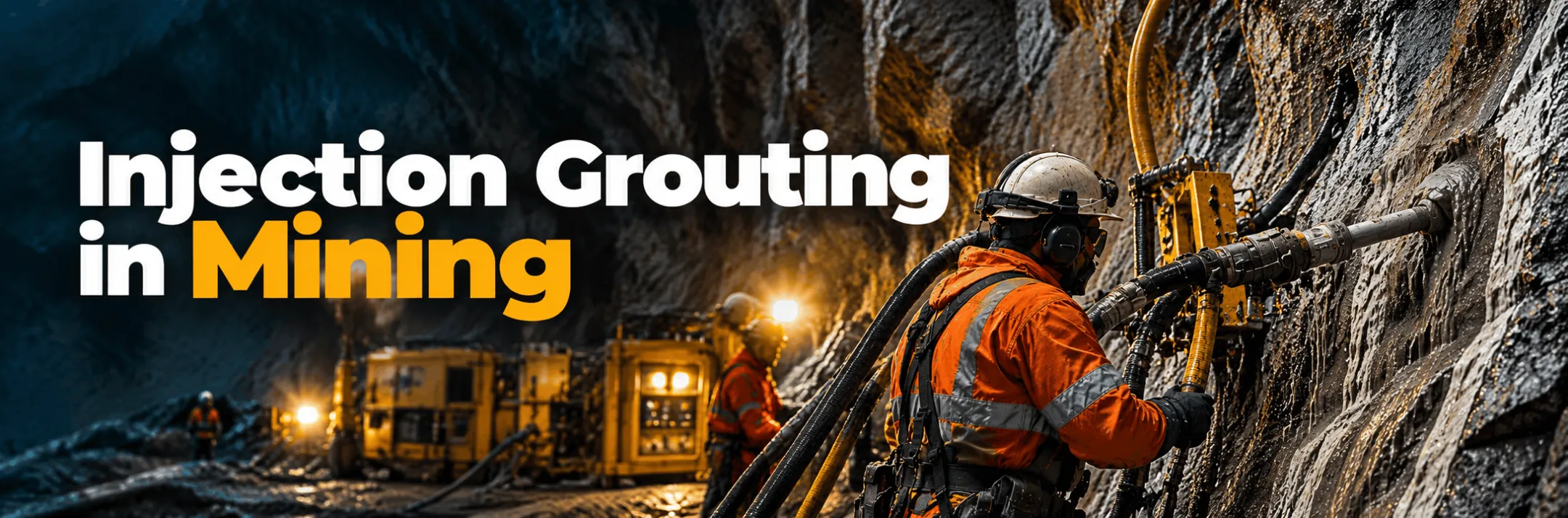
Injection grouting is a ground improvement and repair technique used in mining operations to improve ground stability, consolidate rock masses, control groundwater, and repair foundations or concrete structures. The process involves injecting grout materials into soil, rock fractures, voids, or structural cracks to improve their engineering performance and reduce potential risks.
In mining environments, where geological conditions can be complex and operational risks are significant, injection grouting plays an important role in supporting ground control, maintaining structural integrity, and improving operational safety. The effectiveness of this method depends on selecting the appropriate grout material, understanding subsurface conditions, and controlling the injection process.
What Is Injection Grouting in Mining?
Injection grouting is a technique in which grout is introduced under controlled pressure into targeted areas of soil, rock, or concrete. Depending on the application, grout may fill existing voids, penetrate fractures, reduce permeability, or improve the mechanical properties of the surrounding ground.
In mining operations, injection grouting may be applied to stabilize fractured rock masses, strengthen weak ground, reduce groundwater inflow, and rehabilitate damaged concrete foundations or structures.
The method is not limited to a single type of material or application. Grout selection and injection procedures must be adjusted to suit the geological conditions, engineering objectives, and operational requirements of each project.
Functions of Injection Grouting in Mining Operations
Injection grouting serves several purposes in mining and geotechnical engineering.
1. Ground Stabilization
Injection grouting can improve the stability of weak or fractured ground by filling voids and bonding loose or discontinuous materials where the grout can effectively penetrate. This helps improve ground integrity and may reduce the potential for localized ground movement.
Depending on site conditions, grouting can be used as part of a broader ground stabilization strategy for underground excavations, mine infrastructure, and other areas requiring additional ground support.
2. Rock Mass Consolidation
Fractured rock may contain discontinuities that affect its strength, deformation behavior, and overall stability. Grouting can penetrate suitable fractures and fill selected voids, helping improve the integrity of the rock mass.
The results depend on factors such as fracture aperture, connectivity, grout viscosity, injection pressure, and the characteristics of the rock. Grouting should therefore be designed based on a proper assessment of the rock mass rather than applied as a universal solution.
3. Groundwater Control
Groundwater inflow can affect mining operations by increasing excavation difficulties, creating water management challenges, and potentially affecting ground stability.
Injection grouting can help reduce water movement by sealing selected fractures, joints, and permeable pathways. The appropriate grout type depends on the flow conditions, size of the openings, water pressure, and required durability.
Grouting is generally part of a wider groundwater management strategy that may also include drainage, pumping, and monitoring systems.
4. Foundation and Concrete Structure Repair
Mining facilities rely on foundations and concrete structures to support equipment, machinery, and other critical infrastructure. Cracks, voids, or deterioration can affect their performance and service life.
Injection techniques can be used to repair certain concrete cracks, fill selected voids, or address leakage pathways. For example, epoxy injection may be suitable for certain cracks where structural bonding is required, while polyurethane resin may be appropriate for specific water-leakage conditions.
The repair method must be selected according to the crack characteristics, moisture conditions, structural requirements, and the underlying cause of the damage.
Types of Injection Grouting Used in Mining
Different grouting materials are used depending on the purpose of the treatment and the conditions of the ground or structure.
1. Cementitious Grouting
Cementitious grouting uses cement-based materials, sometimes combined with other additives, to fill voids and suitable fractures in soil or rock.
Common applications include:
Rock mass consolidation.
Filling selected voids and cavities.
Foundation grouting.
Improving ground integrity in suitable geological conditions.
The grout formulation must be selected according to the required flow characteristics, strength development, permeability, and ground conditions. Particle size and grout stability are also important because they influence how effectively the material can penetrate the targeted openings.
2. Chemical Grouting
Chemical grouting uses specially formulated chemical materials to modify ground properties or seal selected permeable pathways. Depending on the material, chemical grout may be useful where conventional cement-based grout cannot adequately penetrate smaller openings.
Applications may include groundwater control, permeability reduction, and treatment of selected soil or rock conditions.
Material selection requires careful consideration of groundwater chemistry, curing behavior, durability, environmental requirements, and compatibility with the surrounding ground.
3. Resin Injection
Resin injection uses polymer-based materials to address specific repair or sealing requirements.
Two examples are:
Epoxy injection: Commonly used for certain concrete cracks where bonding and restoration of continuity are required.
Polyurethane resin injection: Used in suitable applications to seal water-leakage pathways or fill selected voids, depending on the resin formulation and site conditions.
These materials are not interchangeable. Their suitability depends on the condition being treated, the presence of water, the required mechanical performance, and the intended service life.
Pre-Excavation and Post-Excavation Grouting
Injection grouting can be performed at different stages of a mining project.
Pre-excavation grouting is carried out before excavation reaches the target area. It may be used to reduce groundwater inflow, improve ground conditions, or treat selected fractures ahead of excavation. This approach can help manage anticipated geological or hydrogeological challenges.
Post-excavation grouting is performed after excavation or construction has exposed the area requiring treatment. It may be used to address water leakage, fill accessible voids, consolidate selected ground zones, or repair concrete structures.
The choice between these approaches depends on the project design, geological conditions, groundwater behavior, accessibility, and operational requirements.
Factors Affecting Injection Grouting Performance
The effectiveness of injection grouting depends on several technical factors.
1. Geological and Ground Conditions
Soil type, rock strength, fracture distribution, void geometry, and permeability influence grout penetration and treatment effectiveness. A site investigation helps identify the conditions that must be addressed.
2. Grout Material Selection
The grout must match the intended function. Factors such as viscosity, particle size, setting time, strength development, durability, and compatibility with groundwater can affect performance.
3. Injection Pressure and Sequence
Injection pressure must be controlled according to the ground conditions and engineering objectives. Excessive pressure may cause unintended ground movement, hydraulic fracturing, or grout migration into areas outside the treatment zone.
The injection sequence and pressure limits should therefore be established through appropriate design and adjusted based on field observations.
4. Quality Control and Monitoring
Grouting quality control may include monitoring injection pressure, grout volume, flow rate, and refusal criteria, as appropriate to the method. Records should be reviewed against the design requirements to assess whether the intended treatment has been achieved.
Where necessary, verification may involve additional testing, inspection, or monitoring of groundwater and ground behavior.
The Role of Injection Grouting in Mining Safety and Operational Reliability
Injection grouting can contribute to safer and more reliable mining operations by addressing selected ground stability, groundwater, and structural repair challenges. However, it should not be considered a standalone solution for every geotechnical problem.
The grouting design must be based on site-specific conditions and integrated with other engineering controls where necessary, such as rock bolts, shotcrete, drainage systems, monitoring instruments, or other ground support measures.
At PT Anggun Permai Tekindo (APTEKINDO), injection and grouting solutions form part of an integrated approach to mining and geotechnical challenges. Appropriate material selection, application procedures, and quality control are essential to support the performance and reliability of grouting works.
Conclusion
Injection grouting is an important technique in mining and geotechnical engineering, with applications ranging from ground stabilization and rock mass consolidation to groundwater control and concrete structure repair.
Cementitious grouting, chemical grouting, and resin injection each serve different purposes and must be selected according to the conditions and objectives of the project. Successful implementation requires a clear understanding of the ground, appropriate grout selection, controlled injection procedures, and systematic quality assurance.
When designed and executed appropriately, injection grouting can complement other ground support and engineering measures to help improve ground integrity, protect infrastructure, and support safer, more reliable mining operations.
References
1. U.S. Army Corps of Engineers (USACE). (2017). Grouting Technology. Engineer Manual EM 1110-2-3506. Department of the Army. https://www.publications.usace.army.mil/Portals/76/Publications/EngineerManuals/EM_1110-2-3506.pdf
2. Federal Highway Administration (FHWA). (2017). Geotechnical Engineering Circular No. 13: Ground Modification Methods Reference Manual, Volume I. U.S. Department of Transportation. https://www.fhwa.dot.gov/engineering/geotech/improvement/
3. Federal Highway Administration (FHWA). (2017). Geotechnical Engineering Circular No. 13: Ground Modification Methods Reference Manual, Volume II. U.S. Department of Transportation. https://www.fhwa.dot.gov/engineering/geotech/improvement/
4. American Concrete Institute (ACI). Structural Crack Repair by Epoxy Injection (Repair Application Procedure 1). ACI University. https://aciuniversity.concrete.org/Listing/Certificate-Program-Repair-Application-Procedures-1988
5. Federal Highway Administration (FHWA). (2007). Geotechnical Technical Guidance Manual. U.S. Department of Transportation. https://highways.dot.gov/federal-lands/pddm/geotechnical-tgm.pdf
Editorial note: Some references address general geotechnical engineering and concrete repair rather than mining-specific applications. They provide technical background for the principles discussed in this article.
- Share