Ground Stabilization in Mining: Methods, Applications, and Importance
Introduction
Ground stability is one of the most critical factors in ensuring safe and efficient mining operations. Whether in underground mining or surface mining, unstable ground conditions can create significant challenges, including rock falls, ground deformation, slope failures, and water infiltration.
As mining activities extend deeper underground and into increasingly complex geological environments, maintaining ground stability becomes more challenging. Weak rock formations, fractured ground, geological discontinuities, and groundwater pressure can all affect the structural integrity of mining excavations.
This is where ground stabilization plays an essential role. Through appropriate engineering methods and material applications, ground stabilization helps improve the strength and integrity of soil and rock masses, reduce potential ground movement, and support safer mining operations.
Understanding the available stabilization methods and their applications is therefore important for managing geotechnical risks throughout the mining lifecycle.
What Is Ground Stabilization in Mining?
Ground stabilization refers to a range of engineering techniques used to improve the mechanical properties and structural integrity of soil and rock formations.
In mining environments, these techniques are applied to strengthen weak ground, reduce deformation, control water infiltration, and improve the stability of excavated areas.
Ground stabilization is particularly important in areas where geological conditions may compromise excavation safety, such as:
- Fractured or highly weathered rock formations.
- Weak geological structures and fault zones.
- Loose or unconsolidated ground.
- Areas exposed to groundwater infiltration.
- Underground excavations with potentially unstable rock masses.
By improving ground conditions before, during, or after excavation, stabilization techniques help create a more controlled environment for mining activities.
Why Is Ground Stabilization Important in Mining?
Ground instability can affect both worker safety and mining productivity. Without appropriate ground control measures, unstable formations may lead to operational interruptions, equipment damage, and potentially serious safety incidents.
Ground stabilization provides several important benefits.
1. Improving Ground and Rock Mass Stability
One of the primary objectives of ground stabilization is to strengthen weak or fractured geological formations.
Engineering techniques such as injection grouting can fill voids and fractures within the ground, helping improve cohesion and reduce the movement of loose materials.
2. Reducing the Risk of Ground Failure
Unstable ground conditions can contribute to rock falls, localized collapses, and other forms of ground failure.
Appropriate stabilization measures help address identified weaknesses and reduce the likelihood of instability when combined with proper geotechnical assessment and ground support design.
3. Controlling Groundwater Infiltration
Groundwater can enter underground excavations through fractures, joints, and permeable geological formations.
Water infiltration may weaken certain ground conditions and create additional challenges for excavation and underground infrastructure.
Ground stabilization techniques, particularly specialized grouting applications, can help reduce water pathways and improve groundwater control.
4. Supporting Operational Efficiency
Ground instability can cause unexpected delays, additional rehabilitation work, and increased maintenance requirements.
By addressing ground conditions proactively, mining operators can improve excavation reliability and reduce disruptions associated with geotechnical problems.
Common Ground Stabilization Methods Used in Mining
Different geological conditions require different stabilization approaches. The selection of an appropriate method depends on factors such as rock mass characteristics, groundwater conditions, excavation geometry, and engineering requirements.
The following are some commonly applied ground stabilization methods in mining.
1. Injection Grouting
Injection grouting involves introducing specialized grout materials into soil, rock fractures, joints, or voids under controlled pressure.
The grout penetrates accessible openings and hardens or reacts to improve ground conditions, depending on the material and application.
Common grouting materials include:
- Cement-based grout.
- Microfine cement grout.
- Chemical grout.
- Specialized resin-based grout.
Injection grouting is commonly used for ground consolidation, void filling, and groundwater control.
It can be applied before excavation to improve existing ground conditions or after excavation to address identified weaknesses and water infiltration.
2. Cement Grouting
Cement grouting uses cement-based materials to fill fractures, voids, and interconnected openings within geological formations.
Once the grout sets, it can help improve the integrity of the treated ground and reduce water flow through accessible pathways.
This method is particularly relevant for fractured rock masses and underground mining environments where ground consolidation and water control are required.
The selection of cement type, water-to-cement ratio, grout consistency, and injection pressure must be determined according to site-specific conditions.
3. Soil Nailing
Soil nailing is a ground reinforcement technique that involves installing steel bars or nails into existing soil or weathered ground.
These reinforcement elements work together with the surrounding ground to improve stability and resist potential movement.
In mining applications, soil nailing can be used in selected slope stabilization projects, particularly where existing ground conditions and engineering assessments support its application.
Shotcrete or other facing systems may also be installed to provide surface protection and help control localized erosion or material loss.
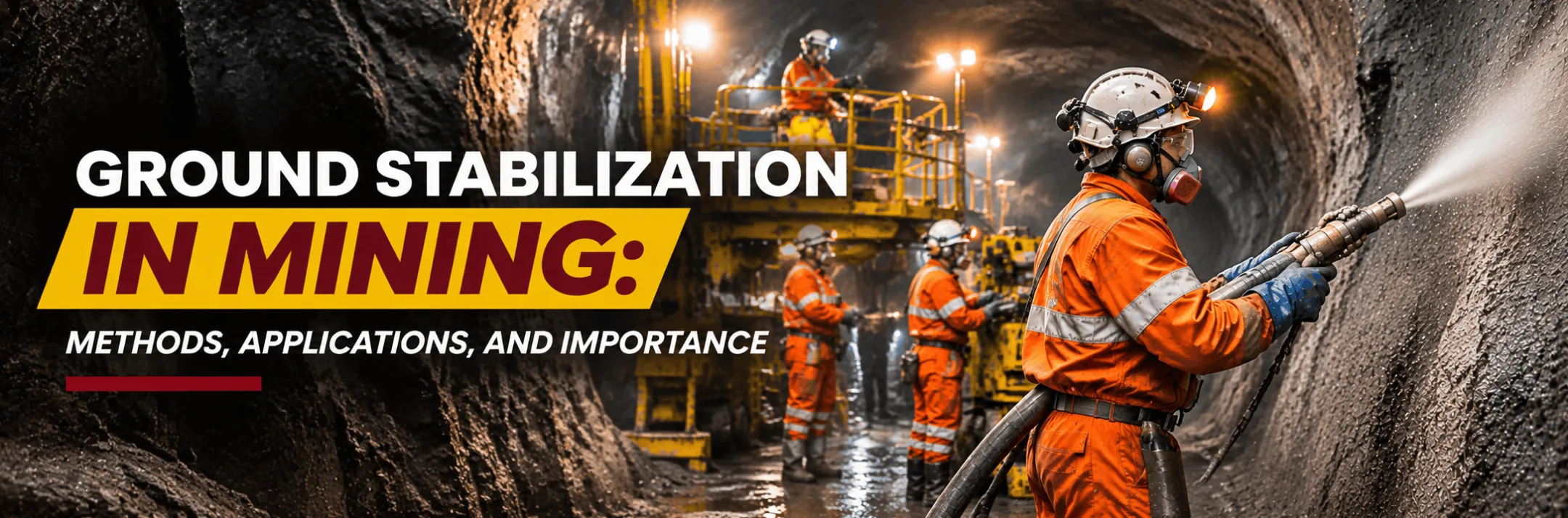
4. Shotcrete Application
Shotcrete is a concrete material pneumatically projected onto a prepared surface through a spraying system.
In underground mining, shotcrete is widely used as part of a ground support system to provide surface reinforcement and help retain loose or fractured rock.
It can also be combined with other reinforcement elements, such as rock bolts, mesh, and steel fibers, depending on the ground support design.
Although shotcrete primarily provides surface support rather than deep ground consolidation, it plays an important complementary role in maintaining excavation stability.
5. Rock Bolting
Rock bolting is a reinforcement method that involves installing steel bolts into rock formations to improve their structural behavior.
Rock bolts help reinforce the surrounding rock mass by providing support across discontinuities and potentially unstable zones.
They are commonly used in underground mine development, tunnels, and other excavations where rock mass reinforcement is required.
Factors to Consider When Selecting a Ground Stabilization Method
Selecting the appropriate stabilization method requires a thorough understanding of site-specific geological and operational conditions.
Several important factors should be considered:
Geological Conditions: Rock type, fracture distribution, weathering, discontinuities, and soil characteristics influence the suitability of each stabilization technique.
Groundwater Conditions: Water pressure, seepage pathways, and groundwater flow must be evaluated, particularly when selecting grouting materials and injection methods.
Excavation Requirements: The depth, geometry, size, and intended function of an excavation influence the required stabilization approach.
Material Performance: Grout properties, setting time, penetration capability, strength development, and compatibility with ground conditions should be considered.
Engineering Assessment: Geotechnical investigations, monitoring data, and engineering design are essential to determine the appropriate stabilization method and verify its performance.
In many mining projects, a combination of stabilization and ground support techniques provides a more comprehensive solution than relying on a single method.
The Role of Ground Stabilization in Modern Mining
As mining operations become more complex, ground stabilization continues to play an increasingly important role in geotechnical risk management.
Advancements in grouting materials, injection equipment, and application techniques provide mining operators with more options for addressing challenging ground conditions.
However, successful ground stabilization does not depend solely on the materials or equipment used. It requires an integrated approach involving geological investigation, engineering design, appropriate application methods, and performance monitoring.
When implemented correctly, ground stabilization can contribute to safer underground excavations, improved ground conditions, and more reliable mining operations.
Conclusion
Ground stabilization is an essential component of modern mining engineering. From injection grouting and cement grouting to soil nailing, shotcrete, and rock bolting, each method serves a specific purpose in managing ground instability.
The right approach depends on geological conditions, groundwater characteristics, excavation requirements, and engineering assessments.
For mining operators, understanding these methods is an important step toward managing geotechnical risks and maintaining safe, efficient, and sustainable mining operations.
At PT Anggun Permai Tekindo (APTEKINDO), ground stabilization and specialized mining solutions are part of the technical capabilities supporting the evolving needs of the mining industry.
References
1. U.S. Army Corps of Engineers. (2017). Engineering and Design: Grouting Technology (EM 1110-2-3506). Department of the Army.
Access publication (PDF).
2. Federal Highway Administration. (2015). Geotechnical Engineering Circular No. 7: Soil Nail Walls – Reference Manual (FHWA-NHI-14-007). U.S. Department of Transportation.
Access publication (PDF).
3. Federal Highway Administration. (2017). Geotechnical Engineering Circular No. 13: Ground Modification Methods Reference Manual, Volumes I & II. U.S. Department of Transportation.
Access publication.
4. European Federation of National Associations Representing for Concrete (EFNARC). (1999). Guidelines for the Specification and Execution of Sprayed Concrete.
Access EFNARC publications.
5. Esterhuizen, G. S., Dolinar, D. R., Ellenberger, J. L., & Prosser, L. J. (2011). Pillar and Roof Span Design Guidelines for Underground Stone Mines. NIOSH Publication No. 2011-171.
Access publication.
6. National Institute for Occupational Safety and Health (NIOSH). (n.d.). Ground Control Overview. Centers for Disease Control and Prevention.
Access reference.
7. McCormick, J. A., & Panek, L. A. (1973). Roof/Rock Bolting. SME Mining Engineering Handbook.
Access publication.
- Share