

Don't overlook soil improvement, even if the ground appears stable
A haul road that begins to develop surface undulations is often immediately assumed to require additional material or pavement repairs. While these measures may temporarily restore the road's condition, they do not always address the root cause. In many mining operations, the damage actually originates from the subgrade, which deforms after being subjected to thousands of loading cycles from haul trucks every day. As long as the soil continues to deform, the pavement layers above it will deteriorate again, even after repeated repairs.
The same phenomenon can also be observed in ROM pads, workshops, crushers, and waste dump areas. These infrastructures are designed to withstand both static and dynamic loads over long periods.
When the soil characteristics cannot adequately support these functions, issues such as differential settlement, surface deformation, and increasing maintenance requirements become difficult to avoid. In other words, the primary challenge lies not in the structures built above the ground, but in how the soil responds to loading throughout the operational life of the mine.
Soil Improvement Is Not Intended to Simply Make Soil Harder
Many people view soil improvement as an effort to increase soil strength. In reality, the purpose of these works is far more specific than merely making the ground harder. Engineers select improvement methods to modify soil behavior according to the requirements of the infrastructure being constructed.
In one project, the primary objective may be to increase bearing capacity so the ground can support an embankment. In another, the more important goal may be to reduce deformation, control settlement, or improve the soil's response to repeated loading.
These differing objectives explain why no single method can be applied to all mining projects. Roshan et al. (2022) explain that each soil improvement technique has been developed to address different failure mechanisms. Therefore, the success of a project is determined not by how advanced the method is, but by how effectively it addresses the specific soil behavior that needs to be improved.
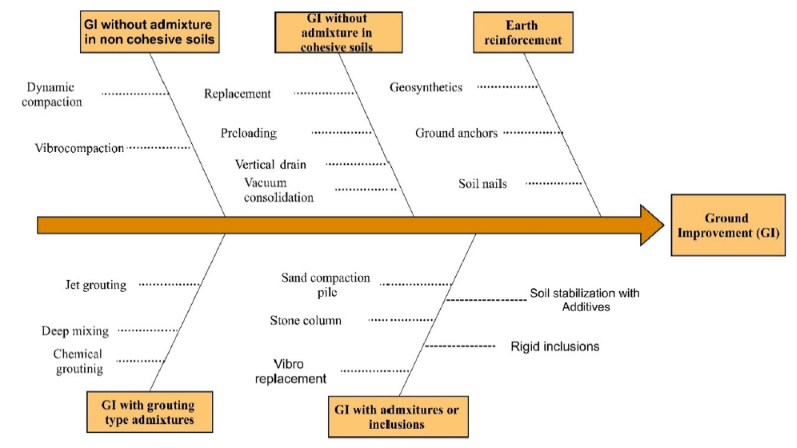
Ground Improvement Classification
Engineers Do Not Choose Methods—They Diagnose Problems
When an area experiences settlement, an engineer's first decision is not whether to use cement stabilization, geogrids, or deep soil mixing. The first question that must be answered is why the soil is settling.
Is it caused by low bearing capacity, ongoing consolidation, high moisture content, or a combination of several factors? The answer to this question determines the most effective method and prevents the use of solutions that are unsuitable for field conditions.
With this approach, soil improvement resembles a diagnostic process more than a construction activity. Every decision begins with understanding the soil failure mechanism and then selecting a method capable of modifying soil behavior to achieve the engineering objectives. This approach not only improves the effectiveness of the treatment but also reduces the risk of rework, which is often a major source of project cost overruns.
Why a Method That Works at One Mine May Not Work at Another
In practice, engineers rarely select soil improvement methods based solely on previous project experience. Two mine sites located only a few kilometers apart may have different geological characteristics, soil types, and groundwater conditions. These differences cause the soil to respond differently to loading, meaning that a method that is effective at one location may not produce the same results elsewhere.
For example, soft clay with high moisture content generally experiences settlement due to consolidation. Under such conditions, accelerating consolidation or implementing stabilization techniques may be more effective than increasing pavement thickness.
Conversely, granular soils that lose strength due to load distribution issues may benefit more from geosynthetics that improve the interaction between soil layers and pavement materials. The difference lies not in the quality of the method itself, but in the failure mechanism that needs to be controlled.
Roshan et al. (2022) explain that soil improvement methods can be classified according to their objectives, such as increasing shear strength, reducing compressibility, improving drainage systems, or reinforcing soil structure.
This classification helps engineers evaluate the most suitable methods based on site characteristics, ensuring that decisions are based not only on cost or ease of construction.
Investigation Data Determines the Quality of Decisions
The selection of a soil improvement method cannot be based solely on visual observations in the field. Soil that appears dry and dense at the surface may have completely different characteristics several meters below ground. Therefore, geotechnical investigations are an inseparable part of the planning process.
Information such as soil type, Standard Penetration Test (SPT) values, California Bearing Ratio (CBR), shear strength, moisture content, and groundwater levels provides insight into how the soil will behave under loading. These data are then used to identify the most likely failure mechanisms.
For example, low shear strength values indicate the need for stability improvement, while compressibility test results may reveal the potential for long-term settlement that must be controlled before construction begins.
Interestingly, engineers do not seek to collect as much data as possible; rather, they seek to collect data that are relevant to answering design questions. If the project involves constructing a haul road, the investigation must explain how the subgrade will respond to repeated loading from haul trucks.
If the project involves building a waste dump, the focus shifts to the soil's ability to support embankment loads over the long term.In other words, the quality of an investigation is determined not by the quantity of data collected, but by the extent to which the data support engineering decision-making.
The Best Decisions Are Made Before Remedial Work Becomes Necessary
In mining projects, the success of soil improvement is not measured by how many areas have been repaired, but by how effectively the chosen method reduces risks throughout the life of the infrastructure.
When soil improvement is planned based on adequate investigations and sound geotechnical analyses, problems such as haul road deformation, ROM pad settlement, and subgrade instability can be anticipated before they disrupt production activities. This approach provides far greater benefits than implementing corrective measures after infrastructure has already deteriorated.
In addition to improving infrastructure reliability, soil improvement also provides greater flexibility for mine development. As mining areas expand, the need for new haul roads, supporting facilities, and waste disposal areas continues to evolve.
If soil characteristics are understood from the outset, engineers can evaluate various design alternatives and select the most appropriate improvement method for each location. Consequently, engineering decisions consider not only initial construction costs but also maintenance costs, infrastructure service life, and the long-term sustainability of mining operations.
This approach forms the foundation of APTEKINDO's geotechnical work. Every soil improvement recommendation begins with understanding soil characteristics, identifying potential failure mechanisms, and considering the operational requirements of the project.
Investigation results are then translated into engineering solutions tailored to field conditions, ensuring that the selected methods are not only technically effective but also practical for implementation in mining environments.
Ultimately, the success of soil improvement is not determined by the most modern methods or the most sophisticated technologies. It is determined by the engineer's ability to understand how the soil will behave once mining operations begin. The better this behavior can be predicted, the lower the likelihood of infrastructure disruptions that could affect safety, productivity, and operational costs.
References
Roshan, M. J., et al. (2022). Improved Methods to Prevent Railway Embankment Failure and Subgrade Degradation: A Review. Transportation Geotechnics, 37, 100834.
- Share