

Geotechnical Projects and Their Impact on Mining Operational Safety
The success of a mining operation is often measured by production output, equipment utilization efficiency, or the company's ability to meet sales targets. However, a fundamental factor determines whether all these activities can be carried out safely and sustainably: the geotechnical conditions of the mining area.
In both open-pit and underground mining, soil and rock mass conditions influence nearly every operational aspect. Slope stability, underground opening safety, supporting infrastructure development, and production continuity all depend on a thorough understanding of local geological and geotechnical characteristics. For this reason, a Geotechnical Project should not be viewed merely as an investigation or technical analysis activity. Its role extends far beyond that, serving as a foundation for decision-making that directly affects safety, productivity, and the long-term sustainability of mining operations.
As mining activities become increasingly complex and workplace safety requirements continue to rise, mining companies are expected to manage geotechnical risks more proactively. This approach begins with careful planning through the implementation of comprehensive, data-driven Geotechnical Projects.
Understanding Site Conditions Before Risks Emerge
In modern mining practice, technical decisions can no longer rely solely on field experience or general assumptions regarding rock conditions. Every mining area possesses unique geological characteristics and therefore requires a site-specific evaluation before operational activities commence.
Through a Geotechnical Project, companies obtain critical information regarding the physical and mechanical properties of soil and rock materials, which serve as the basis for mine design development. These data are used to determine slope geometry, underground excavation dimensions, support system requirements, disposal area design, and other supporting infrastructure needs.
Decisions made using accurate geotechnical data can significantly reduce uncertainties throughout the operational life of a mine. Conversely, inadequate understanding of subsurface conditions often becomes a major source of safety concerns and productivity losses.
According to Firoozi et al. (2025), modern geotechnical engineering is no longer focused solely on structural stability. It now encompasses infrastructure resilience, resource efficiency, and long-term risk management. This evolution demonstrates that geotechnical engineering has become an integral component of comprehensive project management strategies.
Within the mining industry, these benefits are reflected in a company's ability to anticipate potential geotechnical failures before they escalate into major operational disruptions. In other words, investment in a Geotechnical Project often delivers far greater value than the costs associated with addressing the consequences of failure.
Why Rock Mass Stability Should Never Be Overlooked
Workplace safety remains the highest priority in the mining industry. Although numerous operational procedures and safety standards are implemented, geotechnical hazards continue to represent one of the most significant threats to personnel and equipment.
Rock mass instability can lead to a variety of incidents, including slope failures, rock falls, tunnel deformation, and ground collapses in working areas. Such events not only result in material losses but can also pose serious risks to human life.
Therefore, one of the primary objectives of a Geotechnical Project is to identify potential hazards at an early stage so that mitigation measures can be planned before risks develop into failures. This process includes field investigations, geological mapping, laboratory testing, stability analysis, and the implementation of monitoring systems to track changes in rock mass conditions throughout mining operations.
This preventive approach is increasingly important because geotechnical conditions are inherently dynamic. Excavation activities, blasting operations, and changes in mine geometry can alter stress distributions within the rock mass. Without adequate monitoring, these changes may evolve into hazardous conditions.
As a result, mining safety depends not only on how work is performed but also on how well a company understands the behavior of the soil and rock that form its working environment.
When Rock Conditions Begin to Disrupt Production
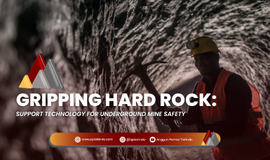
The importance of geotechnical engineering in maintaining both safety and productivity is clearly illustrated in a study conducted by Nugroho et al. (2019) at the Pongkor Gold Mine. The research examined rock masses characterized by very weak rock strength and a high degree of alteration, which resulted in a squeezing failure phenomenon.
This phenomenon occurs when a rock mass gradually deforms due to stress concentrations surrounding underground mine openings. If not properly managed, it can lead to support system damage, reduced excavation dimensions, and significant disruptions to production activities.
In the case studied, ongoing deformation required repeated reinforcement of the support system. However, additional support alone was insufficient to address the root cause of the problem. The geotechnical team subsequently applied the Convergent Confinement Method (CCM) to better understand the relationship between rock mass deformation and the capacity of the installed support system (Nugroho et al., 2019).
The analysis demonstrated that an optimized support design could improve the factor of safety and reduce the likelihood of recurring deformation. The study also highlighted the importance of installing support systems in-cycle, immediately after excavation activities are completed. This approach helps prevent deformation from progressing into more severe geotechnical failures.
The case provides an important lesson: geotechnical challenges cannot always be solved by simply adding more materials or increasing support capacity. A thorough understanding of rock mass behavior and deformation mechanisms is often the determining factor in achieving successful field solutions.
The Strategic Value of Geotechnical Projects
Beyond supporting safety and productivity, Geotechnical Projects also play a critical role in achieving more sustainable mining operations. Today, mining companies are expected not only to maximize production but also to manage environmental impacts and resource utilization responsibly.
Firoozi et al. (2025) explain that modern geotechnical practices increasingly adopt approaches that simultaneously consider technical, economic, and environmental factors. This integrated perspective supports decision-making that is not only technically sound but also efficient in terms of material and energy consumption.
In mining operations, these principles can be applied through slope optimization, improved disposal area management, reduced corrective work resulting from geotechnical failures, and the use of monitoring systems to detect potential issues at an early stage.
A life-cycle approach also helps companies recognize that sound geotechnical decisions generate benefits beyond immediate operational needs. They can reduce maintenance costs, minimize operational risks, and lower environmental impacts over the long term.
As sustainability continues to become a key industry priority, geotechnical engineering has emerged as a vital element in strengthening the long-term resilience of mining operations.
Geotechnical Projects: More Than Technical Studies, an Operational Investment
As the mining industry continues to evolve and grow in complexity, the ability to manage geotechnical risks effectively has become a key differentiator between resilient operations and those vulnerable to disruption. Slope stability, underground excavation safety, and infrastructure reliability are all closely linked to the quality of geotechnical analysis and planning conducted from the earliest stages of a project.
The study by Nugroho et al. (2019) demonstrates that appropriate geotechnical approaches can successfully address challenges associated with extremely weak rock conditions that have the potential to hinder production. Meanwhile, Firoozi et al. (2025) emphasize that modern geotechnical engineering contributes far beyond structural stability, supporting infrastructure resilience, long-term risk management, and project sustainability.
For the mining industry, operational success is determined not only by the quality of mineral reserves or production capabilities. The ability to understand and manage soil and rock mass behavior is equally important. Therefore, a Geotechnical Project should be regarded as a strategic investment that supports workplace safety, enhances productivity, and ensures mining operations can proceed according to plan.
References
Firoozi AA, Firoozi AA, Maghami MR. 2025. Sustainable Practices in Geotechnical Engineering: Forging Pathways for Resilient Infrastructure. Results in Engineering. 26:105577.
Nugroho BW, Suparjono, Pratama R. 2019. Rekayasa Geoteknik untuk Penanganan Squeezing Failure dan Penembusan Area Ambrukan. Proceedings of TPT XXVIII PERHAPI. pp. 561–572.
- Share