

What Is Slope Protection in Mining Operations?
In mining operations, a slope is more than simply part of the terrain that needs to be excavated or accessed. It is an important part of mine infrastructure that can directly affect the safety of workers, equipment, access routes, and operational continuity.
In open-pit mining, for example, continuous excavation changes slope geometry and the stress conditions within soil and rock masses. Geological conditions, groundwater, rock structures, slope design, blasting activities, and changing site conditions can all influence slope stability.
This is why Slope Protection is an important aspect of managing slope conditions.
However, slope protection does not simply mean “covering” a slope.
In practice, slope protection is part of a broader geotechnical and ground control approach designed to help manage risks associated with soil or rock movement, erosion, rockfall, and deterioration of slope surface conditions.
Geotechnical guidelines for open-pit mining emphasize the importance of geotechnical engineering, monitoring, and appropriate ground support and reinforcement based on actual mine conditions.
Why Is Slope Protection Important in Mining?
Slope failure can have significant consequences for mining operations.
Ground or rock movement can affect:
- mine access roads,
- working areas,
- equipment,
- infrastructure,
- production activities,
- and worker safety.
Pit wall failures can occur in both single-bench and multi-bench walls. Contributing factors may include unfavorable geological conditions, aggressive slope design, inadequate surface and groundwater management, and ineffective monitoring.
Therefore, slope management should not only be carried out when signs of failure appear.
A more effective approach is to understand geotechnical conditions from the design stage, determine appropriate controls, and continuously monitor and evaluate actual site conditions.
Slope Protection vs. Slope Stabilization
Two terms that frequently appear in slope-related work are Slope Protection and Slope Stabilization.
The two are closely related, but they do not always mean the same thing.
Slope Protection is a broader concept that may include measures designed to protect the slope surface or control factors that could contribute to deterioration.
Examples include:
- erosion control,
- surface protection,
- drainage,
- mesh,
- Shotcrete,
- vegetation reinforcement.
Meanwhile, Slope Stabilization is more closely associated with measures intended to improve or maintain slope stability through reinforcement or specific geotechnical methods.
One example is Soil Nailing.
In practice, both approaches can be applied together as part of a system designed according to actual site conditions.
What Are the Common Slope Protection Methods?
There is no single method that is automatically suitable for every slope.
The selection of a slope protection method should consider soil and rock conditions, slope geometry, groundwater, erosion levels, loading conditions, environmental factors, and operational requirements.
Some commonly applied methods include:
1. Soil Nailing
Soil Nailing is a reinforcement method that uses nails installed into the soil mass to help improve the stability of the slope system.
Soil Nailing can be used as part of a slope stabilization system when the ground conditions and geotechnical design support its application.
In mining environments, Soil Nailing may be combined with other systems such as mesh, Shotcrete, drainage, or erosion control.
However, Soil Nailing is not a universal solution. Its design and application must be adapted to the characteristics of the ground and the requirements of the project.
2. Shotcrete
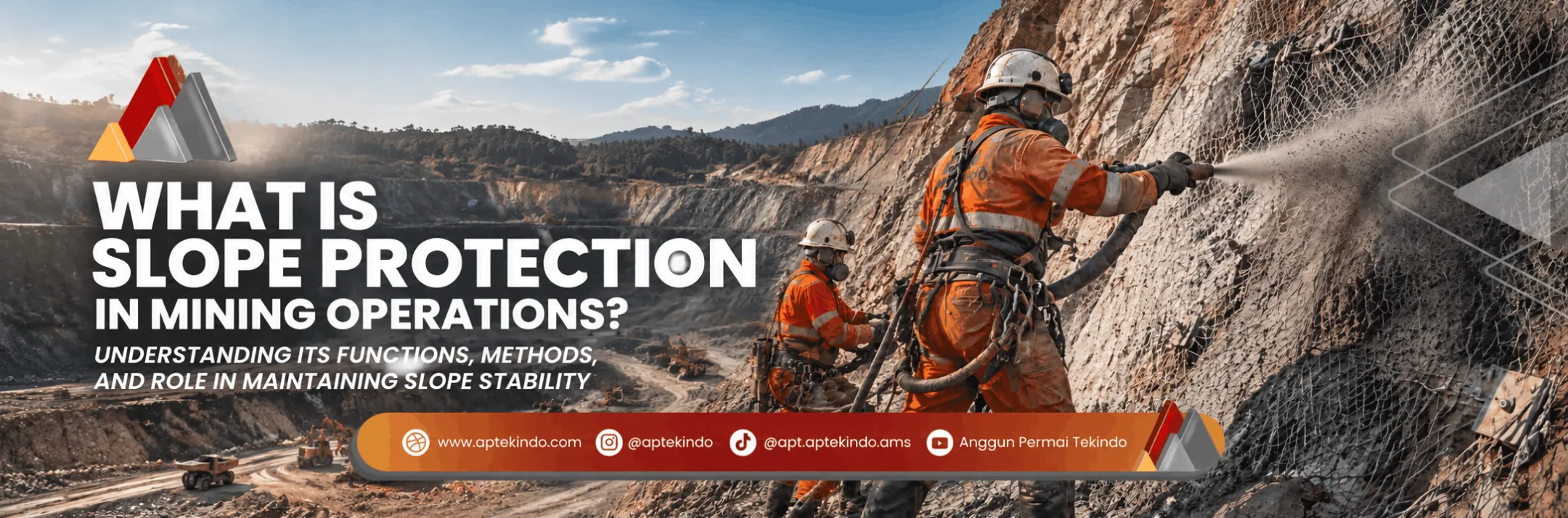
Shotcrete can be used as both surface protection and as part of a ground support system.
Shotcrete creates a layer over the surface that can help control loose material and protect the surface from certain environmental conditions.
In underground mining, fiber-reinforced Shotcrete can also be used as one component of a Ground Support system.
Its performance does not depend solely on the material itself. Mix design, application technique, equipment, substrate conditions, and quality control can all influence the final result.
Therefore, Shotcrete should be viewed as part of an engineered support system, rather than simply concrete sprayed onto a surface.
3. Mesh or Reinforcement Mesh
Mesh can be used to help retain material on a slope surface and can form part of a broader reinforcement system.
Depending on site conditions, mesh can be combined with Soil Nailing, Shotcrete, rock bolts, or other reinforcement systems.
The appropriate configuration should be determined based on ground conditions and engineering requirements.
4. Drainage
One aspect that is often critical in slope management is water control.
Water can influence soil and rock conditions and may increase certain risks associated with slope instability.
For this reason, surface drainage and groundwater management can form an important part of a slope protection system.
Depending on site conditions, water management can involve surface drainage, dewatering, groundwater control, or other engineered measures.
5. Erosion Control
Not every slope problem is directly related to global stability.
Surface erosion can also gradually deteriorate a slope, particularly in areas exposed to rainfall and surface water flow.
Therefore, Erosion Control can be an important component of a slope protection system.
Methods may include surface treatment, erosion control materials, drainage management, and vegetation reinforcement, depending on site conditions.
Is One Method Enough?
Not necessarily.
This is an important aspect of understanding slope protection.
A particular slope may require a combination of different methods.
For example:
Soil Nailing
- Mesh
- Shotcrete
- Drainage
- Erosion Control
This does not mean that all of these methods must always be used together.
The appropriate system should be determined based on site investigation, geotechnical assessment, engineering design, and actual field conditions.
Ground control measures should be developed using sufficient geotechnical information and validated through monitoring of actual ground performance.
Monitoring Remains Essential
Slope protection does not mean that the risk of slope movement becomes zero.
Ground conditions can change over time.
Therefore, monitoring remains an important part of slope management.
Monitoring can help identify changes such as:
- displacement,
- tension cracks,
- changes in slope conditions,
- groundwater changes,
- or other indications of ground movement.
Monitoring approaches can include surveying, displacement monitoring, borehole inclinometers, extensometers, and other appropriate instrumentation.
The key is not simply collecting data, but systematically analyzing and interpreting the information to understand how the ground is performing.
This makes slope protection part of an ongoing cycle:
Assess → Design → Protect → Monitor → Evaluate
rather than a one-time construction activity.
The Role of a Specialist Mining Services Company
This is where a Mining Services Company can play an important role.
Slope protection requires more than simply supplying materials.
It requires an understanding of:
- site conditions,
- materials,
- equipment,
- application methods,
- installation,
- quality control,
- safety,
- and engineering requirements.
A specialist service provider can help translate technical requirements into controlled field execution.
Depending on the project, the scope may include Soil Nailing, Mesh Installation, Shotcrete Application, Erosion Control, Drainage, and Vegetation Reinforcement.
The combination of technical knowledge, suitable materials, application expertise, and field experience can help ensure that the selected system is properly implemented.
Slope Protection as Part of Mining Safety
In mining operations, ground stability is not only an engineering issue.
It is directly connected to safety, productivity, equipment protection, access, and operational continuity.
Therefore, slope protection needs to be approached comprehensively.
The question should not only be:
“How can we protect the slope surface?”
It should also be:
“What is causing the slope condition, how could the risk develop, and what system is most appropriate to control it?”
The answer will vary from one site to another.
This is why Slope Protection in mining requires a combination of geotechnical understanding, engineering design, appropriate technology, quality execution, and continuous monitoring.
Conclusion
Slope Protection is an important part of managing slope conditions in mining operations.
Methods may include Soil Nailing, Shotcrete, Mesh, Drainage, Erosion Control, and various other reinforcement systems.
However, no single method should be considered a universal solution.
The appropriate system should take into account geotechnical conditions, slope geometry, groundwater, environmental conditions, and operational requirements.
With the right approach, slope protection can become part of a broader strategy to support ground stability, safety, and operational continuity in mining areas.
Ultimately, effective slope protection is not simply about applying a particular material or method. It is about understanding the ground, identifying the risks, selecting the appropriate solution, executing it correctly, and continuously evaluating its performance.
References
- WorkSafe Western Australia. Geotechnical Considerations in Open Pit Mines: Guideline.
- WorkSafe Western Australia. Ground Control for Western Australian Mining Operations: Code of Practice.
- WorkSafe Western Australia. Ground Control Management in Western Australian Mining Operations: Guideline.
- WorkSafe Western Australia. Mines Safety Bulletin No. 171 – Pit Wall Failure Management.
- Federal Highway Administration (FHWA). Geotechnical Engineering Circular No. 7 – Soil Nail Walls.
- American Shotcrete Association / Shotcrete Institute. Guideline on the Applicability of Fiber-Reinforced Shotcrete for Ground Support in Mines.
- Share