

Soil Nailing in Mining: How Does It Improve Slope Stability?
In mining operations, slope conditions are an important part of overall ground control. Excavation can change slope geometry and stress conditions, while soil and rock properties, groundwater, loading, and environmental factors may influence slope performance.
For this reason, mining projects may require different Slope Protection and Slope Stabilization measures depending on actual site conditions.
One of these methods is Soil Nailing.
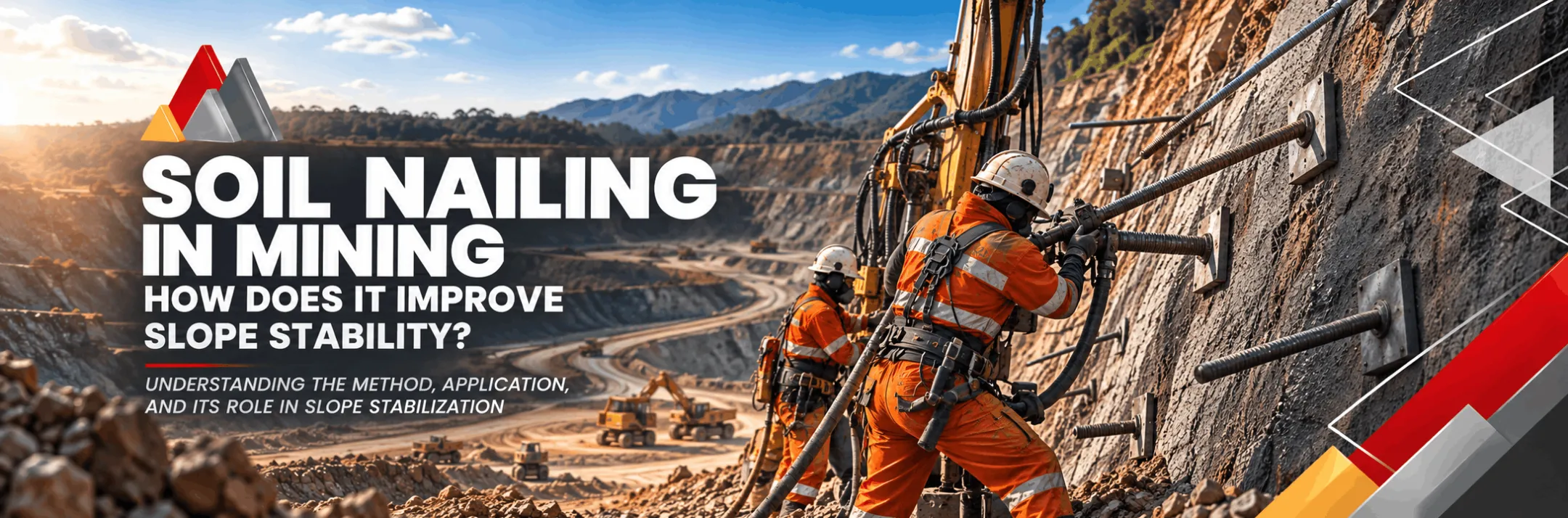
Soil nailing is an in-situ reinforcement method in which nails are installed into the ground to create a reinforced soil mass. The Federal Highway Administration (FHWA) describes soil nailing as an in-situ reinforcement technique that can improve the overall stability of soil. (Federal Highway Administration)
However, soil nailing is much more than drilling holes and installing steel bars. Its effectiveness depends on the suitability of the method, geotechnical design, construction sequence, facing, drainage, and quality control.
What Is Soil Nailing?
Simply put, Soil Nailing is a ground reinforcement method that uses a series of reinforcement elements installed into the soil.
These elements are commonly steel bars or other reinforcement members that are installed into drilled holes and then grouted.
When installed in a designed pattern, the nails work together with the surrounding soil to create a reinforced mass.
FHWA explains that soil nails are typically installed in relatively large numbers and in a designed pattern so that the reinforced soil section can help retain the ground behind it. (Federal Highway Administration)
In certain systems, Shotcrete is also used as facing to help retain surface material and connect the reinforcement system.
How Does Soil Nailing Work?
The basic principle is the creation of a reinforced soil mass.
Ground that may be susceptible to movement is reinforced by installing nails into the soil.
A simplified sequence is:
Existing Ground
↓
Drilling
↓
Soil Nail Installation
↓
Grouting
↓
Facing / Shotcrete
↓
Reinforced Slope
The nails form part of the reinforcement system that helps resist forces acting within the ground.
However, nail configuration cannot simply be selected arbitrarily.
Nail length, diameter, inclination, spacing, capacity, and installation pattern should be determined through geotechnical design and site assessment.
FHWA identifies slope geometry, soil properties, groundwater, seismic loading, and nail size, length, and inclination among the parameters considered in soil nail wall analysis. (Federal Highway Administration)
Why Can Soil Nailing Improve Slope Stability?
One of the primary purposes of soil nailing is to improve the stability of the reinforced ground.
When appropriately designed and installed, the nails help form a reinforced soil mass that can control potential movement.
FHWA identifies soil nailing as an in-situ reinforcement method that can improve overall stability and has been used to stabilize slopes and excavations. (Federal Highway Administration)
In mining, this principle can be relevant to selected areas where slope reinforcement is required and where site conditions are suitable for the method.
However:
Soil nailing is not a universal solution for every slope.
Its suitability must be established through appropriate geotechnical assessment and engineering design.
What Is the Relationship Between Soil Nailing and Shotcrete?
Soil Nailing and Shotcrete can often form part of the same system.
In soil nail wall applications, Shotcrete may be used as facing.
A typical construction sequence may involve:
- Excavation in controlled lifts
- Drilling
- Soil nail installation
- Grouting
- Reinforcement/facing installation
- Shotcrete application
- Repeating the process to the required elevation
FHWA describes soil nail walls as typically using a top-down construction sequence, with excavation performed in lifts and soil nails and initial Shotcrete facing installed at each lift. (Federal Highway Administration)
Therefore, Shotcrete in this context should not simply be viewed as a surface coating. It can form part of the engineered facing system.
When Can Soil Nailing Be Considered?
Soil nailing is not suitable for every slope.
Several factors can influence its feasibility, including:
1. Soil Conditions
The ground must allow drilling, installation, and grouting to be carried out effectively.
2. Slope Geometry
Slope height, inclination, and configuration influence system design.
3. Groundwater
Groundwater conditions need to be considered because water can affect ground behavior and drainage requirements.
4. Loading
Additional loads around the slope may influence the required reinforcement system.
5. Construction Sequence
Soil nailing is generally installed progressively, making construction sequence an important part of the system.
6. Site Access
Available working space and equipment access can influence the practicality of the construction method.
FHWA specifically identifies geometry, soil properties, groundwater, seismic loading, and nail configuration as important parameters for soil nail wall analysis. (Federal Highway Administration)
Soil Nailing Is More Than Installing Steel Bars
A common misconception is that soil nailing simply means placing steel bars into the ground.
In reality, the system involves multiple components:
Engineering Design
→ determines reinforcement configuration and capacity.
Drilling
→ creates holes according to specifications.
Nail Installation
→ places the reinforcement.
Grouting
→ establishes the connection between the reinforcement and surrounding ground.
Facing
→ may include Shotcrete and reinforcement according to design.
Drainage
→ manages water where required.
Quality Control
→ verifies that construction meets project specifications.
FHWA guidance for earth retaining systems also covers selection, design, performance, installation, quality assurance/quality control, and construction inspection. (Federal Highway Administration)
What Are the Advantages of Soil Nailing?
When site conditions are appropriate, soil nailing can offer several advantages.
In-Situ Reinforcement
The system reinforces the existing ground rather than relying solely on a conventional retaining structure.
Progressive Construction
Installation can follow the excavation sequence.
Potentially Suitable for Restricted Areas
Because reinforcement is installed into the existing ground, soil nailing can be useful in selected situations where available space is limited.
Can Be Combined with Shotcrete
Soil nails can be integrated with Shotcrete facing to create a more comprehensive reinforcement system.
However, these advantages depend on site conditions, design requirements, construction methods, and quality of execution.
Soil Nailing as Part of Slope Protection
Soil nailing should not be considered separately from the broader slope management system.
For example:
Soil Nailing
→ reinforcement
Shotcrete
→ facing / surface support
Mesh
→ retention or reinforcement, depending on design
Drainage
→ water control
Monitoring
→ performance evaluation
These elements can work together as an integrated system designed for the specific requirements of a project.
Therefore, Slope Protection and Slope Stabilization can complement each other.
Is Soil Nailing Suitable for Every Mine?
No.
Every mining site has different geological conditions, slope geometry, groundwater conditions, operational requirements, and risks.
Soil nailing should therefore be evaluated based on actual site conditions rather than simply because the method has been successful elsewhere.
A more appropriate approach is:
Investigate → Assess → Design → Select Method → Execute → Monitor
rather than:
Select Method → Apply
This helps ensure that the selected solution addresses the actual geotechnical problem.
The Role of a Mining Services Company
Soil nailing requires the integration of engineering, materials, equipment, manpower, safety, and quality control.
This is where a specialist mining services company can play an important role.
Depending on the project, the scope may include:
- drilling,
- soil nail installation,
- grouting,
- Shotcrete,
- mesh installation,
- drainage,
- slope protection,
- ground stabilization,
- and other supporting works.
Integrating these methods allows the solution to be adapted to actual field requirements.
Conclusion
Soil Nailing is an in-situ reinforcement method that can help improve the stability of soil masses and form part of an engineered Slope Stabilization system.
The method involves installing reinforcement into existing ground, typically through drilling and grouting, and may be combined with facing systems such as Shotcrete.
However, soil nailing is not a universal solution.
Method selection should consider ground conditions, slope geometry, groundwater, loading, construction sequence, accessibility, engineering requirements, and other relevant factors.
Ultimately, the success of soil nailing is not determined by the reinforcement material alone. It depends on how the complete system is designed, installed, quality-controlled, and monitored.
Daftar Pustaka / References
- Federal Highway Administration (FHWA). Geotechnical Engineering Circular No. 7 – Soil Nail Walls (FHWA-NHI-14-007). 2015. FHWA lists this as its dedicated guidance for soil nail walls. (Federal Highway Administration)
- Federal Highway Administration (FHWA). For Soil Nail Walls, It's a SNAP. Focus, HRT-11-012, April 2011. (Federal Highway Administration)
- Federal Highway Administration (FHWA). Ground Modification Methods Reference Manual – Volume II, Chapter 5: Soil Nail Walls. (Federal Highway Administration)
- Federal Highway Administration (FHWA). A Quarter Century of Geotechnical Research, Chapter 3: Ground Improvement Project. (Federal Highway Administration)
- Federal Highway Administration (FHWA). Earth Retaining Structures – Geotechnical Guidance. (Federal Highway Administration)
- Share