

Optimization of Ventilation Systems in Underground Gold Mines
Hundreds of meters below the surface, air is no longer something naturally available, but something that must be designed, controlled, and maintained at all times. In underground gold mines, the ventilation system is one of the most critical elements in maintaining operational safety and sustainability. Unlike open environments, underground spaces have limited natural air circulation, making the entire mine breathing system heavily dependent on artificial ventilation design. Under these conditions, the role of ventilators and respiratory safety support systems becomes extremely important.
The main function of a mine ventilation system is to circulate fresh air into working areas and remove contaminated air containing hazardous gases, dust, and heat from inside the mine. Research regarding ventilation optimization in deep gold mines explains that ventilation systems are a core component of mining production safety because they directly maintain air quality and workplace environmental comfort (Sun and Wang, 2025).
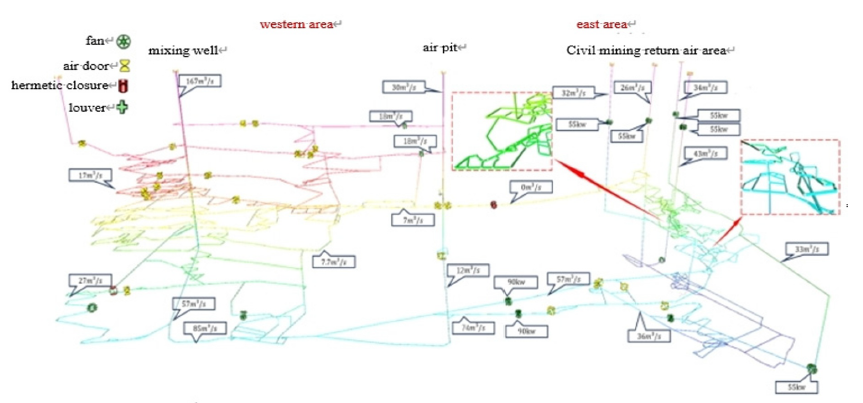
Figure 1. Ventsim simulation of a ventilation system optimization scheme based on zone control.
As mine depth increases, the complexity of the ventilation system also grows. Air must be distributed through long and branching tunnel networks with various obstacles that cause pressure loss and reduced airflow efficiency. Studies show that deep mines often face problems such as high ventilation resistance, uneven air distribution, and insufficient air supply in certain areas (Sun and Wang, 2025).
These conditions can directly impact worker safety. Inadequate air supply may lead to reduced oxygen levels, increased concentrations of hazardous gases such as carbon monoxide, and higher temperature and humidity levels. In extreme cases, these conditions can cause respiratory problems and even fatal accidents.
The role of auxiliary ventilation systems and respiratory safety equipment therefore becomes highly important. These systems are essentially part of an emergency breathing system designed to provide clean air to workers during critical situations. Such equipment is intended for use when the primary ventilation system cannot provide safe air conditions, for example during fires, explosions, or ventilation failures.
However, the effectiveness of emergency breathing systems cannot be separated from the performance of the main ventilation system. A poorly optimized ventilation system increases the frequency of emergency conditions, making respiratory support equipment more frequently required. Therefore, ventilation system optimization is the primary step in reducing these risks.
In research conducted at an underground gold mine, a comprehensive analysis of the ventilation system was carried out using a three-dimensional simulation approach based on Ventsim software. Through measurements of airflow velocity and air distribution throughout the mine, researchers obtained an overview of the actual ventilation conditions, including areas experiencing insufficient air supply (Sun and Wang, 2025).
The analysis results showed that one of the main issues was uneven air distribution, especially in deeper mining areas. Several ventilation routes had high resistance levels, preventing airflow from effectively reaching working areas. In addition, excessively long ventilation routes caused air quality degradation before reaching the target locations.
To address these issues, ventilation system optimization was conducted through ventilation network reconfiguration and increased fan capacity. One of the measures implemented was replacing fans with higher-capacity units at certain levels and installing airflow control devices such as dampers to regulate air distribution.
Simulation results demonstrated significant improvements after optimization. The total incoming air volume increased by 34.65 percent, while air distribution became more uniform, with airflow feasibility reaching 94.73 percent (Sun and Wang, 2025). These improvements indicate that a well-designed ventilation system can significantly enhance underground environmental conditions.
For respiratory safety systems, these conditions have very important implications. With an optimized ventilation system, the need for emergency respiratory equipment can be minimized. However, such equipment still remains an essential component as the final layer of protection in the event of system failure or unexpected emergencies.
Furthermore, integration between ventilation systems and safety systems must be implemented comprehensively. Ventilation planning should not only consider operational air requirements but also account for emergency scenarios. This includes determining evacuation routes, respiratory equipment storage locations, and real-time air quality monitoring systems.
In underground gold mining practices, this approach becomes extremely important considering the complexity of mine networks and the high risks associated with deep-level operations. A proper ventilation system not only improves operational efficiency but also serves as the primary foundation for maintaining worker safety.
Ultimately, emergency breathing systems cannot stand alone as a complete safety solution. They are part of a larger system, namely the mine ventilation system itself. Ventilation optimization through data-driven and simulation-based approaches is key to ensuring that the air entering the mine meets safety standards.
With the combination of an optimized ventilation system and the proper use of safety equipment, underground gold mines can operate with lower levels of risk. In this context, air is not merely a basic necessity, but a critical factor determining the success and safety of the entire mining operation.
References
Sun Y, Wang J. 2025. Optimization of ventilation system in deep well gold mine based on Ventsim
- Share