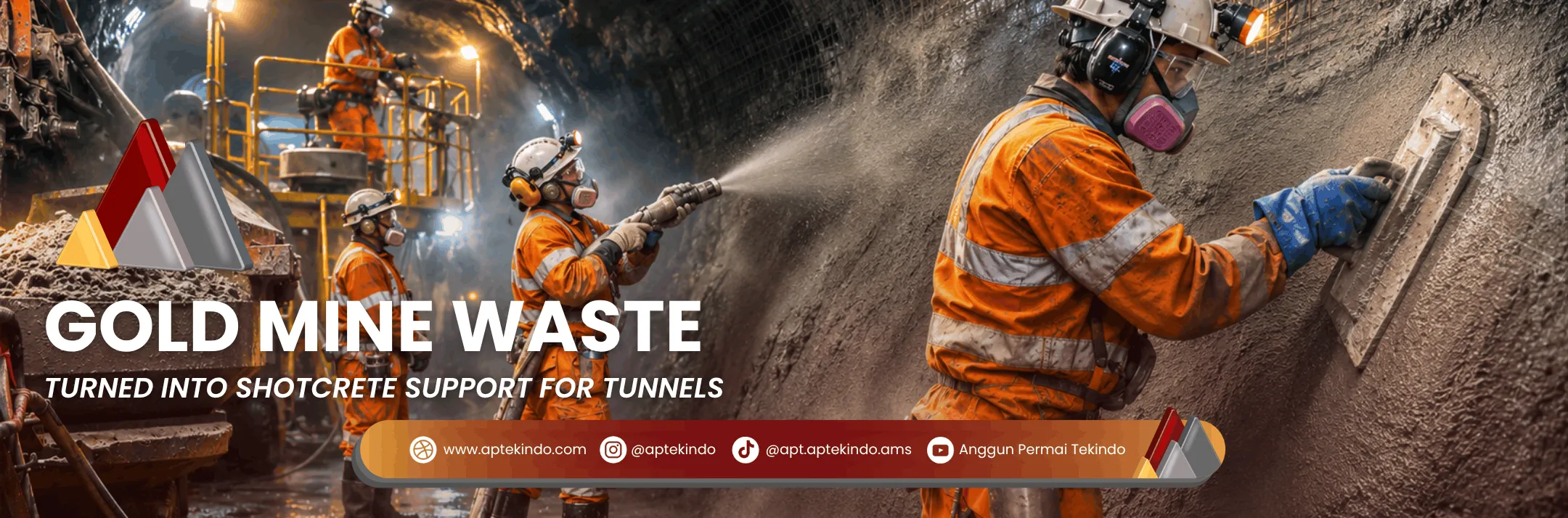
Gold Mine Waste Turned into Shotcrete Support for Tunnels
At the –180 m level of a gold mine in Shandong, China, the walls of a test tunnel are jointed and cracked. Blasting exposed fractures on the surface, while fracture water that has flowed for a long time leaves the rock very wet. These conditions make it difficult to spray wet shotcrete, a mix of cement and aggregate (filler grains such as sand and gravel) sprayed onto the wall as support (Peng et al. 2026).
Spraying itself has two built-in weaknesses: dust and rebound, meaning material that bounces back and falls off during spraying. Both waste material and can keep the layer from reaching its target strength, so it has to be sprayed again.
On the other hand, mines still buy large amounts of sand and gravel, while the tailings dams (storage for ore processing residue) of mining companies in China are nearing capacity. Can unclassified gold tailings, meaning tailings that have not been sorted by grain size, replace sand as the aggregate in wet shotcrete?
Grain Gaps Filled with Industrial Waste
The first obstacle is grain size: the tailings tested are fine-grained but lack particles in the 1–30 µm range. This gap is closed by a binder made from solid waste, namely a blend of Portland cement, fly ash (fly ash), blast furnace slag (slag), and an artificial activator in the form of a powder that triggers the reaction. Finer binder particles make the grain structure of the mix more continuous and the slurry denser.
Table 1. Particle Size Distribution of the Binder and Tailings (Peng et al. 2026)

How this binder hardens was studied in paste, a mixture of binder and water without tailings, because the tailings are assumed not to take part in the reaction. From 1 day to 28 days, the paste structure changes from loose and porous to dense.
At the selected composition, the binder paste reached a compressive strength (a measure of the ability to bear load) of 52.8 MPa at 28 days. Without an accelerator, a liquid that speeds up setting and is added during spraying, this paste only begins to set after 782 minutes.
Finding a Slurry That Is Both Fluid and Strong
The grain gap is now closed, but the slurry must still meet two competing requirements: fluid enough to pump and strong enough within a day. The choice was made using cube specimens molded in the laboratory because the compressive strength of field cores is affected by rebound, compaction, rapid setting, and field curing. The binder-to-tailings ratio and mass concentration (how thick the slurry is) were varied across sixteen mixes.
Among those sixteen mixes, slurries that were more fluid and richer in binder suffered from bleeding, meaning water that separates and rises to the surface of the slurry. To be easy to pump, bleeding must stay below 2% after the slurry stands for 3 hours. This limit was met at a mass concentration of 85–86%.
The bleeding limit is a problem for binder-rich mixes: their early strength is high, but their bleeding is excessive at a mass concentration of 83–84%. Tailings-rich mixes at the same concentration face a different obstacle, namely a 1-day compressive strength that does not reach the minimum requirement of 8 MPa. The mix with the most tailings fails on both sides: its early strength is low when fluid and it is hard to pump when thick.
The selected mix sits in the middle: a binder-to-tailings ratio of 1:1.4 with a mass concentration of 85%. This combination gives acceptable early strength and workability while using as much tailings as possible (Peng et al. 2026).
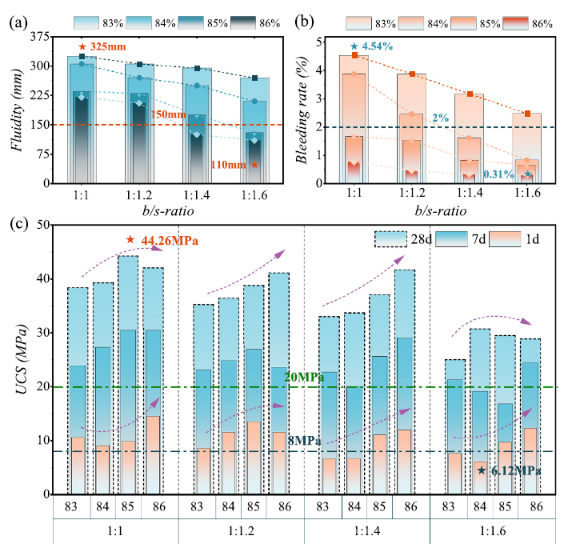
Figure 1. Effect of mix ratio and mass concentration on (a) flowability, (b) bleeding rate, and (c) compressive strength (Peng et al. 2026)
Passing the Test in a Wet Tunnel
The selected mix was then taken to the tunnel. The tailings were dewatered with a vibrating screen to a moisture content of 12–15%, mixed with the binder at a surface station, then carried by tanker truck to the spraying trolley, where the accelerator was added at a dose adjusted on site. A 50 m test section was finished in a single 8-hour shift.
The whole process used existing wet shotcrete equipment. Each cubic meter of mix absorbs about 1.1 t of tailings, not counting rebound.
Layer strength was checked using drill cores taken from the sprayed layer at 1 and 28 days, two samples per age. All samples met the minimum compressive strength requirement. The lowest value, 8.52 MPa at 1 day, is close to the 8 MPa limit (Peng et al. 2026).
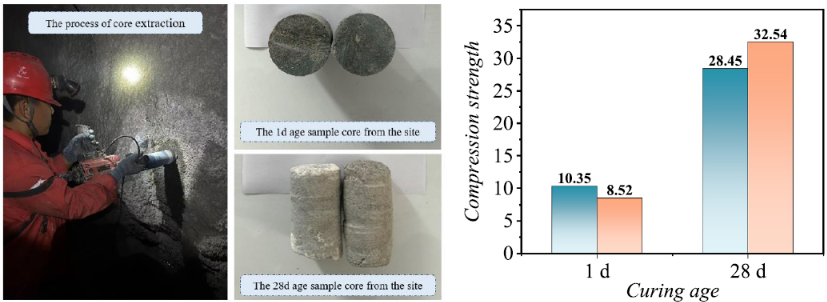
Figure 2. Core sampling (coring), photo of the drill core, and compressive strength of the drill core (Peng et al. 2026)
Besides layer strength, field rebound was also recorded: 1–5% of the mass of sprayed slurry on the side walls and 5–10% on the roof. The comparison figure of 15–30% comes from a field investigation of spraying with processed sand at a mine in Shandong. The work area was also relatively free of dust based on qualitative observation.
Fast Setting, but at a Price
The accelerator added at the trolley differs from the activator inside the binder and was tested separately in the laboratory on cube specimens of the tailings mix. The 1-day compressive strength reached 9.8 MPa with the accelerator and 11.5 MPa without it. At 28 days, samples with the accelerator reached more than 90% of the strength of samples without it, above the minimum requirement of 70%. Strength keeps rising at later ages, but never matches samples without the accelerator.
This strength difference probably comes from the pores: at the same age, samples with the accelerator are more porous even though the difference in porosity is relatively small. The accelerator material is thought to disturb the ion balance in the slurry. The rapidly formed crystal network is thought to thicken the slurry and trap free water, so hardening is uneven (Peng et al. 2026).
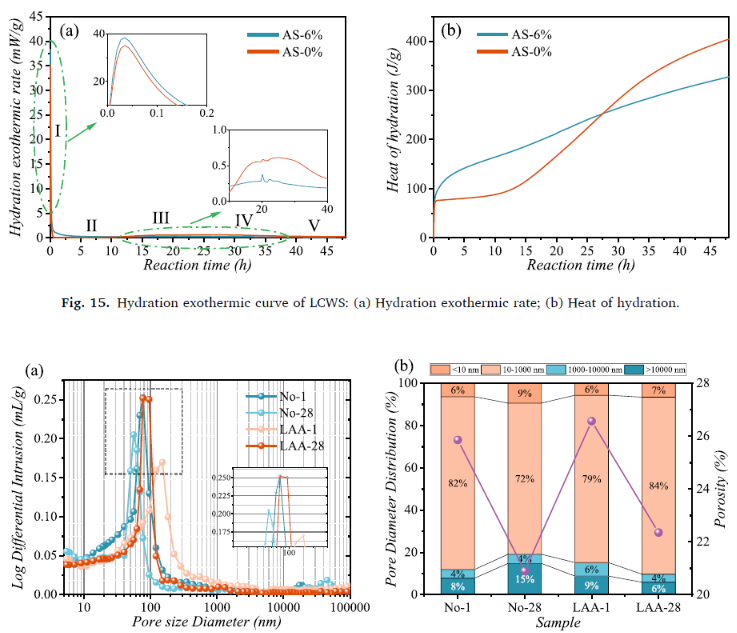
Figure 3. Pore characteristics: (a) pore intrusion distribution; (b) pore diameter distribution and porosity (Peng et al. 2026)
All of these findings come from a single gold tailings source. For tailings from other sources, the grain structure, binder composition, and mix ratio should be adjusted.
Conclusion
Unclassified gold tailings can be used as the aggregate in wet shotcrete with a solid-waste-based binder, as proven in one tunnel section with tailings from a single source. A binder-to-tailings ratio of 1:1.4 and a mass concentration of 85% give a balance between ease of pumping, early strength, and long-term strength. In the field, existing equipment can be used, rebound was recorded as low, and about 1.1 t of tailings is absorbed per cubic meter of mix, with economic and environmental advantages also reported. The accelerator speeds up setting, but makes the internal structure uneven, slightly limiting long-term strength (Peng et al. 2026).
This is the kind of work where APTEKINDO comes in, through its shotcrete and ground support services that keep tunnel walls supported so that mining activities can run safely and smoothly.
References
Peng Y, Gao Y, Wu T, Ji M, Huang C, Zhou Y, Luan H, Liu T, Sun H, Dino GA. 2026. Utilizing unclassified tailings for a novel low-carbon wet shotcrete (LCWS) material: Formulation optimization, multi-scale properties, and practical benefits. Case Stud Constr Mater. 25:e06417. doi:10.1016/j.cscm.2026.e06417.
- Share