


Concrete Admixture from Coal Mine Waste Rock
Piles of waste rock around coal mines take up land and pollute soil, groundwater, and air. This rock is called gangue, the solid waste from coal mining and processing. Its composition is similar to natural gravel, and its aluminum, silica, and iron compounds can potentially take part in reactions in concrete (Song et al. 2025). Because of this, gangue can be used as coarse aggregate (gravel or crushed stone), fine aggregate (a sand substitute), and concrete admixture.
Concrete admixture means an additional material besides cement, water, and aggregate; here it takes the form of gangue powder replacing part of the cement. The problem is that gangue absorbs a lot of water and breaks easily. Can unburned gangue fulfill all three roles without making the concrete weak and quick to deteriorate in a mining environment?
Waste Rock Is Crushed and Ground
Gangue from a coal mine in Linfen, Shanxi, was crushed into two sizes, namely 5–20 mm for coarse aggregate and 0.15–5 mm for fine aggregate. The powder was ground and then sieved through a 200 mesh screen. All materials were used without prior burning, even though burning gangue requires a lot of energy.
After crushing, gangue aggregate still absorbs mixing water and can reduce the workability of the concrete. For this reason, the aggregate was wetted and then left for 1 hour before mixing.
As a concrete admixture, gangue powder contains compounds that can react with calcium hydroxide, one of the products of cement reaction, and form calcium silicate hydrate, the binding substance produced by cement reaction. Its reactivity is low. Its fine grains also fill small voids inside the concrete.
Stone Weakens, Sand and Powder Help
Laboratory tests show different roles for each form of gangue. The more natural gravel is replaced by gangue stone, the lower the 28-day compressive strength of the concrete; compressive strength is a measure of the ability of concrete to bear load.
The main causes are the water absorption and fragility of gangue stone. In ordinary concrete, cracks mainly occur at the interface between aggregate and cement paste, whereas in gangue concrete the stone itself also breaks.
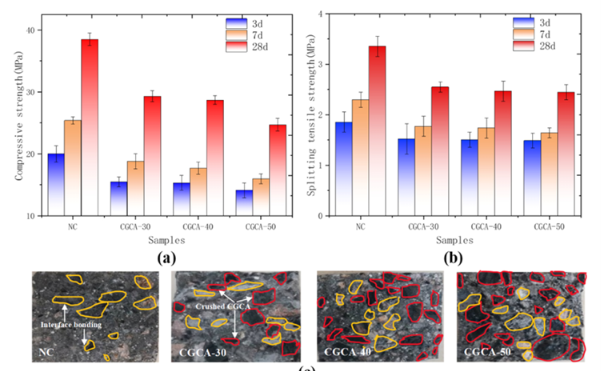
Figure 1. Mechanical properties of coal mine gangue concrete (CGC) with coal gangue coarse aggregate (CGCA): (a) compressive strength, (b) splitting tensile strength, and (c) failure pattern of CGC in the compression test.
Sand and powder from gangue, which act as fine aggregate and concrete admixture, show a different pattern. At a content of 20% for sand and 2.5% for powder, the compressive strength of the concrete slightly exceeds that of ordinary concrete, then declines as the content is increased. At low content, gangue sand absorbs part of the mixing water so the water-to-cement ratio drops.
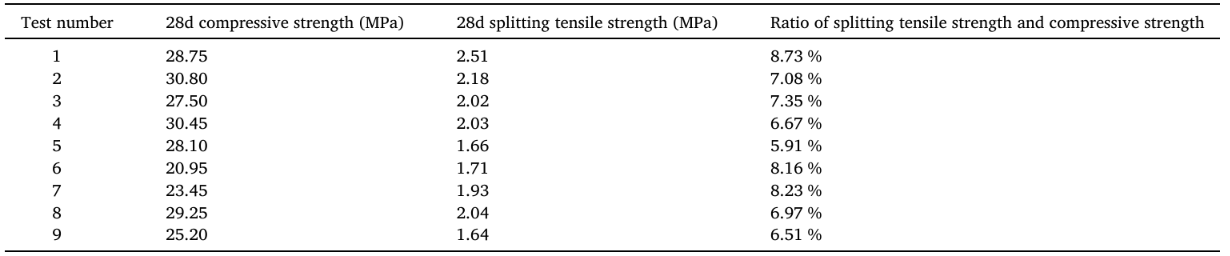
The best mix was sought through nine combinations of content. The mix with 25% stone, 20% sand, and 2.5% gangue powder reached a compressive strength of 30.80 MPa at 28 days, for concrete designed to grade C30.
Table 1. Results of orthogonal testing on mechanical properties
 The mixture was also the densest among the four samples whose microstructures were examined. Its porosity the percentage of voids within the concrete—was 8.71%, whereas the sample with the lowest compressive strength reached 11.99%. The lower the porosity, the higher the compressive strength. (Song et al. 2025).
Sulfate Resistant, Weak in Freeze-Thaw
Inside a mine, concrete faces water containing sulfate and a little chloride, as well as temperatures that can drop because of ventilation from the surface. In a 5% sodium sulfate solution soak for 90 days, the compressive strength of gangue concrete actually rose, and its mass decreased by less than 1% in the first month. This result applies to a 90-day soak; expansive sulfate reaction products may damage the concrete in a longer soak (Song et al. 2025).
Resistance to freeze-thaw cycles is different. Concrete is considered failed if its relative dynamic elastic modulus, a measure of concrete stiffness, drops to 60% or its mass loss reaches 5%. Four of the nine mixes failed at the 25th cycle, including the mix with the most gangue stone and powder.
The best mix lasted more than 100 cycles. When sulfate and freeze-thaw act together, its durability drops to 100 cycles because of the crystallization pressure of ettringite and gypsum, two expansive products of sulfate reaction.
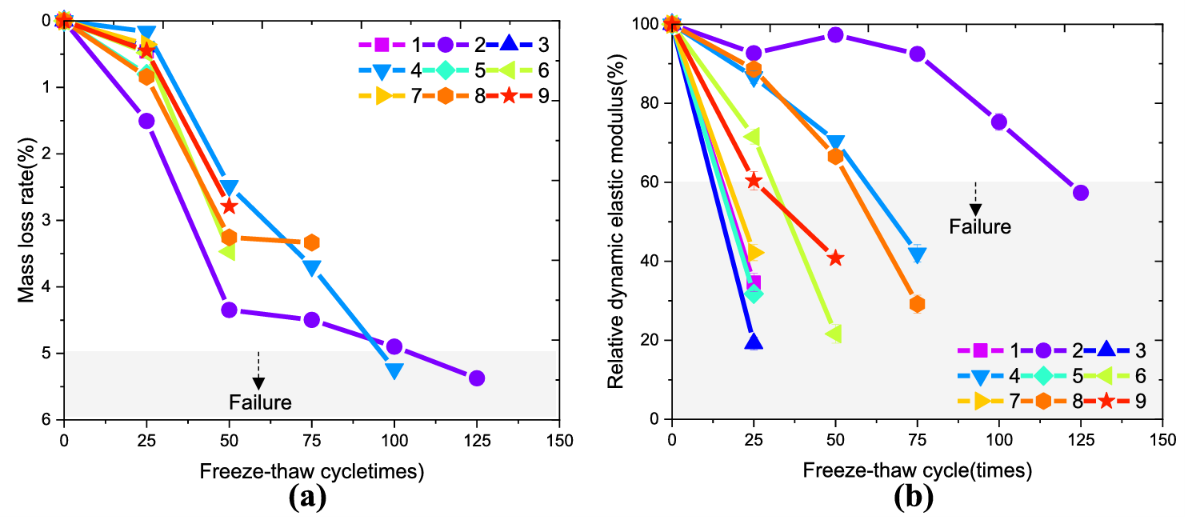
Gambar 2. Influence of CG on freeze-thaw cycle properties (a) mass loss rate, (b) relative dynamic elastic modulus
The electric flux test, a measure of how easily chloride ions penetrate concrete, places all mixes in the moderate penetration category. The more gangue stone or powder, the more easily chloride penetrates the concrete. The gangue stone content should not exceed 25%.
Carbon Emissions Fall, Use Still Limited
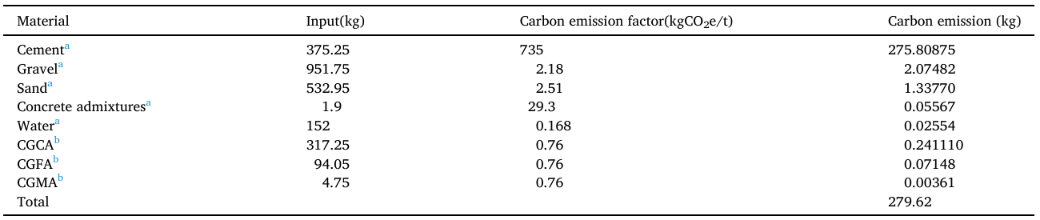
Cement accounts for more than 90% of the carbon emissions of gangue concrete. Therefore, powder as a concrete admixture replacing cement has the greatest effect, followed by stone and then gangue sand. In the best mix, raw material emissions are 276.08 kg CO₂e per m³, a measure equivalent to carbon dioxide.
The reference for C30 concrete in China’s building emission standard is 295 kg. Transport and casting add emissions, with a calculation that rests on assumptions about distance and laboratory-scale energy data (Song et al. 2025).dioxide.
The benchmark for C30 concrete under Chinese building emission standards is 295 kg. Transportation and pouring add to these emissions, with calculations based on assumed distances and energy data derived from laboratory-scale studies. (Song et al. 2025).
Table 2. Carbon emissions from the main raw materials of coal mine gangue concrete (CGC).
 Gangue is currently used primarily for non-structural construction materials, backfilling of excavated voids, and road embankments. In structural components, its application remains limited to simulations and laboratory testing. All the aforementioned results are derived from laboratory test specimens using gangue from a single mine.
To reduce the impact of gangue stone, brittle particles are removed before mixing. A slump test (a measure of the consistency of the mix), compressive strength at 7 and 28 days, and splitting tensile strength are recommended before field use.
Gangue that has not been burned can become gravel, sand, and cement-replacing powder in concrete whose compressive strength meets the design grade, with lower raw material carbon emissions. Stone from gangue weakens concrete, whereas sand and powder from gangue give a small improvement.
The concrete stays stable in sulfate soak for 90 days, but deteriorates quickly when sulfate and freeze-thaw act together. Its use in structural components is still limited to simulation and laboratory tests, so additional treatment of gangue is recommended (Song et al. 2025).
This is the kind of concrete work in a mining environment where APTEKINDO plays a role through its shotcrete and ground support services, which keep tunnel walls supported so that mining work can run safely and smoothly.
References
Song Q, Yang Y, Xu S, Liu C, Liu J, Bao J, Xue S. 2025. Mechanical properties, durability, and carbon emissions of concrete with coal gangue coarse aggregate, fine aggregate and mineral admixtures in coal mining environment. Case Studies in Construction Materials. 23:e05187. doi:10.1016/j.cscm.2025.e05187.
- Share