

Steel Connection Details in Gold Mine Infrastructure
Steel structures may appear robust from the outside, but their true strength often lies in the connections elements that are not always visible, yet critically important.
In steel structural systems, connections are not merely connectors between components; they control how forces are transferred and distributed throughout the structure. In underground gold mining, this becomes significantly more complex, as structures are subjected not only to static loads but also to dynamic loads from mining activities, along with environmental influences such as vibrations, humidity, and changing geotechnical conditions.
Structural detailing, particularly at connection points, plays a crucial role in ensuring overall system stability. Connections must be capable of transferring various types of forces, including axial forces, shear forces, and bending moments, from one element to another. Any deficiency in design or execution can lead to uneven force distribution, ultimately triggering local or even global structural failure.
Traditionally, connections are often idealized as either perfectly pinned or fully rigid. However, research indicates that most steel connections used in practice exhibit semi-rigid behavior, meaning they fall between these two extremes (Muresan, 2013). In other words, connections experience both rotation and deformation under load, influencing the overall structural response.
This semi-rigid behavior is particularly important in underground gold mining environments. Structural systems such as steel portals, support frames, and auxiliary support systems must adapt to dynamic load variations. Activities like blasting, rock movement, and stress redistribution result in continuously changing load conditions.
In such scenarios, connections with controlled deformation capacity are often more advantageous than overly rigid ones. Semi-rigid connections allow structures to absorb energy through deformation before reaching failure. This provides additional time for the system to adapt to changing loads and reduces the likelihood of sudden collapse.
The behavior of connections can be described through the relationship between moment and rotation. The moment–rotation curve demonstrates that connections do not behave as purely rigid or pinned but instead exhibit a gradual increase in moment with increasing rotation (Muresan, 2013). This nonlinear relationship forms the basis of modern structural analysis, particularly in understanding how connections contribute to global stiffness.
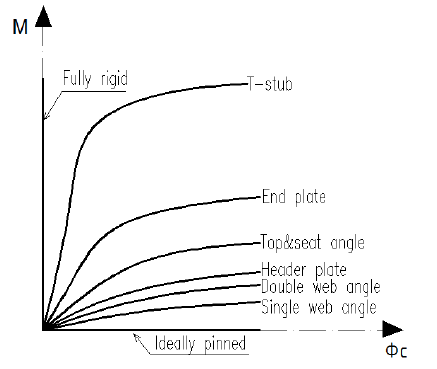
Figure 1. Moment–rotation curve illustrating semi-rigid connection behavior (Chen, 2000; Balc, 2012).
The type of connection used also significantly affects system performance. For instance, angle connections are known for their flexibility and are commonly used to resist shear forces. They are relatively simple and economical but have limited capacity for moment transfer.
On the other hand, end plate connections provide better moment transfer and additional stiffness. These connections use steel plates welded to beam ends and connected to columns using high-strength bolts. With proper configuration, they can perform effectively under complex loading conditions.
Welded connections are also widely used due to their high stiffness and continuity between elements. However, they carry a risk of brittle failure if not properly designed and executed. Studies indicate that highly rigid connections tend to fail suddenly without significant prior deformation (Muresan, 2013). For this reason, semi-rigid connections are often preferred in certain conditions, as they provide warning signs before failure occurs.
Beyond connection type, detailing is equally critical. Parameters such as bolt size, number and arrangement of holes, plate thickness, and welding quality must be carefully designed. Even minor variations in these parameters can significantly affect the stiffness and strength of connections.
In underground gold mining, environmental factors must also be considered. High humidity and groundwater presence can lead to corrosion, particularly at connection points that are often the weakest areas. Corrosion reduces cross-sectional capacity and can accelerate structural failure if not properly mitigated through protective measures and appropriate design.
Connection modeling in modern structural analysis has also evolved significantly. Connections are no longer treated as idealized elements but are modeled with defined stiffness, often represented as rotational springs. This approach enables a more realistic representation of overall structural behavior (Muresan, 2013).
In elastic analysis, connections are classified based on stiffness, while plastic analysis focuses on strength. Elastoplastic analysis, however, considers both aspects simultaneously. This approach is highly relevant for underground mining conditions, where nonlinear behavior arises from the interaction between structure and surrounding environment.
Furthermore, connection design must also consider constructability and economic factors. The choice between bolted and welded connections is influenced not only by strength requirements but also by ease of installation, fabrication costs, and site conditions. In underground mining environments with limited space and access, these considerations become critical.
Ultimately, steel structural detailing is a key factor in determining overall structural performance. Connections are not merely links between elements they govern how structures respond to loads and adapt to changing conditions.
In underground gold mining, where structural failure carries significant consequences, proper connection design is essential. By understanding semi-rigid behavior, selecting appropriate connection types, and paying close attention to detailing, structural stability can be significantly improved while minimizing the risk of failure.
References
Balc, R. M. (2012). Structuri Metalice in Cadre: Calculul si Alcatuirea Nodurilor. Technical University of Cluj-Napoca.
Chen, W. F. (2000). Practical Analysis for Semi-Rigid Frame Design. World Scientific.
Muresan, I. C. (2013). Research on analysis and design philosophy of the connections in steel structures. Technical University of Cluj-Napoca.
- Share