

Water Control Challenges for Modern Mining Contractors
Challenges of Water Management in Mining Operations
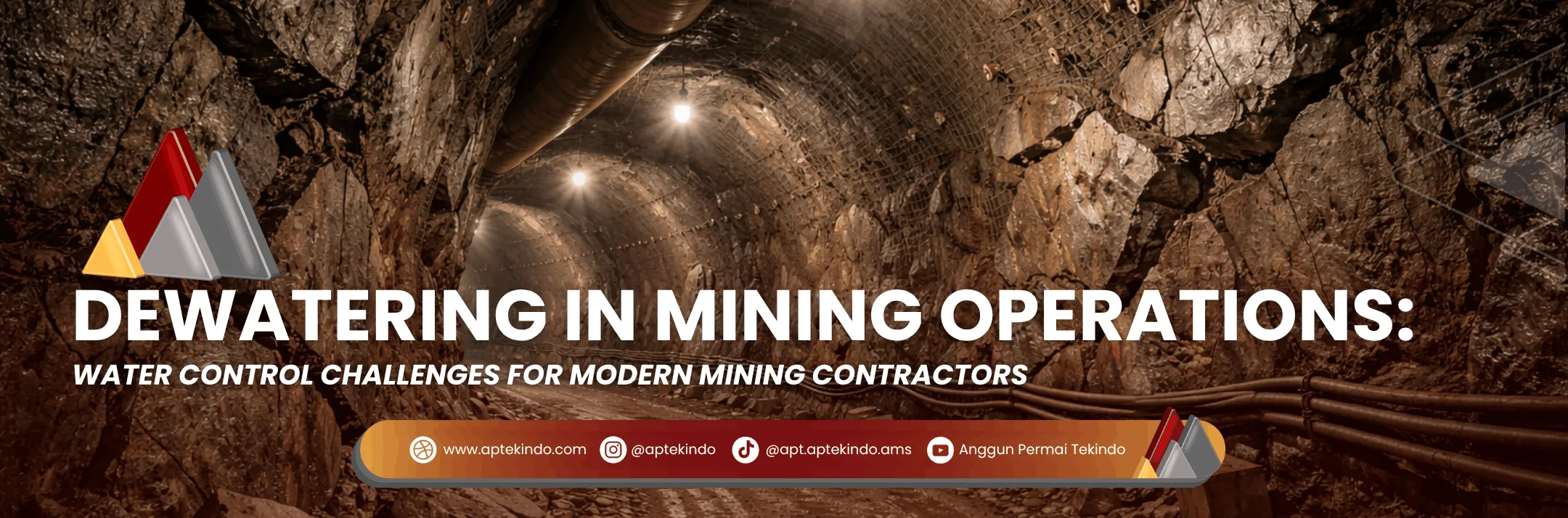
Mining activities have always faced a challenge that is often considered routine but has a major impact on operational continuity: water. In many mining projects, especially open-pit mines with complex hydrogeological conditions, the presence of water is not merely a matter of puddles in working areas. Water can affect slope stability, accelerate hauling road deterioration, reduce heavy equipment productivity, and increase occupational safety risks.
Water control challenges cannot be separated from daily productivity targets in mining areas. Overly wet loading areas can reduce heavy equipment stability. Water-saturated hauling roads increase rolling resistance and slow material transportation cycles. In certain conditions, water accumulation and seepage can even trigger temporary production shutdowns because the working area is considered unsafe.
The assumption that dewatering simply means pumping water out of the pit is no longer relevant in modern mining operations. In reality, water management systems in mining areas are closely related to geotechnical conditions, rock characteristics, and subsurface structural changes caused by production activities. As mining progresses, blasting and the opening of new areas can create additional fractures that alter groundwater flow patterns.
Song et al. (2024) explain that mining activities can alter groundwater circulation patterns due to the formation of new cracks and changes in hydraulic pathways within the rock mass. These conditions allow water to move through fracture zones that were previously inactive. In many cases, these changes are difficult to identify visually, meaning new disturbance potentials often emerge without clear early warning signs.
The Impact of Dewatering on Mine Stability and Productivity
The problem becomes even more complex in mines with fault zones or highly fractured rock formations. Water can infiltrate through small subsurface pathways and gradually affect working area stability. In the early stages, the impact may only appear as minor seepage on slopes or disposal areas. However, if left uncontrolled, these conditions can develop into reductions in soil strength, deformation of working areas, and localized slope failures.
For mining contractors, situations like these are not only technical challenges but also operational challenges. Heavy equipment productivity heavily depends on stable working area conditions. When the ground surface loses bearing capacity due to increased moisture content, the ability of equipment to move and operate optimally also decreases. Many mining operations experience increased fuel consumption and reduced productivity simply because hauling road conditions are excessively wet.
The relationship between dewatering and geotechnical projects becomes increasingly important because water pressure within the ground can reduce the shear strength of materials. In open-pit mining areas, increased pore water pressure is often one of the factors accelerating slope instability. This explains why water management cannot be separated from mining geotechnical management strategies.
Research by Li et al. (2016) showed that water pressure has a significant influence on rock stability and the effectiveness of grouting processes in fractured zones. The study explains that dynamic water flow can accelerate seepage pathway development and affect the mechanical stability conditions of weak rock zones. These findings are highly relevant to mining operational conditions that continuously change due to daily production activities.
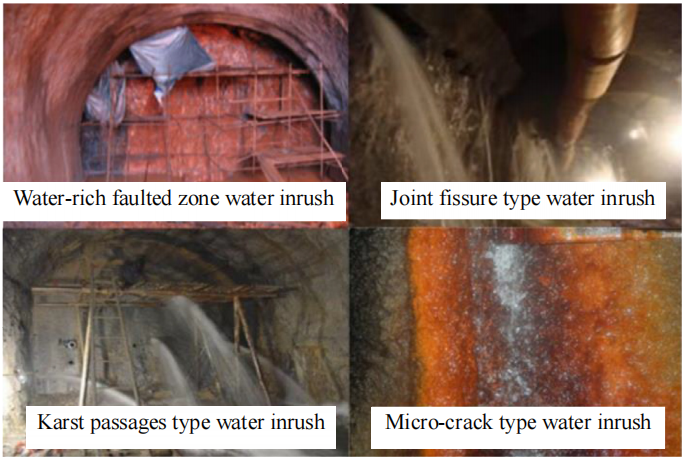
Figure 1. Schematic illustration of various water inrush cases.
Modern Dewatering Strategies and Water Stopping Technology
In field practice, effective water control requires a far more integrated approach than simply using pumps. Monitoring slope conditions, regulating drainage systems, controlling water flow directions, and reinforcing specific areas have become important components of modern dewatering strategies. Delayed responses to changing water conditions often result in repair costs that are significantly higher than preventive measures implemented from the beginning.
As a result, many mining contractors have begun changing their approach to water management. The main focus is no longer solely on removing water from mining areas but on maintaining overall operational stability. This approach is more realistic because mining conditions continuously evolve along with production development.
Under certain conditions, especially in underground areas or zones with high water pressure, conventional dewatering systems are not always sufficient. This is where water stopping and grouting methods become important parts of mining water control. These technologies are used to reduce water flow through rock fractures while simultaneously strengthening weak zones that have the potential to deform.
Li et al. (2016) explain that fast-curing grout has a high capability in controlling dynamic water flow within rock fractures. The study shows that grout effectiveness is influenced by injection pressure, fracture conditions, and the flow ratio between grout and water. In mining environments, this approach is widely applied in tunnel support areas, underground mining operations, and rock zones with high seepage potential.
Interestingly, the primary objective of modern water stopping is not merely to stop water flow. Its main focus is maintaining mining operational continuity. When water seepage is controlled early, the risks of heavy equipment downtime, working area damage, and production disruptions can be significantly reduced. On a large operational scale, efficiencies like these have a direct impact on production costs.
Hydrogeological Approaches in Modern Mining Operations
Another increasingly important aspect of mining water management is the use of hydrogeology-based data approaches. Song et al. (2024) explain that groundwater evolution in mining areas is influenced by a combination of natural factors and human activities. This means water flow patterns can continue changing as mining activities develop.
These conditions mean field experience alone is no longer sufficient. Modern mining operations require groundwater monitoring, hydrogeological analysis, rock fracture mapping, and periodic evaluation of changes in water flow pathways. With a more data-driven approach, potential disturbances can be identified earlier before developing into major problems in production areas.
Dewatering as Part of Mining Operational Strategy
Ultimately, mining water control is not merely a supporting operational task. Dewatering has become an essential part of safety, productivity, and sustainability strategies in mining operations. When water management is carried out using the right approach, working area stability can be maintained, heavy equipment productivity remains optimal, and the risk of operational disruptions can be minimized.
In an increasingly complex mining industry, operational success is determined not only by production capacity but also by the ability to control technical factors that are often invisible on the surface. Understanding hydrogeology, groundwater management, and working area stability has become an important part of maintaining the continuity of modern mining operations. This approach continues to receive attention in mining operational management, including in projects carried out by PT. APTEKINDO as a mining contractor.
References
Li S, Zhang Q, Wang H, et al. (2016). “Grouting in rock mass: Theories and applications”. Journal of Rock Mechanics and Geotechnical Engineering, 8(6), pp. 753–766.
Song Y, Guo J, Li F, Wang J, Ma F, Wu G, Li G. (2024). “Investigation into factors controlling groundwater evolution in mining areas with an integrated approach”. Heliyon, 10, e38860.
- Share