

Types of Soils in Mine Tailings and Their Mechanical Behavior
In geotechnical engineering, discussing soil types in mine tailings goes beyond visual classification and into the realm of soil mechanics parameters that control permeability, compressibility, shear strength, and the potential for strength loss.
Tailings are the residual materials from mineral extraction processes that have undergone crushing and processing, making them engineered soils rather than natural deposits.
1. Classification of Soil Types in Tailings (Soil Mechanics Approach)
From an index-property perspective, tailings are still classified using the Unified Soil Classification System (USCS), a system based on grain size distribution and plasticity. However, interpretation must also consider soil fabric and the in-situ stress conditions.
A. Sand-like Tailings
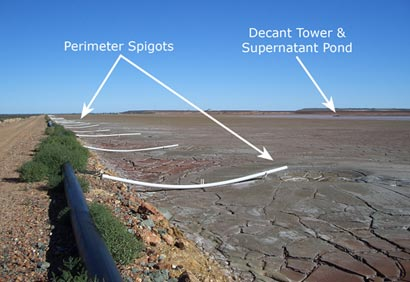
Index characteristics
- Low to moderate fines content
- Low or non-plastic
- Commonly classified as SP (Poorly Graded Sand) or SM (Silty Sand) under USCS
Research has shown that some tailings fall into the category of poorly graded silty sand (SP–SM), meaning a granular material with a significant silt fraction.
Mechanical behavior
- Shear strength is governed primarily by interparticle friction
- When loose and saturated, the material tends to be contractive (volume decreases during loading)
- Susceptible to liquefaction, which is the loss of shear strength due to increased pore water pressure during rapid loading (e.g., earthquakes or strong vibrations)
Key design parameters
- φ′ (effective friction angle)
- Dr (Relative Density)
- Evaluation of CRR (Cyclic Resistance Ratio) to assess liquefaction resistance under cyclic loading
B. Silt-like Tailings
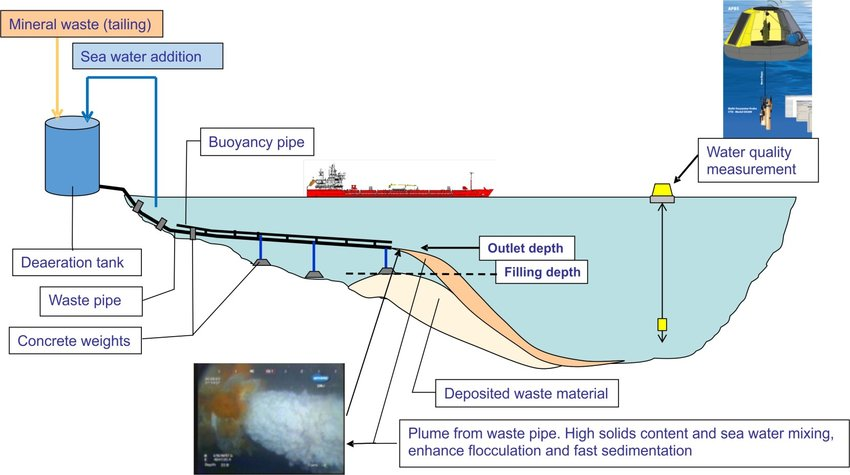
Index characteristics
- Particle sizes predominantly in the silt range (0.002–0.075 mm)
- Low plasticity → often classified as ML (Low Plasticity Silt)
Mechanical behavior
- Lower permeability than sand → slower drainage
- Prone to developing excess pore water pressure under rapid loading
- Undrained shear strength is strongly influenced by initial depositional structure
These materials often lie in a transitional zone:
- Not as stable as dense sands
- Not as plastic as active clays
Long-term behavior prediction is more complex
C. Clay-like Tailings
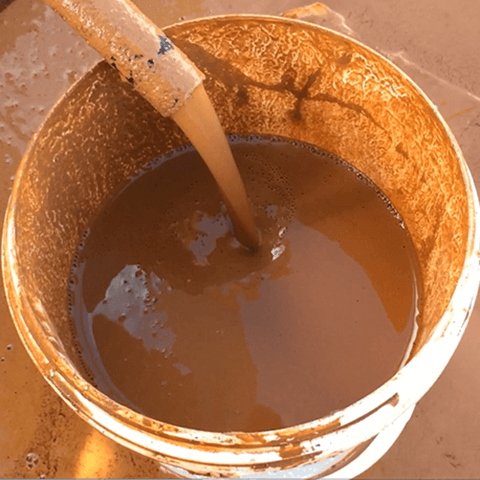
Index characteristics
- Measurable PI (Plasticity Index)
- May be classified as CL (Low Plasticity Clay) or CH (High Plasticity Clay)
Studies indicate that clay mineral content significantly affects the mechanical behavior of tailings and has a direct impact on tailings dam stability.
Mechanical behavior
- High compressibility
- Slow consolidation
- Undrained shear strength (su) is highly sensitive to water content
- Potential for strain softening (reduction in shear strength after a certain strain level)
Key design parameters
- Cc (Compression Index)
- Cv (Coefficient of Consolidation)
- k (Hydraulic Conductivity)
2. Tailings as a Mixed Material “Hybrid” Behavior
Most tailings are mixtures of sand, silt, and clay.
According to technical reports from the International Society for Soil Mechanics and Geotechnical Engineering (ISSMGE), some tailings materials may exhibit:
- High compressibility similar to clay
- High internal friction angle similar to sand
This mixed behavior means:
- The material may appear stable when dry
- But can lose strength rapidly when saturated and disturbed
A more appropriate framework is Critical State Soil Mechanics (CSSM), which explains soil behavior at large strains where effective stress remains constant.
3. Direct Implications for TSF Design
TSF (Tailings Storage Facility) = engineered facility for tailings containment.
4. Required Testing for Tailings Characterization
Index tests
- PSD (Particle Size Distribution)
- Atterberg Limits (Liquid Limit & Plastic Limit)
- Gs (Specific Gravity)
Hydraulic tests
- Permeability
- Consolidation (oedometer test)
Shear strength tests
- Triaxial CU (Consolidated Undrained) with pore pressure measurement
- Triaxial CD (Consolidated Drained) for effective parameters
Critical state behavior
- Evaluation of state parameter (ψ) = distance of soil state from the critical state line
- Assessment of static liquefaction potential under monotonic loading
Conclusion
In TSF engineering, the key question is not merely:
“What soil type does this tailing fall into?”
But rather:
“Under saturated and in-situ stress conditions, will this tailing behave as a stable granular soil, a cohesive soil, or a contractive material prone to sudden strength loss?”
Major TSF failures often occur due to transitions in mechanical behavior, not simply incorrect index classification.
References
Ramos-Hernández & Pérez-Rea — Classification of tailings as SP–SM (silty sand) under USCS
Zhang et al. — Influence of clay minerals on the mechanical behavior of tailings
Fourie et al., ISSMGE State of the Art Report — Mixed sand-like and clay-like behavior in tailings.
- Share