

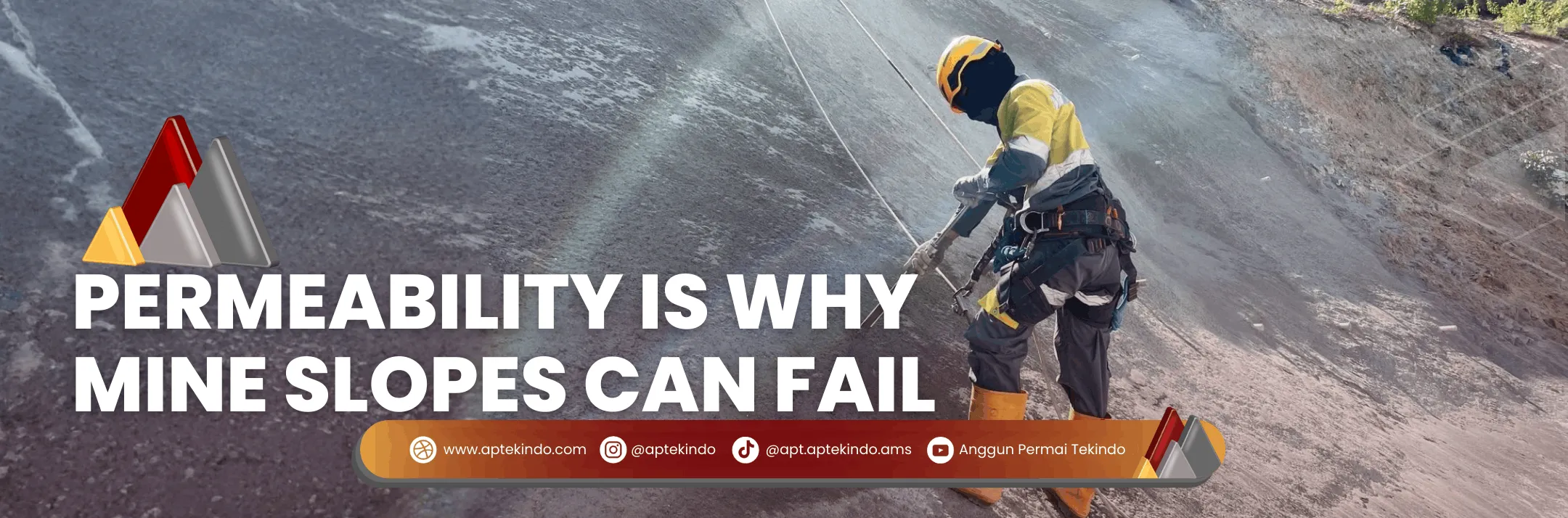
Permeability Is Why Mine Slopes Can Fail
In mining geotechnics, permeability is the parameter that controls how water moves through soil, rock, and tailings masses. This value strongly influences pore water pressure, effective shear strength, and the stability of slopes and tailings dams (TSF / Tailings Storage Facility).
As explained in classical soil mechanics literature, “shear strength of soils is governed by effective stress, which is reduced by pore-water pressures.” This principle confirms that poorly drained water can directly reduce a soil’s ability to resist shear stresses.
What Is Permeability?
Permeability (Hydraulic Conductivity, k) is the ability of soil or rock to transmit water through its pores. The common unit is meters per second (m/s).
Factors influencing permeability:
- Grain size distribution
- Pore structure (void ratio)
- Degree of saturation
- Fractures within rock masses
Higher k → water flows quickly → pore pressure dissipates rapidly
Lower k → water becomes trapped → pore pressure increases
Permeability and Mine Slope Stability
In slope stability analysis, the effective stress principle is used:
σ′ = σ − u
σ′ = effective stress
σ = total stress
u = pore water pressure
When permeability is low, rainfall or seepage water becomes trapped, causing u to increase. As a result, σ′ decreases, and soil shear strength is reduced.
A well-known geotechnical reference states, “an increase in pore water pressure results in a decrease in effective stress and, consequently, a reduction in soil shear strength.” This explains why many mine slope failures occur after intense rainfall rather than changes in slope geometry.
Permeability in Tailings Materials
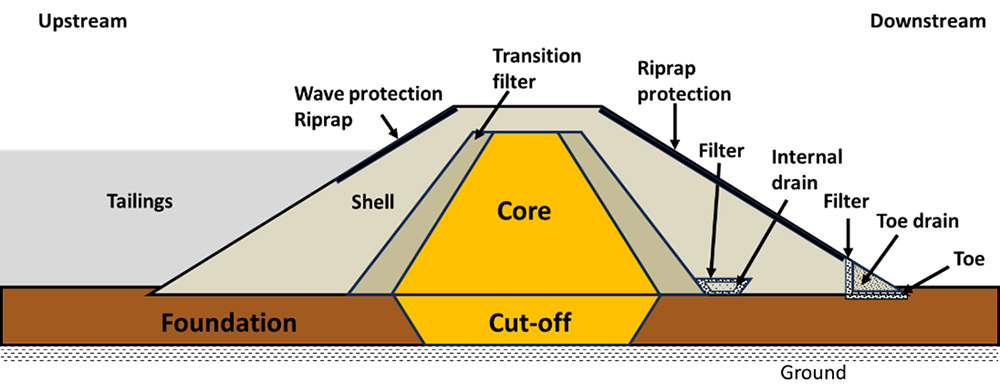
In tailings, permeability is strongly influenced by grain size fractions.
According to global technical guidance on tailings dams, “control of seepage and pore pressure is fundamental to maintaining the stability of tailings dams.” This means water flow control is a core component of safe TSF design.
Permeability and Mine Drainage Systems
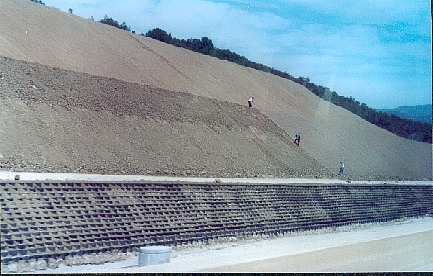
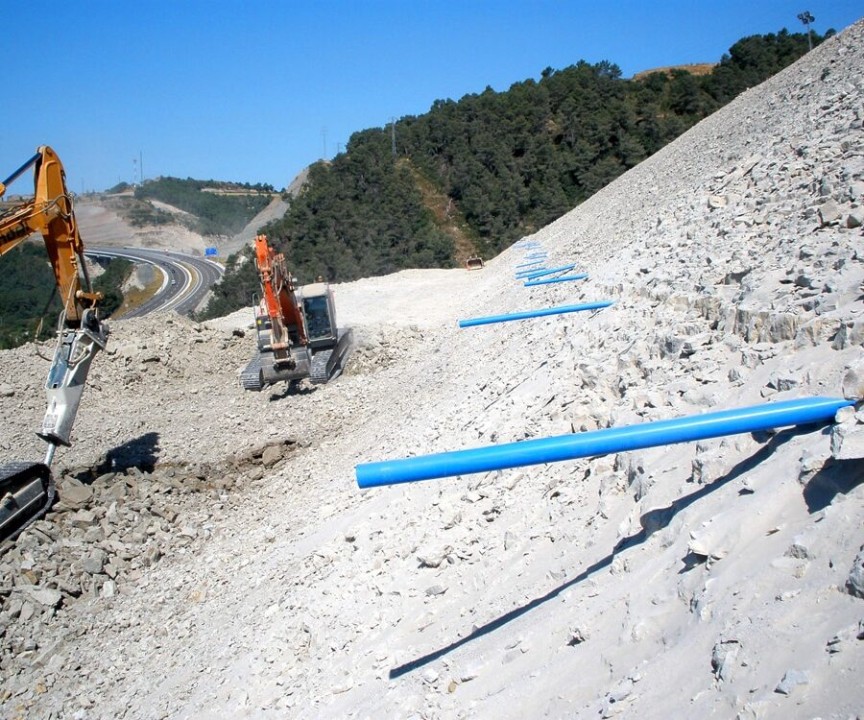
Drainage systems are designed to control pore water pressure distribution within slopes or tailings embankments.
Examples include:
- Horizontal drains → lower groundwater levels
- Toe drains → reduce water pressure at the slope base
- Geocomposite / strip drains → channel water behind shotcrete linings
- Chimney drains in TSF → control vertical seepage flow
The objective is to ensure water exits faster than pore pressure can build up.
Permeability and Slope Factor of Safety
FoS (Factor of Safety) is the ratio between resisting forces and driving forces in a slope.
If permeability is low:
- Pore water pressure increases
- Effective stress decreases
- Effective shear strength parameters (c′ = effective cohesion, φ′ = effective friction angle) are not fully mobilized
As a result, FoS decreases even if slope geometry remains unchanged.
Permeability Testing
Laboratory tests
- Constant Head Test → coarse soils
- Falling Head Test → fine soils
- Permeability derived from consolidation (oedometer) tests
Field tests
- Packer tests in rock
- Pumping tests
- Piezometer monitoring for pore pressure measurement
Conclusion
Permeability is a primary controlling factor in mine stability because it determines whether water will drain quickly or become trapped and increase pore pressure.
Many slope and TSF failures occur not due to incorrect geometry, but because internal drainage systems cannot adequately control pore water pressures.
References
Karl Terzaghi – Principle of effective stress in soil mechanics
Duncan, J.M. & Wright, S.G. – Soil Strength and Slope Stability (effect of pore water pressure on shear strength)
International Commission on Large Dams (ICOLD) – Bulletin on tailings dam safety and seepage control
Fell, R. et al. – Geotechnical Engineering of Dams (role of drainage in earth and tailings dam stability)
- Share